
Roles
Get the roles right, or don't bother starting. We break down the skills and responsibilities of every role in Business Design as an innovation management approach — and why the project team setup is the single biggest factor for success.

Bernhard Doll
Business Design Maverick
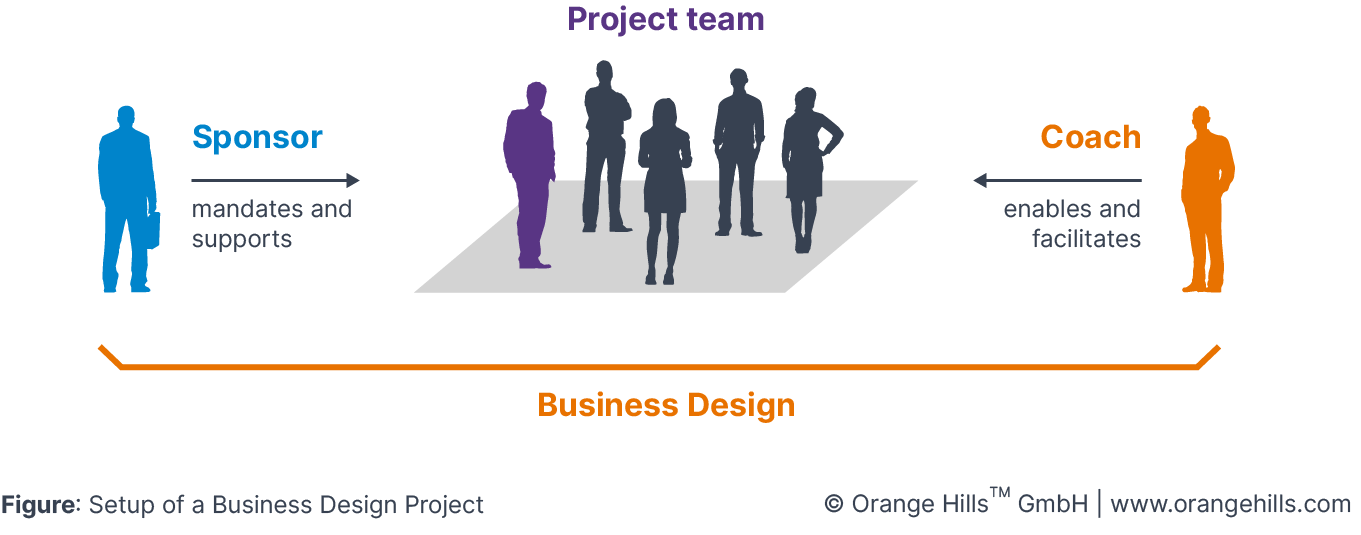
The secret recipe of Business Design is the right people in the right roles, working closely together. We need dedicated leadership roles and roles for the workforce who drive projects. Keep in mind that one person can play many roles, especially in smaller companies. The Project Team that drives a project is the key element of Business Design. It consists of one Team Manager and two to four Team Members. They work closely with a Project Sponsor who aligns results with the company's interest and provides the resources you need. The Team Coach supports the team with methodological expertise and executes team interventions if necessary. And don't forget: customers play a central role and need to be involved throughout the entire End-to-End Innovation Process.
Keep in mind
Don't fall into this trap: thinking you need every expert in the Project Team. That gives you teams of six or more — never a good idea. If you need experts occasionally, treat them as "external experts" and invite them to workshops when you need them.
Here is an overview. Key roles form the core of every innovation management system. Optional roles join when you need them:
C-Level Managers give strategic direction and meaning to everything that happens in the innovation management system. They are not passive observers who just provide money and resources. C-level management must be personally and emotionally involved in Business Design. Key activities are:
| |
The Innovation Manager is responsible for orchestrating the innovation management system and managing portfolios of both new ideas and innovation projects in various phases of the End-to-End Innovation Process. Key activities are:
| |
The Project Sponsor is your power promoter. This person cares deeply about the project results, signs off budgets, allocates resources, protects the team and motivates colleagues to support you. Key activities are:
The project sponsor is accessible to all Team Members via direct and fast channels (SMS, WhatsApp, Signal, Teams) throughout the project. NO proxies, no PAs, no hierarchical boundaries. | |
The Team Manager leads the Project Team and is accountable for its results with all the other Team Members. Think MacGyver: one person with a full overview of all activities, driving the team to high performance. Key activities are:
| |
The Team Member is part of the Project Team — and fully accountable for its results. Each member brings specific expertise in engineering, sales, marketing or finance and applies it throughout the innovation process. Key activities are:
| |
The Team Coach is the expert in managing and facilitating the Business Design process. Be aware: the coach is NOT part of the team. The coach helps each individual — and the team as a whole — to apply the Business Design approach with its Guiding Principles, process, roles and tools. Key activities are:
| |
Customer | Customers are not just subjects to study. They are active participants in Business Design — helping you build Business Models, products and services that actually excite them. Key activities are:
|
Optional:
Prototyping Experts are trained hardware or software engineers with broad prototyping knowledge. These folks make things happen under pressure — building what you need for validation and testing. | |
Research Experts bring a scientific background and deep experience in qualitative and quantitative research methods — studying customers, users and other market players. Key activities are:
| |
External Expert | (Team-)External experts are subject-matter experts who have specific knowledge that is needed in certain phases of the innovation process. They are NOT part of the Project Team and don't join every workshop. Key activities are:
|
A Maverick is a temporary Team Member usually provided by Orange Hills whose job is to stimulate radical and fresh thoughts within Project Teams. A maverick is optional but can be very helpful in a kick-off and Design Workshops to make people push their mental boundaries and leave traditional patterns. Key activities are:
|
Keep in mind
Don't forget the line managers. They have no role in Business Design, but every one of your Team Members has one – and that person decides whether the time promised in the project charter actually exists. Agree each release with the line manager before the project starts: in days per week, for the full duration, with names on it. People who are assigned but not released run the project on top of their day job, and the day job wins. If a line manager blocks the release, clearing the way is the job of the Project Sponsor. More on this in Organisational Structure.
As mentioned before, one person can hold several roles, and in a company of eighty people they will have to. Three combinations still break the setup, and no shortage of people justifies them:
The team coach is never the team manager: A coach who owns the result cannot tell the team that its result is thin.
The project sponsor is never a team member: A team stops contradicting the person who signs off its budget, usually within two workshops, and always without saying so.
The [Innovation Manager] is never the sponsor of the projects they evaluate: Portfolio decisions and project advocacy in one head give you a portfolio full of that person's favourites.
Everything else can be combined. A team member who is also your best researcher is fine. A sponsor who is also a C-Level Manager is common and usually good news.
Keep in mind
Keep in mind: The biggest mistake you can make as a coach is ignoring the team setup! Get Team Members who are passionate about the project, trained in Business Design and ready to invest real time — and you will get them to 100% performance. Get the wrong people, and the project is dead before it starts.