
Team Coach
'Even the best coach can't make you win every game, but they will make you turn up even stronger for every next match.' — Read how team coaches help project teams to perform, and how they make working outside the team's comfort zone feel safe enough to do it.

Bernhard Doll
Business Design Maverick
A team coach is an expert in how to run and facilitate the Business Design process. They are not part of the Project Team. They are responsible for the team's performance, not for its result — a team that has worked with method and rigour has done its job, even when the business model it arrives at is not the one anyone expected.
A team coach helps every individual in the project team to:
apply the Business Design approach with its Guiding Principles, End-to-End Innovation Process, Roles and Tools & Methods,
play their assigned role and get past their own barriers and fears,
grow into a high-performance team that takes full responsibility for the project.
That responsibility only works when the coach stays out of the content. Take a position on which business model is the right one, and you lose your independence — you become a team member or a stakeholder, and someone else has to coach. And remember who the team is working for: the Project Sponsor, not the coach. There is also no team coach without a project charter — the mandate for everything a coach does with the team comes from the agreement with the sponsor, so read the charter as your own contract and not only as the team's briefing. If the frame does not hold, say so before the kick-off.
Team coaches do not have one way of working; they have three. Which one fits depends on what is limiting the team right now: skills it does not have yet, or something getting in the way of skills it already has.
Role | What you do | When it is the right one |
Trainer | Teach the method, watch how the team applies it and correct it | The team does not know the tool yet, or is using it wrongly |
Mentor | Share what you have seen before and name what is coming | The team knows the method but cannot yet judge the situation |
Coach | Ask, summarise, mirror and let the team find the answer | The team can do it and only lacks confidence or perspective |
Switching between the three is the actual skill, and it can happen twice in one workshop. The less experience a team has, the more time a coach spends training; as a team gains experience across iterations, the balance moves towards mentoring and coaching. Directive help finishes today's task and builds dependency; asking takes longer and builds a team that needs the coach less.
A good team coach works closely with the project sponsor and the team, but is not necessarily the team's friend. Taking a team — and often the organisation around it — out of its comfort zone is part of the job, and so is helping them get there feeling safe and supported. Be prepared for an emotional roller coaster that may look like this:
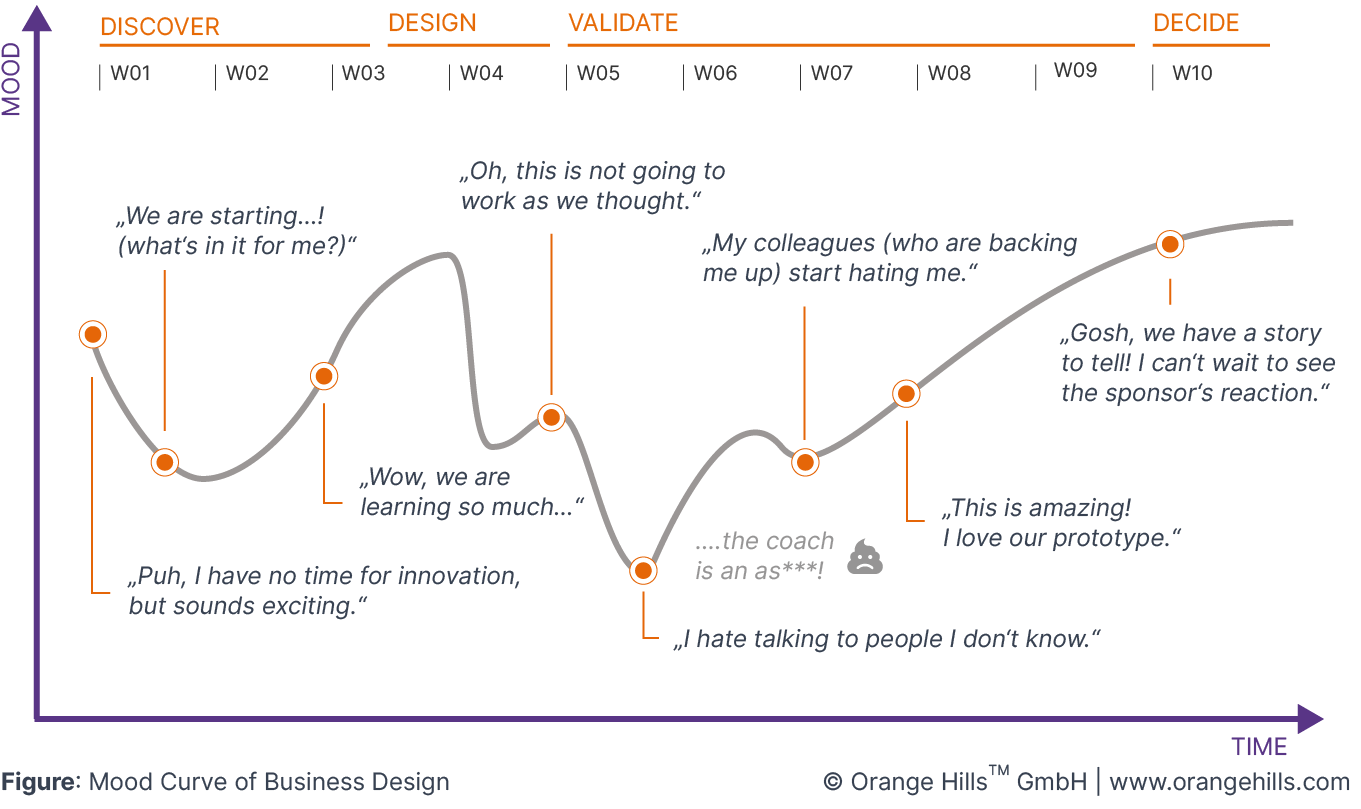
Broken down, this means a team coach is particularly involved in:
preparing workshops and moderating team discussions,
giving methodological guidance and assuring methodological precision (Guiding Principles),
asking questions that open up new perspectives — for example: "I understand you don't think this is going to work. However, what could we do to make it work?",
supervising how the team works together, and raising critical points objectively so the team can resolve them,
managing important stakeholders, above all the sponsor,
intervening when the project team derails, and working on a solution together with the team.
What a team coach does depends on the project format. The role runs across all five phases of the End-to-End Innovation Process, and it changes with each one:
Phase | Who you work with | Where the focus is | Which role dominates |
Keeping the discussion in the future, and making differences in perception visible | Mentor and Coach | ||
A research team, often new to the method | Research quality, interview training, documentation the team can build on | Trainer, across the full arc | |
Experts and decision-makers | Sharp framing, honest evaluation and resistance to transparency | Mentor and correcting Trainer | |
Project team | Validating against resistance, sponsor politics and the D-Day | All three, changing | |
Organisation taking over | Handing over insight, and keeping at least one team member on board | Mentor |
Phase IV is the format most team coaches meet first. The table below shows the key activities across its five steps:
Phase IV
Step | Activities | Comments |
| Be rigorous here. Unclear objectives, a half-committed sponsor or a team without time are not a starting position. Double-check the charter. | |
| Intervene early if the team drifts. Confirmation Bias starts here — involve the whole team in collecting and analysing. | |
| Pay the utmost attention to the questions, hypotheses and experiments. | |
| Teams avoid validation when it threatens the person behind the idea, not just the idea. Watch for it. | |
| The team presents. You stay in the background. |
Coaching is a craft that develops through reflection. Experienced team coaches review their projects — and their own use of the method — together with a co-coach rather than on their own.
Academy
We train team coaches in our Business Design Academy. Join us for the next Business Design Certificate Program (DE)!