
End-to-End Innovation Process
An innovation management system covers the complete journey — from visionary work and strategy all the way to launching, managing and scaling new business on the market. This is what Business Design does. And on this page, you learn how.

Bernhard Doll
Business Design Maverick
A key element of Business Design is the so-called end-to-end innovation process. It covers the entire journey from vision to tangible new products, services, software systems and Business Models ready to ship to market. The process consists of five key phases:
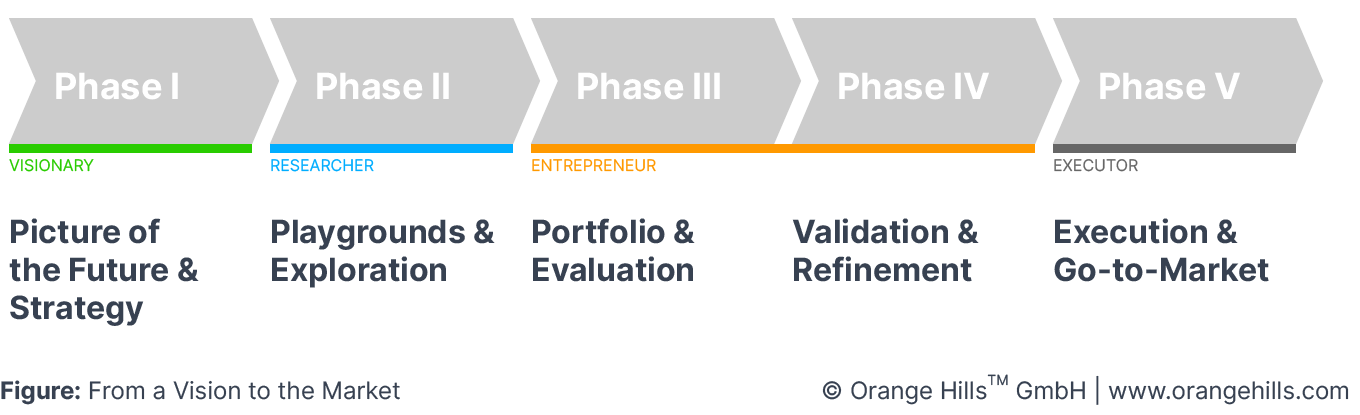
Phase I: Picture of the Future & Strategy:
Defining your entrepreneurial vision of a desirable future — for your customers and your organisation — including offerings and a clear definition of success.Phase II: Playgrounds & Exploration:
Exploring new innovation playgrounds around customer feedback, market trends, organisational strengths, data and resources as well as technology ("turning money into knowledge").Phase III: Portfolio & Evaluation:
Creating and documenting new ideas based on surprising insights from the exploration phase, and evaluating them in a simple yet powerful risk Portfolio.Phase IV: Validation & Refinement:
Turning prioritised ideas into marketable and validated products, services and Business Models — earning the first € through iterative refinement ("turning knowledge into money").Phase V: Execution & Go-to-Market:
Developing final offering and business blueprint, launching and scaling new business inside or outside the organisation according to given objectives ("turning money into a lot of money").
Keep in mind
The simplified illustration of the end-to-end innovation process can suggest that you move through it in a straight line. That is the exception, not the rule. There are at least two iteration loops: 1) in Phase IV, where you validate and refine ideas, and 2) from Phase IV back to Phase I. Here you use insights from practice to adjust the Picture of the Future to reality at a fixed rhythm.
We learned over the years that excelling within each phase is not enough — the interfaces between phases matter just as much. This requires professional innovation management to ensure that knowledge, insights and results flow from phase to phase as smoothly as possible.
We distinguish between these five phases because the mindset and way of working to create meaningful results are quite different in each:
You often need specialised people for each phase with different skills. An expert who excels at customer interaction, explorative research and gathering detailed market information is often not the right person to think in entrepreneurial opportunities and business models. And a creative thinker in Phase IV ("Validation & Refinement") is sometimes not the best choice for launching a business and getting all operational processes in place in Phase V ("Execution & Go-to-Market"). Exceptions exist, but they are rare. In Phase I ("Picture of the Future & Strategy"), you need visionary people with a clear idea of the future and the passion to build it. In Phase II ("Playgrounds & Exploration"), you need the curious person who digs deep into data, numbers and any information they can find on a specific topic. The entrepreneurial mindset is required when entering Phase III ("Portfolio & Evaluation") and, more importantly, Phase IV ("Validation & Refinement"), where pragmatic solutions at high speed matter most. In Phase V, the efficiency-driven and quality-obsessed person is exactly where they belong.
Working processes, tools, methods, energy levels and interdisciplinary teamwork also look very different in explorative projects (Phase II), in sprints (Phase IV) and after the official market launch (Phase V). For instance, the questions we ask in explorative customer and user research are different from the ones we ask in a sprint (Phase IV). See the phase-specific pages for more details.
Finally, Governance — how decisions are made, how management is involved and how projects are funded — also differs across all five phases. Drafting business cases for further investment works well in a 2nd or 3rd sprint iteration (Phase IV). In the playgrounds and exploration phase, however, they are the licence to kill every new idea — and the motivation of the people involved. Funding new projects in Phase II requires a different decision-making approach than later stages like Phase IV.
Take a look at the description of each phase for more details.