
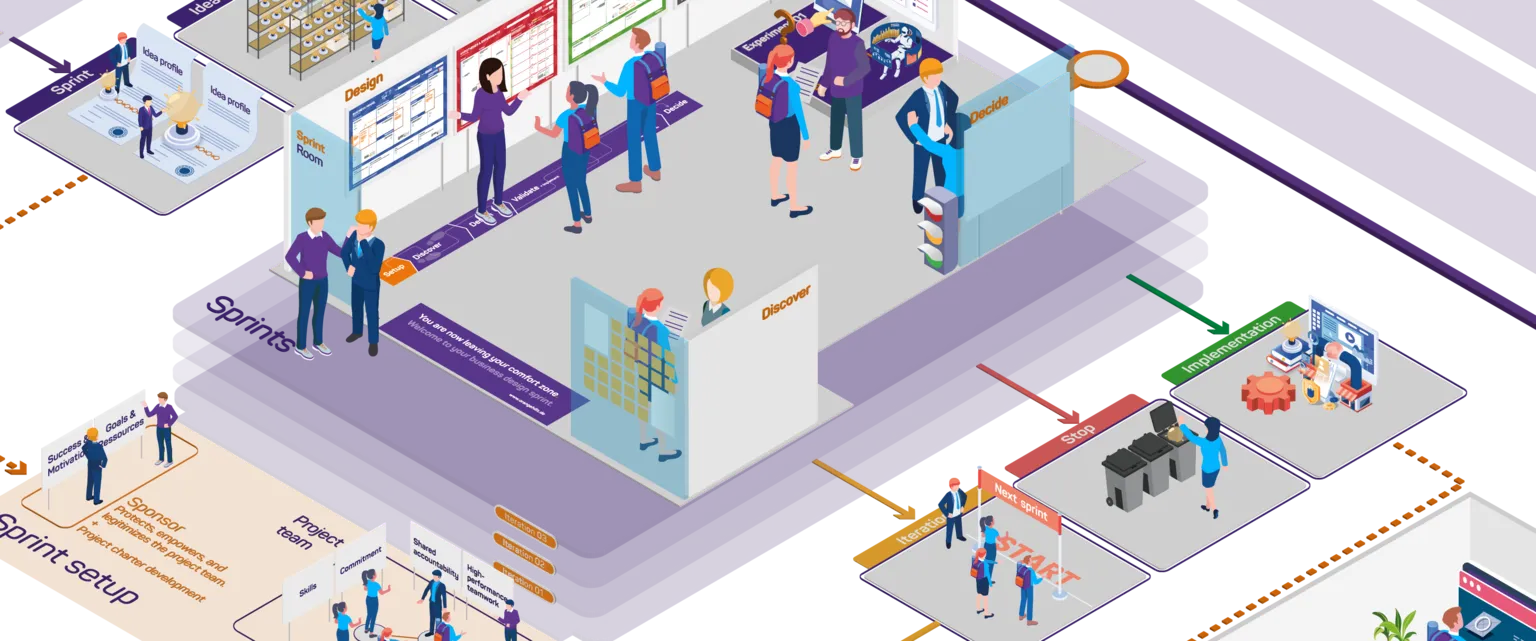
Phase IV: Validation & Refinement
The fourth phase of the end-to-end innovation process is the most operational phase of Business Design — and also the most challenging one. We validate new ideas from the portfolio with the pragmatism of an entrepreneur and the precision of a scientist. This pushes many companies out of their comfort zone. But it also delivers clear results and reduces uncertainty as much as possible, so investment decisions can rest on facts rather than gut feeling. Here we go!

Bernhard Doll
Business Design Maverick
1. Purpose
The phase "Validation & Refinement" of the End-to-End Innovation Process is the embodiment of entrepreneurial thinking. Based on the input from the previous phase, this phase is all about turning rough ideas into validated new business concepts ready to be rolled out to reality. The purpose of this phase is to reduce uncertainties inherent in every new idea as much as possible through a systematic and agile validation approach. To do so, we usually run through various iterations of a standardised process consisting of five steps:
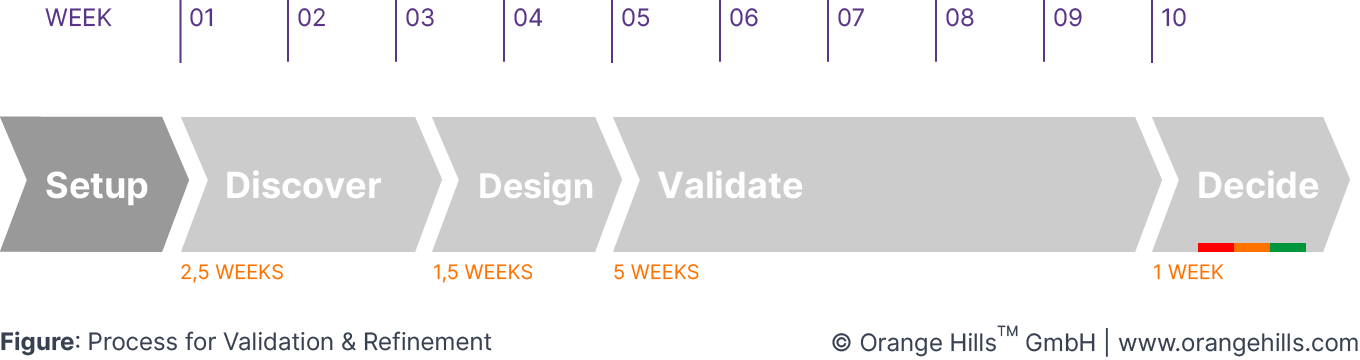
These steps enable us to develop, learn and make clear decisions:
Step 1: Setup: First, you set up your project by ensuring the support of decision makers (= sponsors) within your company, defining the focus of your project and building the right team.
Step 2: Discover: To better understand the context of your project, you discover the space of your customers, competitors and technologies related to your project focus. Above all, you want to understand what "pains" your customers have today when using existing solutions.
Step 3: Design: Based on insights gained, you create business ideas as "pain relievers" and translate them into a Business Model to define how to create value for both your customers and your organisation. Furthermore, you plan how to validate the business model.
Step 4: Validate: To further develop your business model, you explore open questions and test hypotheses to validate key elements of your business model.
Step 5: Decide: Finally, you decide with your internal sponsor how to continue with the project. Often two to three iterations are needed to achieve the necessary knowledge and maturity for market launch.
Together, these five steps make up one "iteration" of a Business Design project. A project can include anywhere from one to several iterations.
Each step gives everyone involved clear structure and guidance — especially important when everything else feels risky and uncertain. In every iteration, we design or improve a future scenario as a new business model, product, service or piece of software (Design), based on a short discovery phase (Discover), and validate the scenario with scientifically designed experiments to learn what works and what doesn't (Validate). Based on these learnings, the Project Sponsor can make a clear decision on how to proceed (Decide). In short, three decisions are possible:
Decision | Explanation |
STOP | The facts tell us to stop wasting time and money — this idea will never work. |
ITERATE | We've gained insights into how to improve our idea and how we work together as a team. Time for the next iteration. |
GO | Wow — the results from this iteration show our idea is ready for the market. Go! |
To kick off a project based on the Business Design process, a Project Charter (= Setup) is required to define some basic elements of the project such as motivation, objectives, schedule and stakeholders. The output of a Business Design process is a management proposal consisting of the results of each step (e.g. business model, hypotheses and results of experiments, prototype), suggestions for the sponsor and the decisions made by the sponsor. This, however, is rarely an easy task and usually leads to a journey with ups and downs as illustrated below. Be prepared for this!
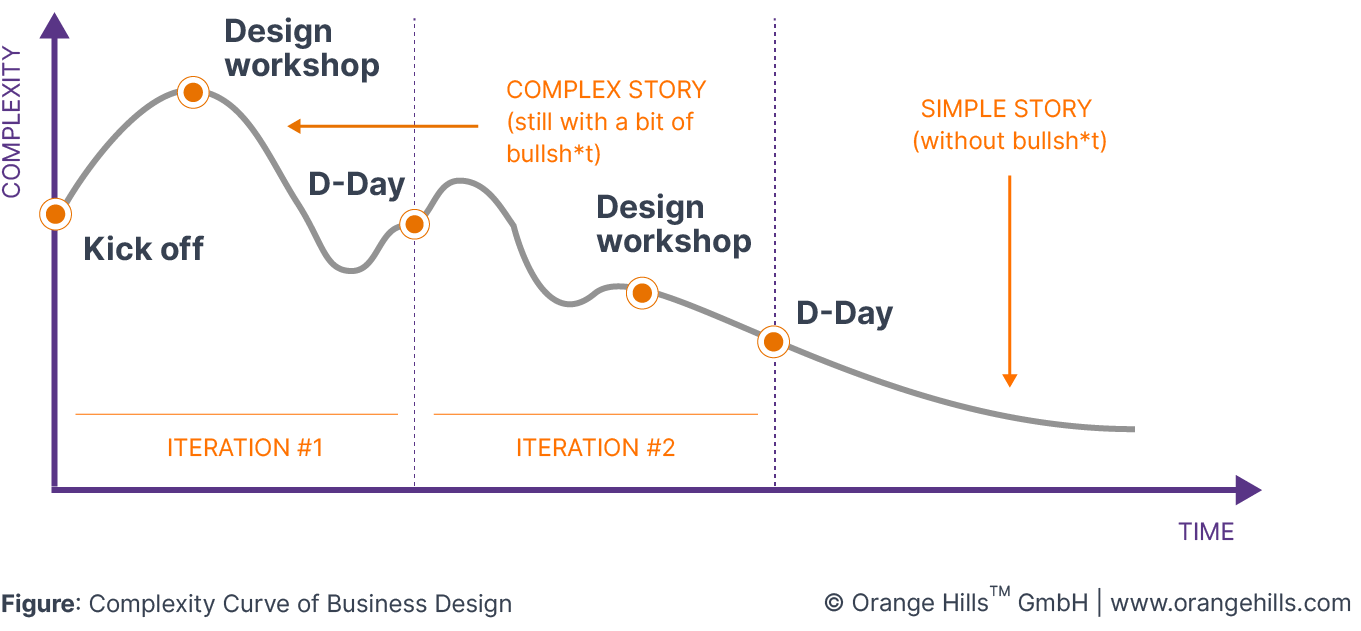
Why is this phase so challenging? Because much of what happens here goes against the traditional culture of large corporations.
Asking customers questions gets read as weakness or unprofessionalism. Testing product concepts that aren't "finished" gets labelled sloppy work. Thinking holistically, often across organisational boundaries, is not something middle management embraces. Measuring success with no mercy and 100% transparency clashes with people's own agendas. High-performance teamwork that pushes people beyond their comfort zone is something most people aren't used to.
An organisation has to digest all of this at once. Be aware of that.
2. Duration
10 weeks + setup (per iteration)
Keep in mind
Keep in mind that we usually run through this agile validation process more than once. "Agility" means in simple terms "systematic learning and adaptation", which usually happens in various iterations within one single project. The project is completed in this phase of the End-to-End Innovation Process once we see either a "red" or a "green" signal at the final workshop. This is the ultimate goal!
3. Key Activities
These are the core activities of this phase:
Discovery of open questions: To better understand your project's context, you explore the space of your customers, competitors and technologies related to your focus. This builds on the research from previous phases, but usually goes deeper, asking more detailed questions within the scope of the project.
Design of holistic solutions: Based on the research results, we design the solution space as a holistic concept, including every element needed to get a solution off the ground. This usually results in a Business Model.
Validate key hypotheses: Every new idea rests on assumptions. We translate the most success-critical assumptions into testable hypotheses, then design experiments that deliver facts to verify or falsify them. This step usually involves simulating parts of the concept using different kinds of simulations and prototypes.
Decision-making in the realm of agility: Finally, we need to decide how to proceed, based on the project's outcomes. This can mean a project gets killed (red), is ready for the next phase (green) or needs another iteration to improve (orange).