
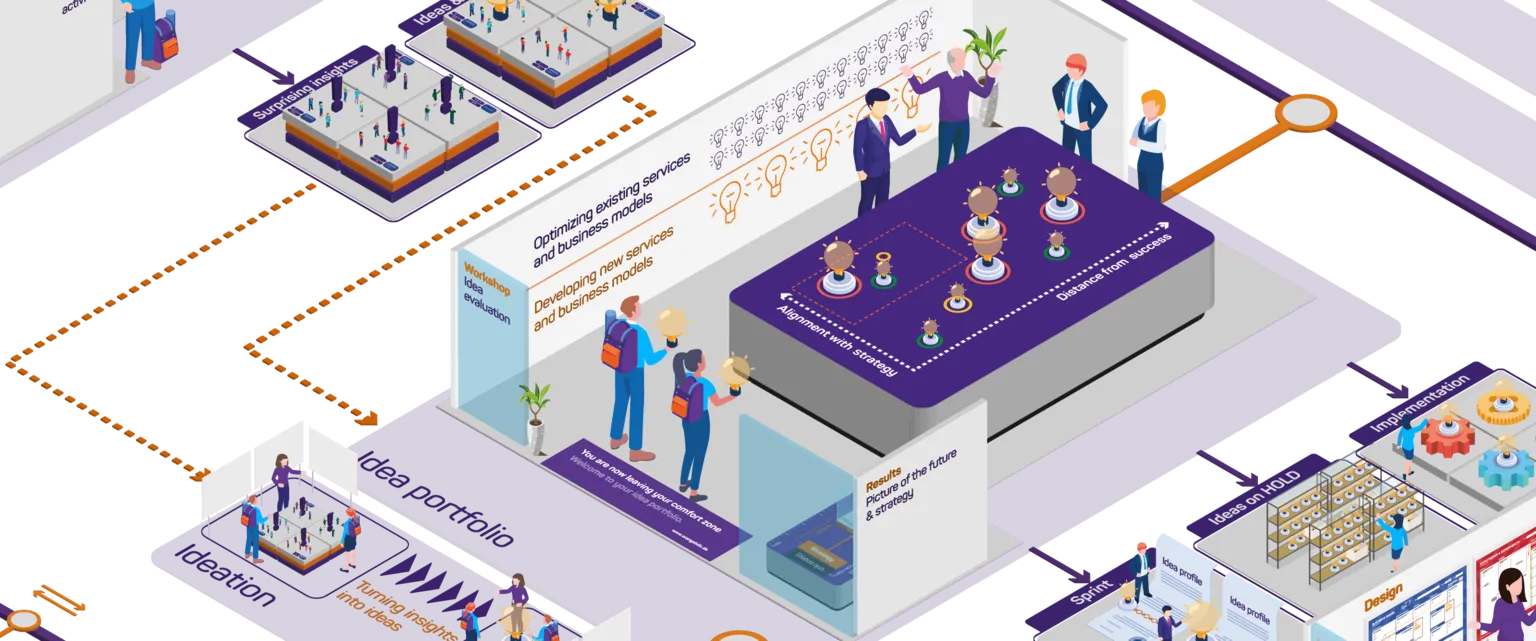
Phase III: Portfolio & Evaluation
The third phase of the end-to-end innovation process is the linchpin of the entire innovation system. First, new ideas are created based on insights from previous research. Second, we ask ourselves how the ideas we've developed help us put our vision and research work into practice, and what opportunity-to-risk ratio underlies them. The idea portfolio is our central tool here — and in this article we show you how to use it.

Bernhard Doll
Business Design Maverick
1. Purpose
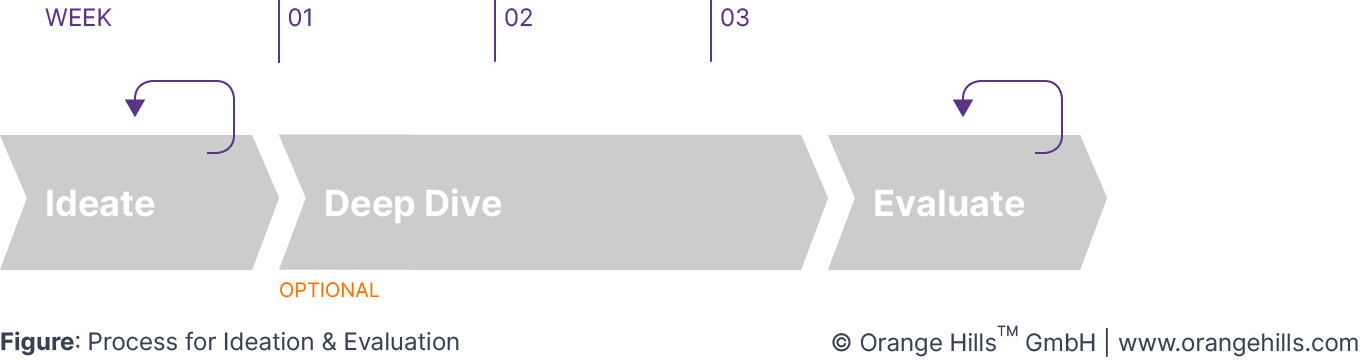
Innovation work requires risk-taking. But in a controlled way. In this phase of the End-to-End Innovation Process, we tackle exactly this challenge. The starting point is the creation of new ideas (Step 1: Ideate) based on the input from previous phases. We create new ideas in dedicated Ideation Workshops. If some ideas are too vague to apply evaluation criteria, we optionally run a so-called deep dive (Step 2: Deep Dive) to increase their clarity and tangibility. Finally, we look at the results through the lens of a (risk) investor, evaluate new ideas (Step 3: Evaluate) and ask questions like:
Which ideas carry particular strategic relevance?
What entrepreneurial opportunities do these ideas create?
What uncertainties exist, and what risks am I taking on?
We ask these questions at regular intervals of 3 to 6 months, throughout the lifecycle of an innovation management system. Management meets in a compact session (portfolio revision meeting) to assess new ideas alongside ideas already in progress, maintaining what we call an idea portfolio. In this portfolio, we plot every idea visually and assess it relative to the others, based on clear evaluation criteria. So why does this step matter?
Business Design, as a distinct approach to innovation management, has built up a reliable way of dealing with uncertainty over the years. No one can know whether a new idea will meet expectations. No one can know whether customers will love a new idea and fit it into their daily lives. That's why innovation management is risk management. Ideas can fail — that's not a mistake, it's the nature of the game.
The most important tool to manage your risk appetite is the Portfolio. An idea portfolio is a visual representation of all your ideas and their relative opportunity-to-risk ratio. Ideas appear as circles of different sizes on a 2- or 3-axis coordinate system. The graphic below shows a sample portfolio.
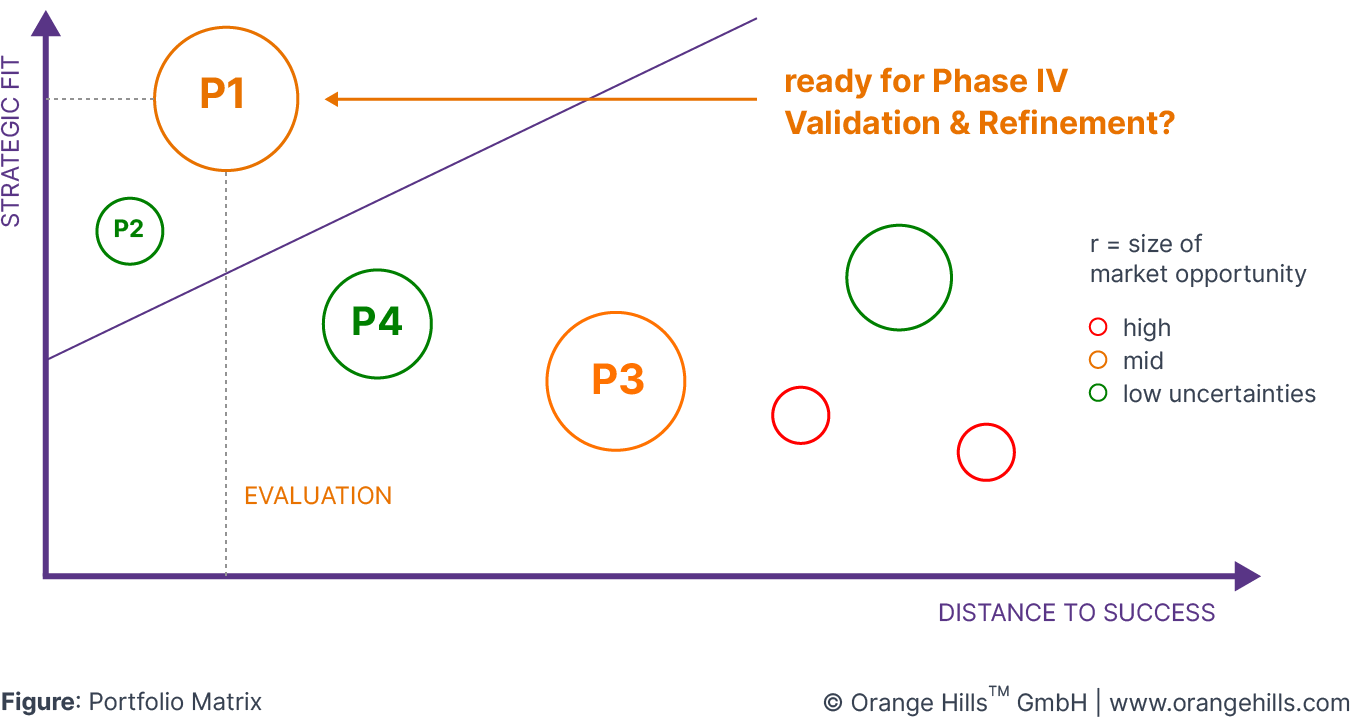
Ideas are placed on the matrix and visualised according to evaluation criteria. If you can't apply your evaluation criteria to an idea, that idea is probably too vague. It needs more flesh on the bones — something we create through what we call deep dives (Step 2: Deep Dive). In a short timeframe of 2 to 3 weeks, we research basic questions around the problem faced by an internal or external customer, and the potential of the solution space to tackle that problem.
Keep in mind
Keep in mind: the portfolio matrix is not a final, absolute verdict on your ideas. A high score doesn't mean automatic implementation either. Its real job is to prepare the right next step for each idea. Ideas with high uncertainty move into Phase IV of the end-to-end innovation process, where you test them before committing bigger investment. Ideas with low uncertainty can often move straight to implementation in Phase V. Some ideas might be deprioritised or killed right away.
At this stage, we don't build detailed financial plans or business cases. The ideas simply aren't mature enough for that yet. This way of working may feel unfamiliar for some companies. Welcome to an agile world.
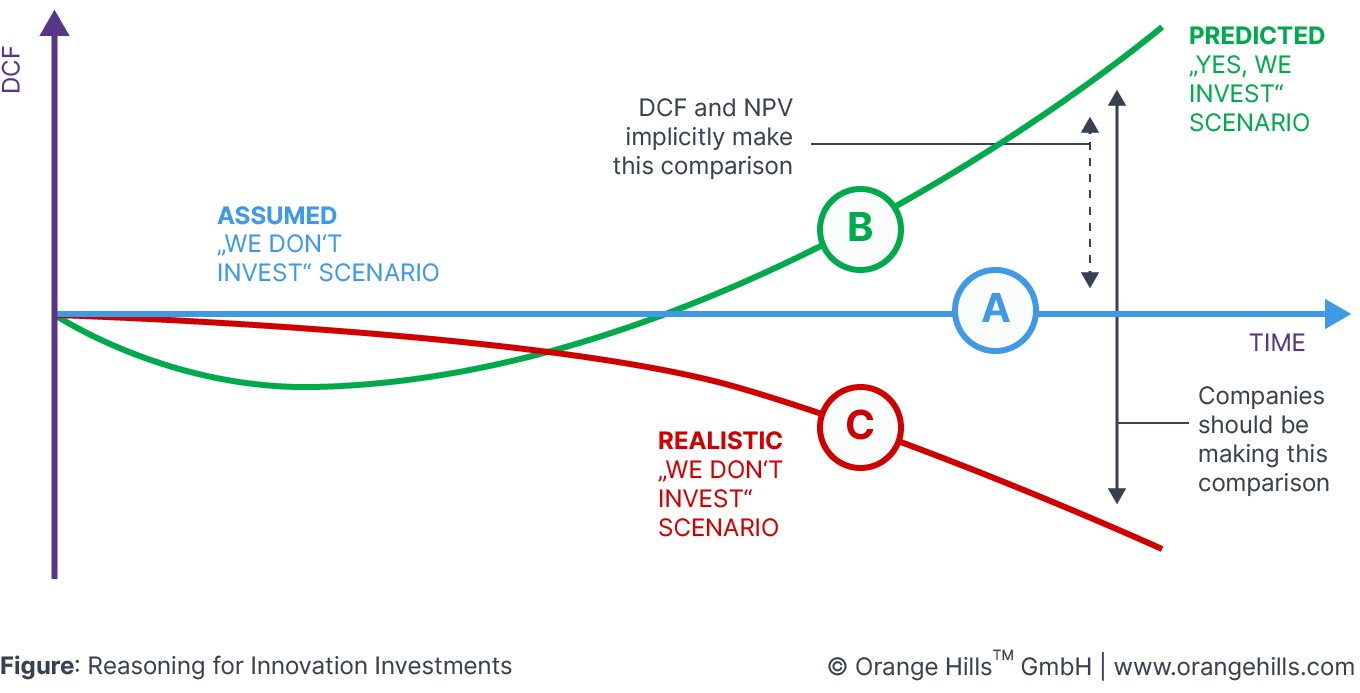
If a business opportunity is measured in terms of revenue growth, we often predict the sum of a business idea's future cash flows and discount them back to today, based on an average interest rate. This method is called Discounted Cash Flow (DCF), a conservative way to evaluate the value of innovation. DCF, however, assumes your business stays steady if you don't invest in innovation. That assumption is often flawed and rarely reflects reality. You need to adapt DCF to your own reality.
Document every idea on the portfolio in the same consistent way. Take a look at the Idea Charter template for your inspiration.
2. Duration
Ongoing
Portfolio revision meeting: 2-3 hours
Deep dives for selected ideas (Step 2: Deep Dive): 2-3 weeks
3. Key Activities
These are the core activities of this phase:
Step 1: Ideate: Based on previous research, new ideas are created that consider surprising insights. These ideas are documented in a standardised form (Idea Charter). The idea creator usually does this with support from an Innovation Manager.
Step 2: Deep Dive (optional): If ideas are too vague to apply evaluation criteria, stakeholders can decide to start what we call "Idea Deep Dives". Here, we raise and answer essential questions and make ideas tangible through visualisation.
Step 3: Evaluate: In a compact session, management meets and reassesses the idea portfolio. The team discusses and evaluates new entrants, and revisits existing ideas to adapt their evaluation based on project outcomes and new learnings. At the end, management decides which ideas can go directly to execution (Phase V) and which ideas should go through proper validation (Phase IV) to test them systematically based on key hypotheses.