Choosing Experiments
After identifying open questions and hypotheses in the design workshop (or optionally the validate workshop), you choose an experiment for each of them. Here's how to pick the one that gets you the facts — and six experiment types to start from.

1. Purpose
In the Design Workshop (or optionally the Validate Workshop), you turned the antilogs in your test focus into open questions and hypotheses (see Hypotheses & Experiments). Now you choose an experiment for each of them: how you get the facts, which prototype you need and what you measure. The output is one experiment per question or hypothesis, planned on a Validate Card, so your team can start Step 4: Validate right away.
Every experiment reduces uncertainty: whether people actually want your offering (desirability), whether it can become a sustainable business (viability) and whether you can deliver it with your resources (feasibility). Combined with the right data, experiments give you the evidence you need to decide whether to move forward.
2. Duration
Part of the 2.5-hour block on questions, hypotheses and experiments in the Design Workshop or the Validate Workshop, plus detailed planning on Validate Cards before the experiments start
3. Key Activities
The following activities represent the core of choosing experiments:
Name the Uncertainty
Decide for each question and hypothesis which kind of uncertainty it addresses. Start with desirability: if people don't want your offering, you don't need to think about the other two — and testing it keeps you from building "solutions in search of a problem". The Introduction explains what Business Design aims for in each category. Here is what they mean for your experiments:
Uncertainty | Typical questions | Signals to watch out for |
Desirability Do people actually want it? |
|
|
Viability Can it survive as a business? |
|
|
Feasibility Can we build and deliver it? |
|
|
Explore or Validate
Check whether your statement contains a number. If it doesn't, it's an open question: you explore it (see Exploring Questions). If it does, it's a hypothesis with a threshold: you validate it — or, more accurately, try to falsify it (see Validating Hypotheses). Exploring tells you why; validating tells you whether enough people act.
Pick the Experiment
The six experiment types are ordered by their level of reality: the further down the table, the closer you get to a real buying situation — and the more effort it takes. Pick the lowest level that still gives you enough reality for your threshold; the more customer investment your threshold asks for, the more reality you need. Then name the prototype you need for it (see Prototyping). Section 7 describes each type in detail.
Experiment | Prototype | Uncertainty | Explore or validate | Level of reality | Customer investment |
Interview with Prototype | Mock-up or click dummy | Desirability | Explore | Low | Time |
Smoke Test | Landing page with an ad campaign | Desirability | Validate | Medium | Time |
Fake Door Test | Landing page or your existing product | Desirability, Viability | Validate | Medium | Time |
Wizard of Oz | A front end that looks real | Desirability, Feasibility | Both | High | Time |
Concierge | A simple way to take orders | Desirability, Viability | Both | High | Time, Financial |
Sell Before You Build | Landing page, sales brochure or crowdfunding page | Viability | Validate | Highest | Financial |
Set Metric and Threshold
Decide what you measure and write your threshold on the Validate Card before the experiment starts — a threshold set afterwards is an opinion, not a fact. These metrics are the most useful when you work with digital prototypes:
Metric | Description |
Conversion Rate | Percentage of users who take the desired action (e.g., sign up, purchase) out of total visitors. |
Bounce Rate | Share of visitors who leave after viewing only one page or without engaging further. |
Number of Registrations / Downloads | Total count of users who register for the product or download the app. |
User Interaction & Engagement (DAU & MAU) | Measures how many daily (DAU) or monthly (MAU) active users engage with your product. |
Retention Rate | Percentage of users who return and keep using the product over time. |
Churn Rate | Percentage of users who stop using or cancel the product within a given time period. |
Product Ratings | Average rating or feedback score given by users (e.g., app store reviews). |
Customer Acquisition Cost (CAC) | The cost of acquiring a new customer, including marketing and sales expenses. |
Customer Lifetime Value (CLV / LTV) | The predicted total revenue a business can earn from a single customer over their lifetime. |
Scroll Depth | The scroll position a user reaches. |
Let's say you run a smoke test to find out whether there is demand for your product and whether your value proposition works. Then you typically track conversion rate, bounce rate, sign-ups and customer acquisition cost. Together, they tell you whether your offering generates enough interest. For how to collect and analyse such data, see Quantitative Data Analysis.
4. Participants
Optional: Prototyping Expert
Optional: Research Expert
5. Tools & Materials
See Tools & Methods for Phase IV for an overview
Hypotheses & Experiments template
6. Instructions for Coaches
Watch out for comfortable choices. Teams like interviews because they are easy to organise and feel safe — but an interview never proves that enough people will act. As soon as a hypothesis has a threshold, push your team up the reality ladder: towards a smoke test, a fake door test or a sell-before-you-build experiment.
Combine experiments. Numbers tell you what happens; interviews tell you why. If a smoke test or a fake door test surprises your team, have them follow up with a few interviews (see Interview with Prototype).
Check the effort before your team commits. Every experiment needs a prototype, participants and time — and Step 4: Validate only lasts five weeks. Ask who builds the prototype and by when, and bring in a Prototyping Expert early if it's ambitious.
Insist on a number before the start. If your team can't agree on a threshold, the hypothesis isn't ready yet — let them explore first (see Exploring Questions).
7. Experiment Types
Every type below comes with the same building blocks, so you can compare them at a glance. Most come with an example of a company that ran one. Expert interviews and desk research, which you mainly use to explore, are covered in Exploring Questions.
Interview with Prototype
Interviews are one of the most basic and often underestimated experiments. In a structured conversation you show potential or current users your prototype and ask why. You hear their needs, motivations and frustrations, and you see how they react to the prototype, which tells you things people rarely put into words. Use interviews to explain the numbers from a smoke test or a fake door test. Be aware that the way you build and present your prototype shapes the reactions you get (see How Prototypes Shape Judgement).
Uncertainty: Desirability. Do people have the problem, and do they understand your solution?
Explore or validate: Explore. Interviews show you why; they don't prove that enough people will act.
Level of reality: Low. Even with a prototype, an interview is always an experimental setting.
Customer investment: Time. An hour of their time, perhaps an invitation to the next meeting.
What you need: A prototype, such as a mock-up or a click dummy, and an interview guide (see Interview with Prototype).
What you measure: First impressions, confusion, quotes and the pains people describe.
Smoke Test
A smoke test puts a minimal version of your offering in front of real customers, usually a landing page with an ad campaign, and measures what they do, not what they say.
Uncertainty: Desirability. Do enough people want it?
Explore or validate: Validate. You need a hypothesis with a threshold.
Level of reality: Medium. Real people and real behaviour, but nothing to buy yet.
Customer investment: Time. A click, or a sign-up for the waiting list or newsletter.
What you need: A Landing Page and an Online Ad Campaign.
What you measure: Conversion rate, bounce rate, sign-ups and customer acquisition cost.
On your Validate Card: The first example in Validating Hypotheses is a smoke test: two weeks of online ads on three partner sites, a landing page with a newsletter sign-up, and you are convinced at a conversion rate of 3%.
Example: Dropbox
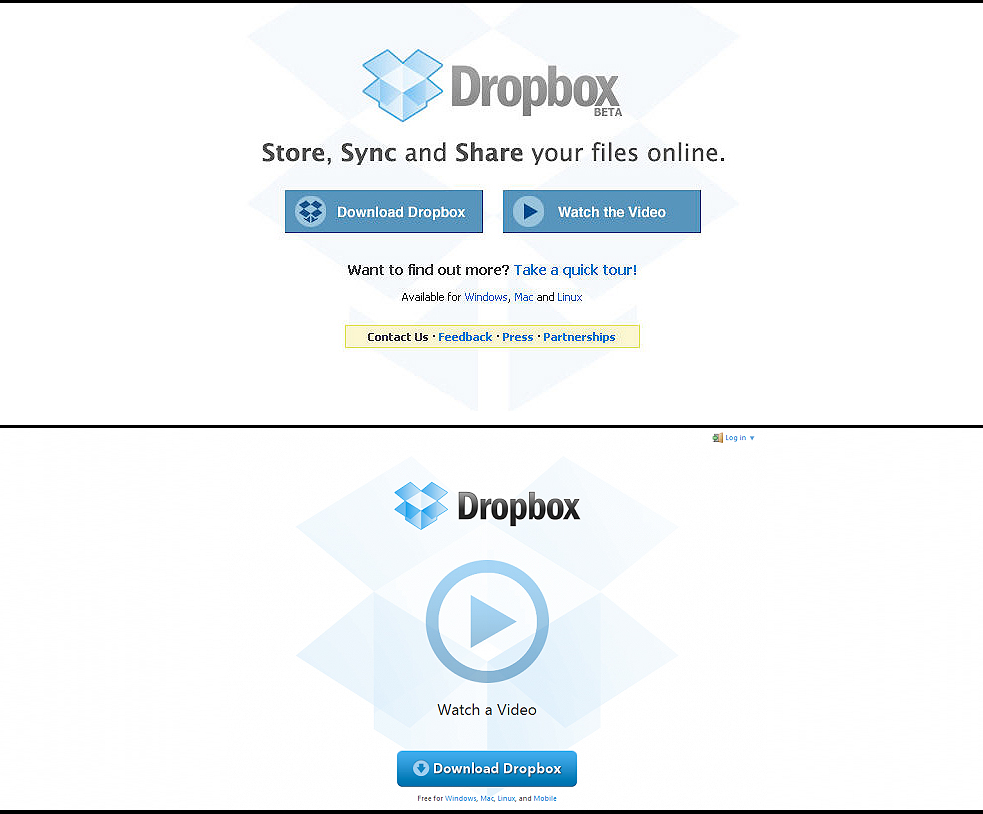
When Drew Houston founded Dropbox in 2007, he had the idea of seamless file synchronisation across devices. He knew it would be hard to build at scale, so he first wanted to know whether anyone cared. He made a three-minute explainer video that walked through how Dropbox would work and invited viewers to join the waiting list. The list grew from 5,000 to 75,000 people overnight. With a simple video, he learned that people were desperate for a solution — before the product existed.
Fake Door Test
A fake door test presents a feature, plan or product that doesn't exist yet. When users try to open it, they hit the fake door: a message tells them it isn't ready. You get real behavioural data on desirability, priorities and willingness to act, which is why teams often use it with existing products to test new features or plans.
Uncertainty: Desirability, and viability if the door is a price or a plan.
Explore or validate: Validate. Count the clicks against your threshold.
Level of reality: Medium. People act as if they were about to use or buy it.
Customer investment: Time. A click on "Buy", "Upgrade" or a price.
What you need: A Landing Page or your existing product, and an honest message behind the door.
What you measure: Clicks on the door, sign-ups and the plans people choose.
Example: Buffer
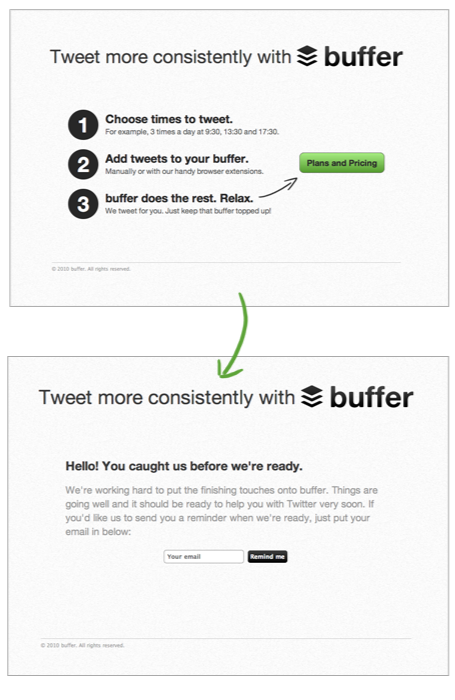
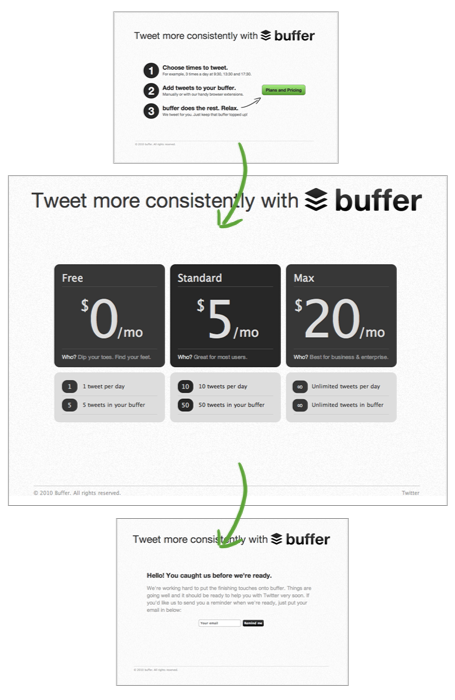
Joel Gascoigne wanted to scratch his own itch: a tool to schedule tweets in advance. But he wasn't sure whether anybody would actually use it, let alone pay for it. So he ran a little experiment with a two-page website — the fake door. The first page explained what Buffer was and asked people for early access. Anyone who clicked on "Plans and Pricing" landed on a second page with different plans and prices, and whoever selected a plan saw the message "You caught us before we're ready". Enough people signed up to give him the confidence to build the product.
Wizard of Oz
In a Wizard of Oz experiment, users think they are using a fully functional product, but behind the curtain people do the work by hand. Unlike in a concierge experiment, users don't know that. You only build the interface they see, and because they believe it is real, they show you what they really want.
Uncertainty: Desirability: do people care enough to use it? And feasibility: which technology do you really need?
Explore or validate: Both. A handful of users shows you what they really want; with a threshold, you validate how they use it.
Level of reality: High. Users experience the real service; they just don't see who is behind it.
Customer investment: Time, sometimes money. Real orders and real usage.
What you need: A front end that looks real, such as a Landing Page, a click dummy or a Lean Offering, and people who do the work behind it.
What you measure: Orders, repeat usage and the requests users make.
Example: Zappos
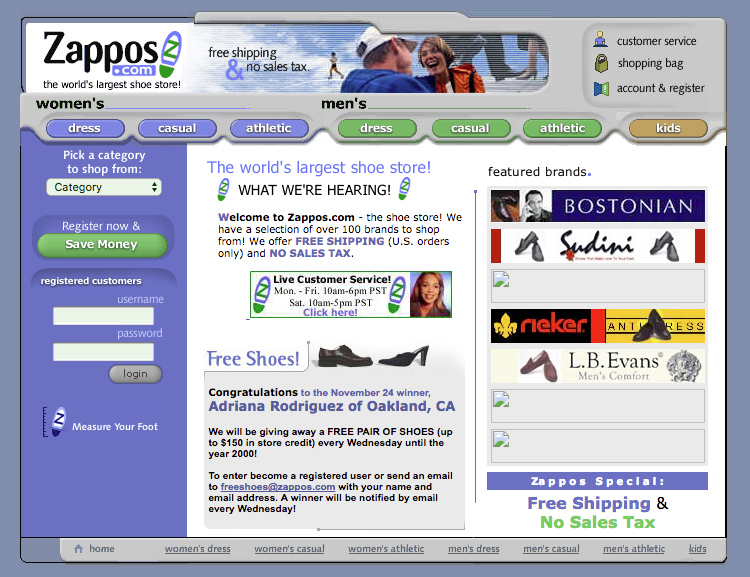
In 1999, Nick Swinmurn had what sounded like a crazy idea: selling shoes online. He wasn't sure whether people would actually buy them that way, so he ran a simple Wizard of Oz experiment. He asked local shoe stores whether he could sell their shoes online, and when they agreed, he put photos of their shoes on a simple website called shoesite.com. It looked like a working online shoe store. Whenever an order came in, he went to the store himself, bought the shoes at retail price and shipped them to the customer. He learned that people are willing to buy shoes online — and that they care about reliable delivery and easy returns.
In 2009, Amazon bought Zappos for around 1.2 billion dollars.
Concierge
In a concierge experiment you deliver your product or service by hand to a small group of customers, and they know it. You give each of them a highly personalised experience and learn whether they actually value it and whether the problem is worth solving, before you build and scale anything. It's one of the fastest ways to test your assumptions.
Uncertainty: Desirability: do customers value it? Often viability, too: will customers and partners pay and play along?
Explore or validate: Both. Up close you learn every pain point; with a threshold, you validate demand.
Level of reality: High. Real customers, a real service, often real money.
Customer investment: Time and money. Orders, payments, repeat bookings.
What you need: A simple way to take orders, such as a Landing Page, and your team's time.
What you measure: Orders, payments, repeat orders and the effort each delivery takes.
Example: DoorDash
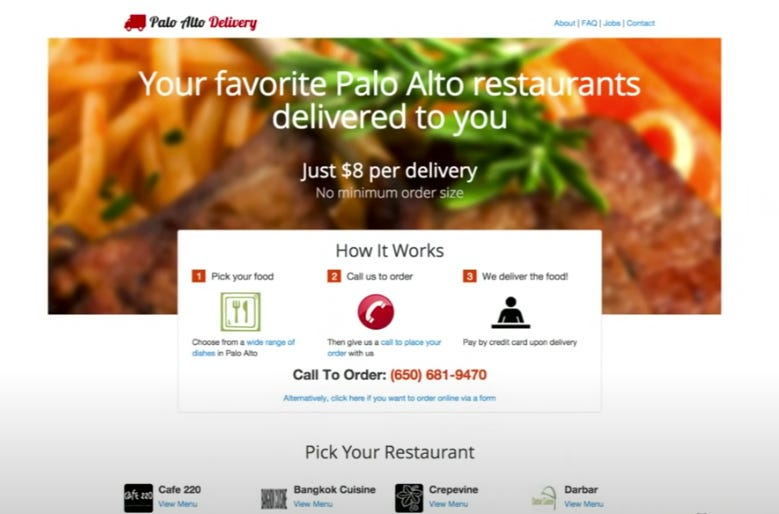
In the early days, the founders of DoorDash wanted to find out whether local restaurants and customers in Palo Alto actually wanted food delivery. Before building an automated system with an app, logistics and a driver network, they ran a concierge experiment. They put up a website, paloaltodelivery.com, with the menus of a few local restaurants. When an order came in, the founders called the restaurant, placed the order, picked it up and delivered it themselves. Delivering by hand, they experienced every pain point and could adjust right away.
They learned that people are willing to pay for delivery, that restaurants are happy not to set it up themselves and that speed, reliability and selection matter most. So the experiment reduced uncertainty about desirability (would people order?) as well as viability (would restaurants cooperate?).
Example: Airbnb
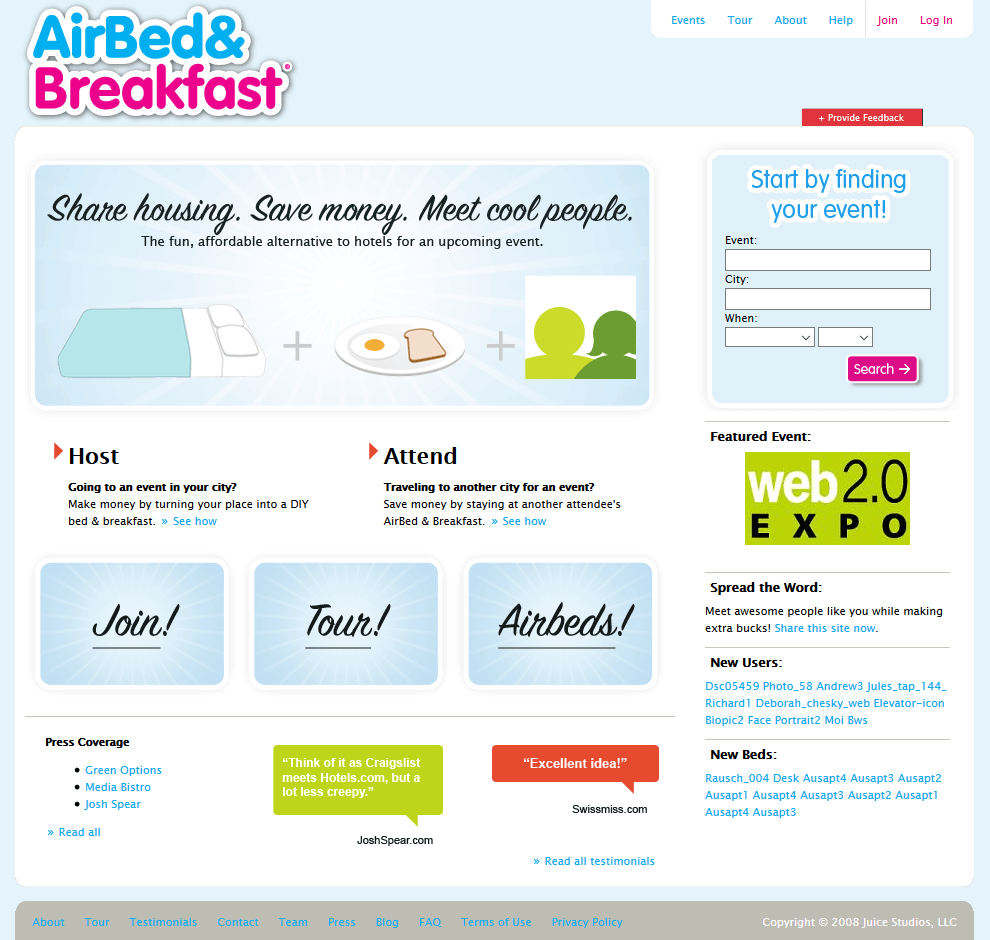
In 2007, the founders of Airbnb noticed that every hotel in San Francisco was fully booked during a design conference. Would people pay to stay in a stranger's home instead? To find out, they put air mattresses in their own living room, put a simple landing page online and advertised it as "Air Bed & Breakfast". They handled everything by hand: they took the photos, talked to the guests, prepared breakfast and acted as concierges for their own little hotel.
They learned that travellers are willing to pay for cheaper and more personal alternatives to hotels, that building trust between strangers matters most and that people value authentic experiences and details. These insights later shaped their entire business model.
Sell Before You Build
You ask people to commit with their wallets, time or other resources before the product exists, sometimes before you even have a prototype. If they pay for something that isn't there yet, they pull the product forward instead of you pushing it onto them. A nice side effect: the money helps fund early development.
Uncertainty: Viability: will people pay, and enough of them? Desirability, too: do they pull the product forward?
Explore or validate: Validate. Money changing hands is the strongest evidence you can get.
Level of reality: Highest. Customers pay before the product exists.
Customer investment: Financial. Deposits, pre-orders, crowdfunding pledges.
What you need: A convincing promise, such as a Landing Page, a sales brochure or a crowdfunding page, and a way to take the money.
What you measure: Deposits, pre-orders and the conversion from pitch to payment.
On your Validate Card: The last two examples in Validating Hypotheses are sell-before-you-build experiments: ten deposits of €100 after 20 sales pitches, and 500 pre-orders on Kickstarter.
Example: Tesla Roadster
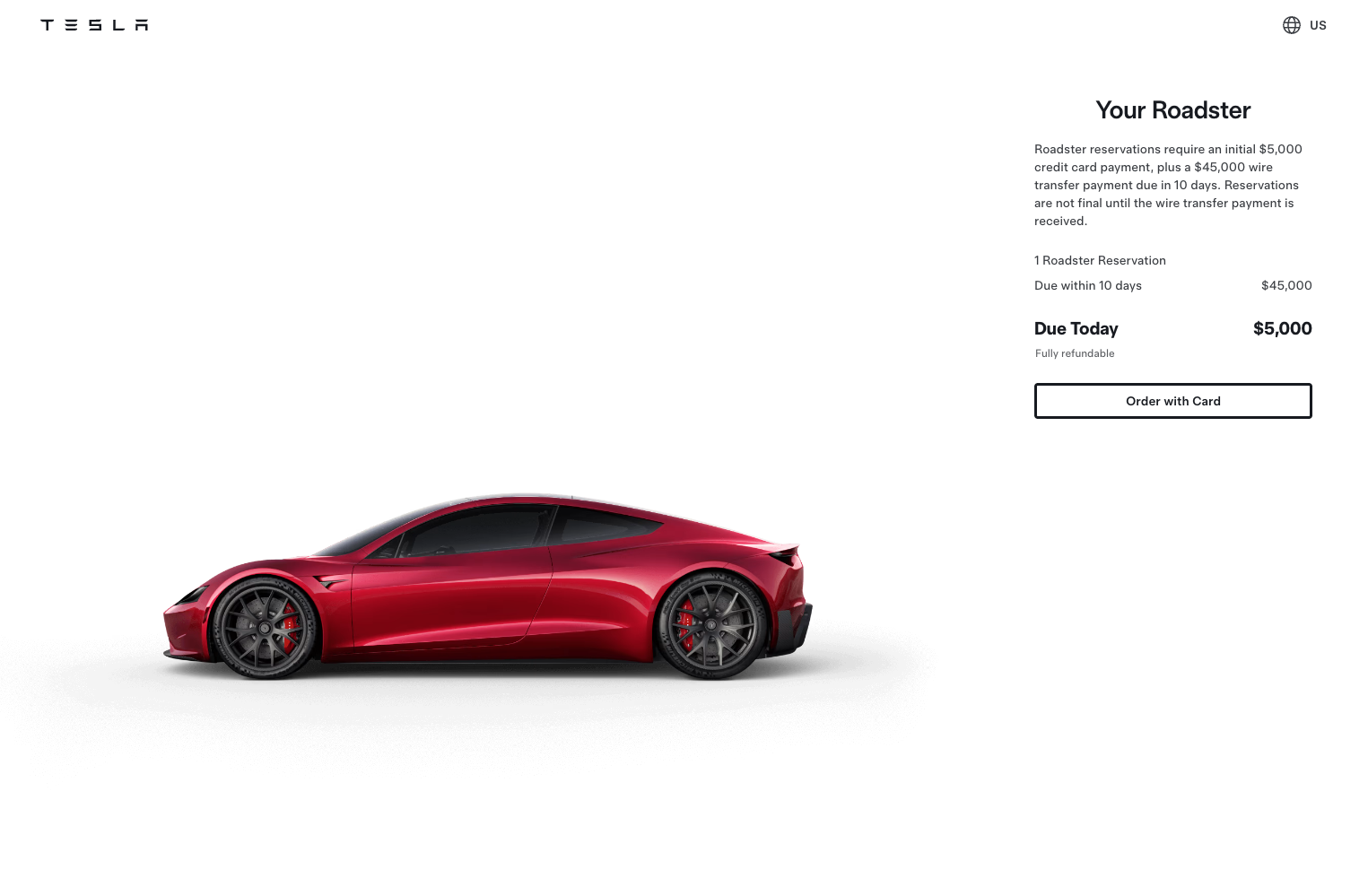
One of the best-known sell-before-you-build experiments is the Tesla Roadster. As a young start-up, Tesla was building an entirely new kind of car: a high-performance electric sports car. To find out whether people wanted it (desirability) and to finance production (viability), Tesla sold before it built. It revealed the Roadster in 2006 and asked the first customers for a deposit of $100,000 — long before production was ready. By 2008, it had over 1,000 reservations: proof that early adopters were excited about a fast electric car that was different.
Tesla repeated the playbook with the Cybertruck. Selling before building has become a core strategy for testing desirability and viability — and for financing innovation.