
Project Charter "Exploration"
Six weeks, one playground and a sponsor who expects everything. The charter is where you settle that — before the project starts. Check out what such a charter can look like.
Content
1. Overview
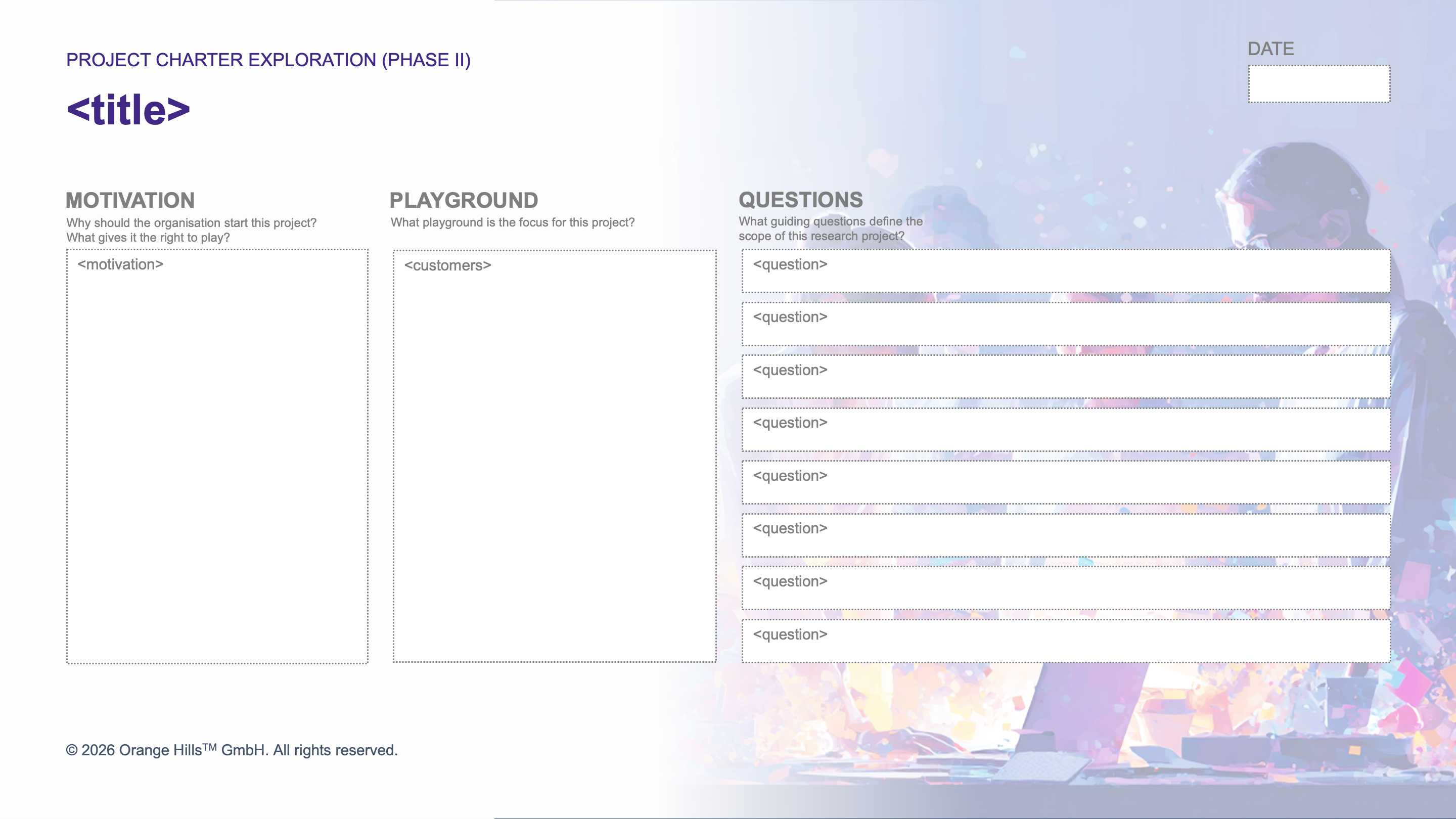
The Project Charter "Exploration" is the specific variant of the Project Charter tailored for a "Playgrounds & Exploration" project in Phase II of the End-to-End Innovation Process. While the general Project Charter concept applies to any project setup, the version for this phase is designed for the preparation of early-stage explorative research work.
The charter is jointly developed and signed by the Project Sponsor and the Team Manager. It represents a commitment: the sponsor provides the entrepreneurial challenge, resources and political cover; the team commits to delivering fact-based insights within the agreed timeframe.
A good charter goes through several iterations before the project starts. Don't rush this. The Team Coach is involved in shaping the charter to ensure focus and scope fit into a single project.
2. Layout & Download
3. Key Elements
The Project Charter "Exploration" addresses six core questions. Each element serves a specific purpose — skip one, and your research project will have a blind spot:
Motivation: Why are we doing this now? Be specific: market pressure, competitive threat, new technology or a concrete business challenge. "Because innovation is important" is not a motivation.
Playground: What playground is the focus for this project? Every research project should be based on a specific playground derived from a future vision (Phase I).
Scope: How broad or how deep does the project go? Six weeks are fixed, so breadth is paid for with depth. Agree on one of the three scopes — scanning, T-shaped or deep-dive — described in Exploring Playgrounds, and write it into the charter. A team that knows its scope can say no to a good question that doesn't fit — and knows where to park it.
Questions: What guiding questions define the direction of this research project? Within a playground, questions may arise that are worth exploring to develop new ideas for innovation. These questions can target technological, regulatory, competitive, market or commercial aspects of new playgrounds.
Resources & Stakeholders: Who is on the team and how much time do they get? Minimum 1 day per week per Team Member. No exceptions. Make sure every team member has confirmed their availability before the charter is signed.
Schedule: When does the project start and what are the milestones? Fix the workshop dates first, then work backwards. An explorative research project needs all dates locked before it starts.
4. How to Write a Strong Charter
Start with the sponsor's motivation or pain. The best charters emerge from conversations, not templates. Sit down with the sponsor, ask probing questions and translate their answers into the charter format.
Sometimes, project sponsors have a hidden agenda and misuse a research project to underpin their predetermined option or ideas. Research should have a clear frame but should not be restrained by what we expect to see as results.
Try to explore a new playground from as many perspectives as possible. However, we often distinguish between technology-driven and market-driven research projects, since very different experts are usually required for the two types of projects.
Decide the scope before the charter is signed, not after the Kick-off Workshop. Once the team is in the room and curious, every additional research area sounds worth having.
Keep in mind
Don't forget to discuss Step 1: Setup with the sponsor early on. Are you aiming to create project results, enable people or stress-test the system? This decision shapes the entire charter. You can't optimise for all three at the same time.
5. Usage Scenarios
Setting up a new "Playgrounds & Exploration" project with the sponsor
Aligning expectations between sponsor, Team Manager and Team Coach before the Kick-off Workshop
Presenting focus and scope of the research at the kick-off workshop (Phase II)
6. Instructions for Coaches
Don't accept a charter at face value. Your job is to challenge and sharpen it. Schedule at least two rounds of revision with the sponsor and Team Manager before the project starts.
Watch out for charters that try to cover too much ground. The number of questions should be related to the time and resources available to execute the project, and to the scope you agreed on. Again, we often distinguish between technology-driven and market-driven research projects to make the setup of such projects easier.
Check the stakeholder section carefully. Every Team Member listed should have confirmed availability of at least 1 day per week. If someone says they are "very busy but will try to make it work" — that's a red flag. Discuss this openly with the sponsor and, if needed, replace the team member before the project starts.
Make sure the sponsor understands what signing the charter means: full commitment to attending at least the Kick-off Workshop and protecting the team from organisational interference during the project.
7. Q & A
What if the Project Sponsor wants to start immediately without a proper charter?
We don't start. A project without a clear charter is a project without direction. Take the time to get it right — even if it means delaying the start by one or two weeks.
What happens if the project focus changes during the project?
Minor adjustments are normal — if new questions come up during the project, go for it. If the focus changes drastically, keep the project sponsor in the loop.
What happens if the project sponsor has too many open questions?
First of all, we are very happy when sponsors understand the value of raising questions and doing proper research work. Remind the sponsor that we only need "guiding questions" that help the team come up with more detailed questions during the project.The sponsor wants both breadth and depth. What do we do?
Make the trade-off explicit instead of promising both. Six weeks buy you either several research areas at a scanning level or one area worked through properly. Ask the sponsor which decision the results have to support — that usually settles it. What doesn't fit becomes the candidate for a follow-up exploration.