
Roadmap for Implementation
Turning an organisation into a vibrant innovation hot spot is a challenging task. It takes many ingredients to build an efficient and effective innovation management system. This section of the knowledge base shows how Orange Hills designs and implements modern innovation management systems based on Business Design.
1. Overview
Bringing Business Design into an existing organisation is not easy. This chapter presents variants on the sequence in which you can implement an innovation system in a business unit or an entire company. In general, it pays off not to roll out an innovation system in one big "big bang" push, but to proceed step by step and regularly assess successes and possible setbacks — then draw conclusions for what happens next. Leaders and employees don’t just learn about innovation work: they live it, defend it against resistance and keep professionalising it over time. That takes commitment, time and patience.
Variant A: The transformation initiative starts with hands-on project work in one of the defined phases of the End-to-End Innovation Process – for example Exploring Playgrounds, or running a Sprint on an existing idea. This gives us an authentic read on every strength and weakness of the organisation, which we then use to adapt both the innovation system and the transformation plan. After the project work, we can jump back to the start of the end-to-end innovation process, begin developing or adjusting a Picture of the Future and establish every step that follows. This variant is the famous "leap into the deep end". Everyone involved needs to know that early pilot projects run through plenty of ups and downs before the innovation system has further, established structures in place.
Possible phases:Planning, running and reflecting on a pilot project: around 15 weeks
Adjusting the innovation system, including alignment: around six weeks
Developing a picture of the future and deriving playgrounds from it, including Leadership training: around six weeks
Planning research projects for selected playgrounds: around 12 weeks, etc.
Variant B: The transformation initiative starts by building an idea Portfolio. This is often a rewarding starting point, because organisations usually already have plenty of ideas on hand, and you can build on existing results without having to change how people think or work. You see progress fast. Once the portfolio is built, you can plan and decide on next steps for selected ideas in it – for example Step 2: Deep Dives or sprints. Assessing the idea portfolio also surfaces early insight into whether developing a picture of the future, exploring playgrounds or other steps makes more sense next. Typical patterns in an idea portfolio include:
"Idea clusters": Many ideas are closely related – for example, they target the same customers or use the same technologies. Here it makes sense to explore the underlying playground, and to design follow-on innovation projects (for example "Sprints") so they capture synergies at every project phase.
"Idea gaps": The ideas turn out to cover only certain areas of the Portfolio – incremental ideas that optimise the core business, for instance. That can create a need to develop more disruptive ideas and add them to the portfolio.
"Evaluation dilemma": There are plenty of ideas, but the idea portfolio’s evaluation criteria are hard to apply. The basis for a proper assessment seems to be missing. That can point to developing a picture of the future, or setting long- and short-term goals, as the better next step.
Possible phases:Documenting existing ideas and building the portfolio: around six weeks
Reflecting on the ideas and deciding on next steps: around four weeks
Starting Step 2: Deep Dives to flesh out selected ideas: around four weeks, or starting a sprint to validate the idea: around 12 weeks
Developing a picture of the future and deriving Playgrounds from it, including leadership training: around six weeks, etc.
Variant C: The transformation initiative starts "classically", by designing or adjusting a picture of the future and then works step by step through the individual phases of the end-to-end innovation process. Professional training and change management accompany every phase you introduce. The advantage of this variant is that you skip no step, and work through each phase. Every step follows logically, which makes the transformation initiative easier to understand. The challenge, as with Variant A, is that this puts the relevant Leadership Team on unfamiliar ground fast, and needs a visionary leadership style. Without that, a picture of the future stays a nice visualisation with little effect on the organisation – and that can put the whole transformation initiative at risk.
Possible phases:Developing a picture of the future and deriving playgrounds from it, including leadership training: around six weeks, etc.
Planning research projects for selected playgrounds: around 12 weeks, etc.
Developing new ideas and building a portfolio from existing and new ideas: around three weeks
Reflecting on the ideas and deciding on next steps: around four weeks
Starting Step 2: Deep Dives to flesh out selected ideas: around four weeks, or starting a "Sprint" to validate the ideas: around 12 weeks
Keep in mind
Adjust the time frames above to the specific circumstances of the business unit. Treat them as minimum estimates.
2. Example
The illustration below shows a typical timeline for a Variant A implementation project over 12 months. We start with pilot projects instead of an extended analysis. This lets us learn under real conditions what works in today's corporate culture – and what doesn't – and adapt the innovation management system based on these learnings. The result: systems that fit the organisation's strengths and deliver results.
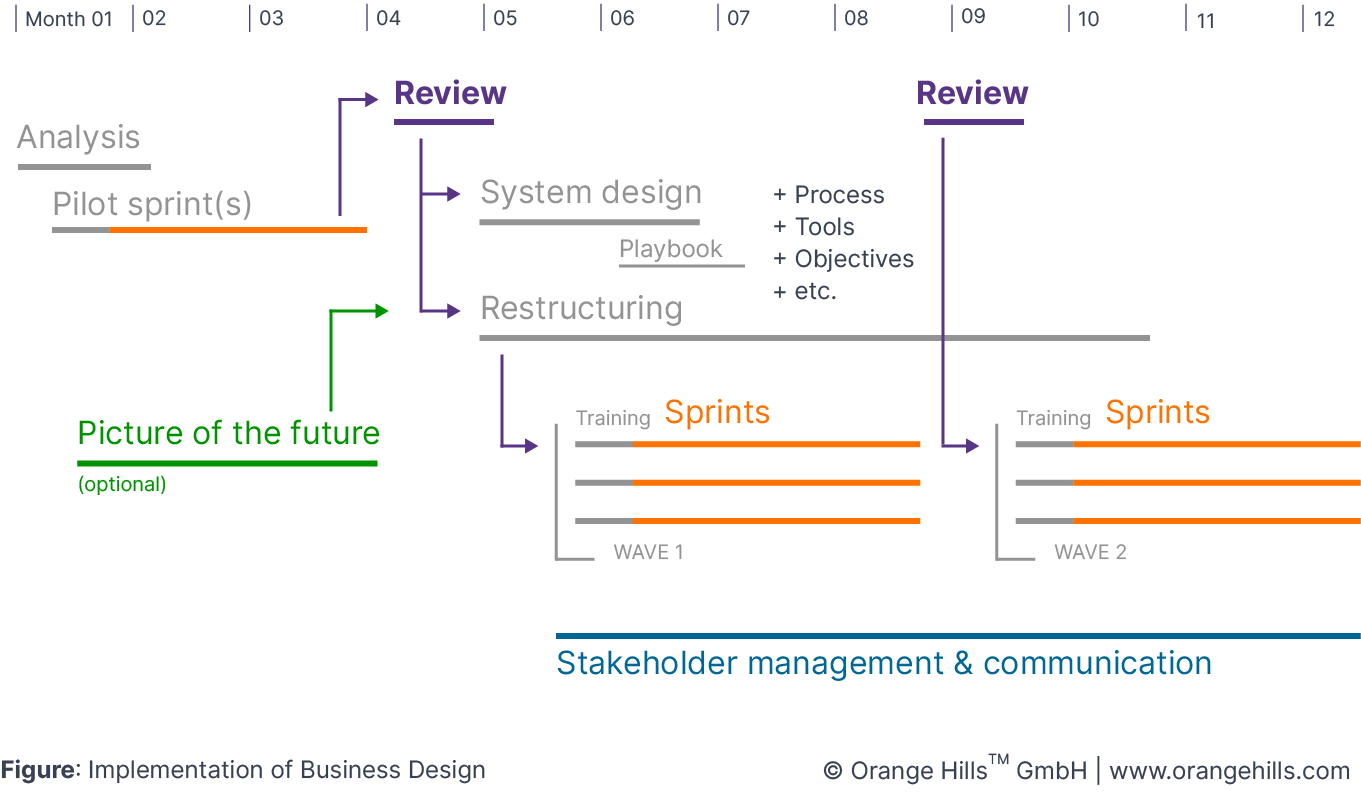
Here is a more detailed overview of the key activities:
Phase | Activities | Duration |
Analysis |
| 3 weeks |
Pilot sprint(s) | Typical Business Design projects with a "not too complex" setup for two purposes:
| 10 weeks |
Series of workshops with management and selected employees (or input from other strategy initiatives) incl. objectives and KPIs | 6 weeks | |
Idea Portfolio | Usually, organisations don't have a lack of ideas. The task here is to take existing ideas, document them in standardised format and put them on an idea Portfolio | 3 weeks |
System design | Definition of the organisational setup for innovation activities, including processes, tools and methods. The entire system is documented in a System Playbook | 6 weeks |
Implementation and restructuring | Ongoing restructuring process to implement the innovation management system design | 5 months + X |
Sprints | Consecutive "waves" of Business Design sprints, run in the usual format | 10 weeks per wave + setup |
Review | Definition of implications for the system design, based on real-life learnings from the projects | 2 weeks each |
Stakeholder management & communication |
| ongoing |
3. Common Pitfalls
To make sure the transformation process works as smoothly as possible, we've collected a set of challenges we keep running into — challenges that, at the end of the day, have seriously derailed Business Design efforts. Here are the most important ones:
Goal and commitment don't match: A C-Level Manager declares innovation work a priority, but the resources available aren't just too scarce — they show a complete misunderstanding of what successful innovation work actually requires. Despite new tools and the possibilities of artificial intelligence, innovation work needs people and teams with a clear strategic direction, time, resources and psychological safety to perform. People need to be prepared to become innovators. These basic conditions are often not met.
Too much focus on ideas, not Leadership and Work Culture: Numerous companies believe their biggest challenge in building innovation management is coming up with exciting ideas. They study trends, fill idea portfolios and evaluate them with elaborate methods. This is usually a wrong assumption. The biggest challenge isn't a shortage of exciting ideas — it's people. We hope that leaders whose actual job is to preserve and grow the core business will automatically become visionary leaders and play that role well. We hope that employees hired to perform single tasks in a highly fragmented system will suddenly turn into intrapreneurs who boldly explore new ideas. C-level managers and middle managers, above all, need to understand what's really stopping their organisation from developing innovation. And that analysis has to include themselves, their people and their own organisation.
Evolution "from the bottom up": We often hear C-level managers say things like: "Innovation work has to be fun. We need to win people over. Let's create "quick wins" first. I don't want to force anyone — innovation needs freedom and volunteers." However good these sentences sound on their own, this way of thinking usually leads to… nothing. It won't happen. In other areas of corporate life, there are many things that are "defined", "guided" and even "forced". And for innovation, there is no difference at all. Innovation is hard, often beyond people's comfort zone and sometimes even a good way to ruin your career — thus, innovation needs to be managed, needs clear leadership and preparation. It needs more than passionate fighters on the ground; it needs leaders who demand innovation, actively build the innovation culture they want and show every day how much innovation work matters to them — through behaviour, not just words. You don't believe us? Try it.
Innovation work = new business unit: For new topics, companies often set up a new business unit or invent new Roles — "Chief Innovation Officer" or "Chief Digital Officer" are examples. There's nothing wrong with these roles as such, but they reveal the underlying mindset: the core business stays as it is, and innovation happens somewhere else. For very radical ideas far from the core business (H3), this may well be the right move. But most innovation work doesn't happen in an "incubator", a "co-working space" or a "venture clienting" project — it happens where the fire is burning. Where's that? In the core business. And that's where you need to enable the relevant roles and bring them along on the innovation journey.
Agile working — in language only: Many companies introduce agile working methods with significant effort. Business Design, too, is shaped in large part by agile principles. In practice, though, we often see that after such a rollout, only the language of agility survives — while the way ideas get developed, projects get run and budgets get planned and decided still runs on classic, linear stage-gate logic. Example? Here it is: Even when introducing Business Design, we see that in Phase IV (Validation & Refinement) many companies run just one iteration per sprint. A single one, per project! And then the light at the end of the iteration has to switch to either green or red. Sometimes there are only green lights, because the ideas were cherry-picked in advance to be the ones the company wanted to pursue anyway. Real validation? No. Reality? No, thanks. If this is how it always goes, agile working — in the sense of systematic learning — is dead on arrival.
Poor field research: Especially in research projects, we regularly see how bad research leads to even worse decisions. It may sound strange to practitioners, but Business Design research needs a precision similar to that of a scientist — that's exactly why this knowledge base exists. Bad research is worse than no research, because it makes us take "fake facts" seriously that aren't facts at all — and then make decisions that hurt us. Research methods get misapplied all the time: exploratory and validating research get mixed up, sample sizes get miscalculated, customers get asked bad questions they can't actually answer and data gets analysed in a completely inadequate way. AI can finally give Project Teams a huge boost here, but Business Design teams still need a solid grasp of how to plan and run research professionally.
Fear of the customer is fear of the truth: We've heard plenty of reasons why you supposedly shouldn't talk to customers while developing a new idea: ideas get stolen, the customer doesn't know what they want, it takes too long, we're not allowed to do that without sales involved — blah, blah, blah. Behind it, usually, is fear. Fear that too much reality during validation could discredit the value of their own idea — and, with it, the person who came up with it. We have to address these fears, because they get in the way of Business Design and of clean, professional innovation work.
The ill-designed failure culture: Many companies know that a failure culture matters — that not every innovation project can be a success. But this sometimes leads to a failed project being talked about, reflected on and dissected so much, in the name of "failure culture". Over and over and over again. The people involved end up permanently associated with that one project. The project keeps getting cited as the example whenever something doesn't work. The colleagues keep getting named whenever something fails — always, of course, under the banner of "failure culture". No — that's not a failure culture, that's branding people. In a real failure culture, failures happen because, say, someone was bold enough to take a risk; the team reflects on them, draws conclusions and moves on. No uproar, no endless talk. Just get on with it.
4. Q & A
Which variant is the right one for us? The one that matches where the evidence and the energy already are. If the organisation has plenty of ideas but no agreed direction, start with Variant B – the Portfolio shows you within six weeks what is really there. If the organisation doubts that innovation work can happen here at all, start with Variant A: one pilot produces more proof than three months of analysis. Variant C only pays off when the leadership team is already willing to lead visionary – otherwise the Picture of the Future ends up as a poster.
Can we combine the variants? Yes, and most transformation initiatives do. The variants describe where you start, not a track you have to stay on. A portfolio that runs into the "evaluation dilemma" leads straight into a picture of the future; a pilot sprint that stalls on unclear playgrounds leads into Phase II. Decide the next step after each phase, on what you learned – not at the beginning, on paper.
We only have six months, not twelve. What do we cut? The number of parallel projects, never the sequence. Run one pilot instead of three, pick two playgrounds instead of six, put fewer ideas on the portfolio. What you must not cut is the review after each phase – a transformation initiative without reflection produces activity, not a system.
How do we know it's working? Not by the number of ideas. Count decisions: how many ideas were stopped on evidence rather than on opinion, how many teams actually talked to customers, how long it takes from idea to a funded next step. Set these measures up front, together with the objectives in Measurement of Success & Progress.