
Step 2: Deep Dive
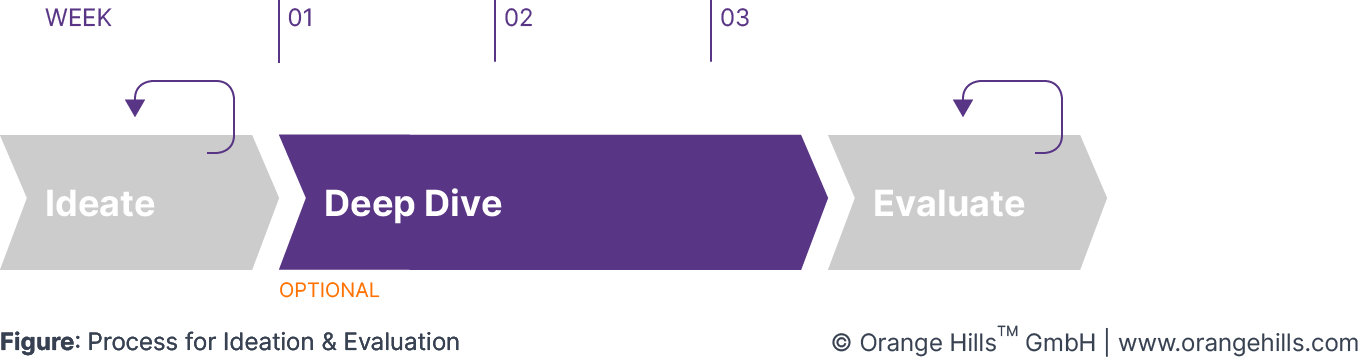
1. Purpose
When developing new ideas, it happens again and again that ideas aren't described clearly or tangibly enough. Applying evaluation criteria becomes almost impossible, because the idea still leaves too much room for interpretation among those involved: "A platform for data exchange among manufacturing companies" is an idea, but it doesn't create a clear picture of what this platform could look like, who it serves and what problem it's meant to solve. In this case, we surface more detail in a short project setup, so we can evaluate the idea properly in an idea portfolio. At the start of a "Deep Dive" project, we bring together a Project Team of 2 to 3 people and ask fundamental questions, such as:
Who is the idea's target group?
How many people or companies make up this target group?
Which problem of the target group should be solved or eased?
How relevant is this problem to the target group?
How much money does the target group already invest in solutions to this problem today?
Can the solution idea be built with our own resources?
Who is already working on comparable solutions today?
How successful are these companies?
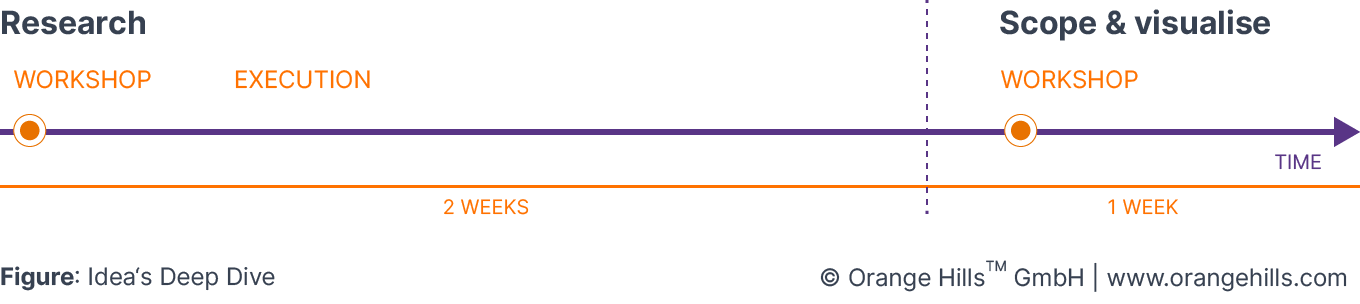
Next, the project team prepares for a research phase, in which we gather initial answers to these questions. Research tasks may include:
Doing interviews with potential customers and users
Conducting desk research around potential competitors
Gathering existing research on the topic (internal and external)
Having conversations (over a coffee) with a handful of experts
This step isn't about validating the idea — it's about describing the idea more tangibly and collecting first data that helps us, if needed, kick off the next fitting steps in the End-to-End Innovation Process. This could be, for example, a project in Phase IV. Once the research phase wraps up, we describe the idea in detail using the research results and, if needed, have a designer visualise the problem and solution space. Finally, the idea lands in the idea portfolio.
2. Duration
2-3 weeks
3. Participants
Designer (optional)
4. Tools & Materials
Similar to Step 2: Discover of Phase IV
5. Instructions for Coaches
Don't confuse Deep Dives with validation: In such a short timeframe, you can't validate ideas. The results wouldn't just be weak — they'd be misleading.
Ask only fundamental questions: Don't dive into highly specific questions too early in a Deep Dive without first challenging the big picture. The detail work comes in later phases.
Take care that visualisations or prototypes don't dazzle decision-makers: Once an idea lands in the Portfolio, decision-makers shouldn't be swayed or distracted by flashy designs. This isn't a beauty contest at this stage.