
Step 3: Evaluate
1. Purpose
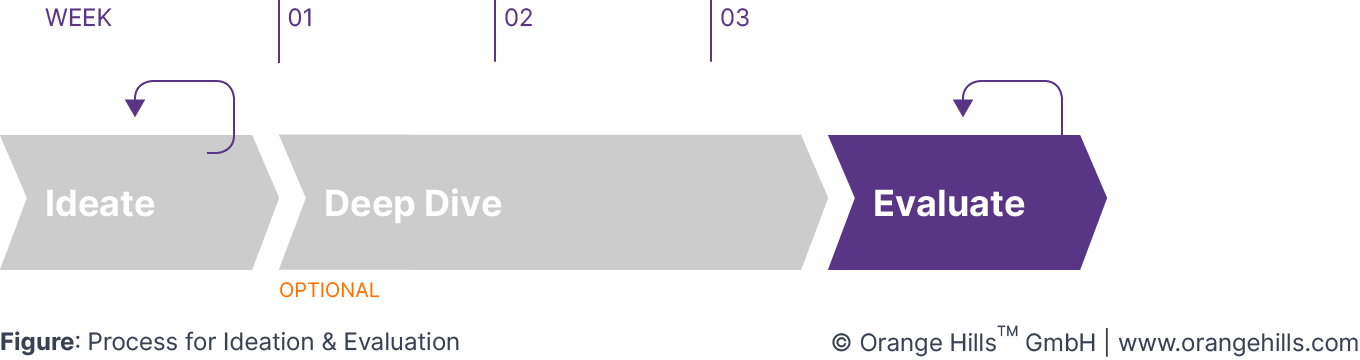
The final step of Phase III is portfolio evaluation. The management team discusses and evaluates new entrants, and revisits existing ideas to update their evaluation based on project outcomes and new learnings. At the end, management decides which ideas move straight to execution (Phase V) and which ideas go through proper validation (Phase IV) to test them systematically against their key hypotheses. Document every idea on the Portfolio in the same format. The Idea Charter template helps you do this.
What matters most at this point in the process: participants take the perspective of an investor. A portfolio is nothing more than an opportunity-risk assessment. Favour ideas with high opportunity and low risk. But the evaluation at this stage is rarely a final decision – it's a decision about the next sensible step. What you're really deciding is which idea moves forward, and in what form. The following questions are the ones that count:
Which idea is concrete enough to be evaluated? (If not: Step 2: Deep Dive)
Which idea has a particularly strong strategic fit and a relatively short distance to success, and therefore deserves focus? Reposition the idea on the portfolio accordingly!
Does a focused idea carry high uncertainty that we should reduce before we invest?
Can an idea be implemented quickly, because no major uncertainty threatens its success?
Does the organisation still have enough resources to take on another idea?
Can an idea be removed from the portfolio entirely, because it no longer has any relevance?
Discuss these questions in a regular meeting with the leadership circle – typically C-Level Managers and the Innovation Manager. You'll find an example agenda at the end of this article. Depending on how fast your industry develops, hold this meeting one to four times a year. Make sure every participant has access to the portfolio and to the relevant idea charters. Participants should come prepared – not hear about an idea for the first time in the meeting. Document every decision in the minutes.
Keep in mind
Investors are risk-takers. Innovation always comes with risk and uncertainty. There is no free lunch: the more risk you take, the more upside potential you can reach. None of this is new, but managers sometimes behave differently. Asking for a detailed business case before it's warranted is a typical example. Yes, business cases are great and important – once you actually know what you're talking about. Too often, though, the request comes too early. We need to validate and refine ideas first (Phase IV), before we can crunch the numbers.
2. Duration
In regular meetings (see example agenda below)
3. Participants
Team Manager (on request)
4. Tools & Materials
5. Example Agenda
Time | Activities | Format* | Stakeholders |
|---|---|---|---|
09:00 - 09:15 | Welcome and introduction to the meeting | P | |
09:15 - 10:00 | Status reports of running innovation projects | P | |
10:00 - 11:30 | Presentation and evaluation of new entrants to the portfolio | D | |
11:30 - 12:00 | Decisions on ideas in the "focus area" | T | All |
12:00 - 12:10 | Wrap-up | B |
* P = Presentation | D = Discussion | B = Break | T = Teamwork