
Step 1: Ideate
Content
1. Purpose
Developing ideas is a fundamental step in any innovation process. Without an idea, there is no innovation. But ideation usually gets far too much weight. Once you have worked through building a future vision with a strategy and goals (Phase I) and the foundational research on your playgrounds (Phase II), deriving new ideas is not a complicated task. They usually emerge on their own, without applying any fancy creativity techniques. We have nothing against methods like brainstorming, the 6-3-5 method or a morphological analysis. They just don’t replace the systematic preparation of phases I and II, and in most cases you won’t need them. But without a picture of what your own organisation should look like in X years, without a clear idea of success, and without results from research into customers, market or technology, you have no basis to develop and evaluate ideas. Every idea is then somehow right, or somehow wrong. You can barely tell sense from nonsense. In summary, we can say that developing ideas only makes sense when:
there is a future vision for the organisation (phase I)
success (long- and short-term) is defined (phase I), and
we have inspiring results from exploratory research into relevant playgrounds (phase II) that we can translate into ideas.
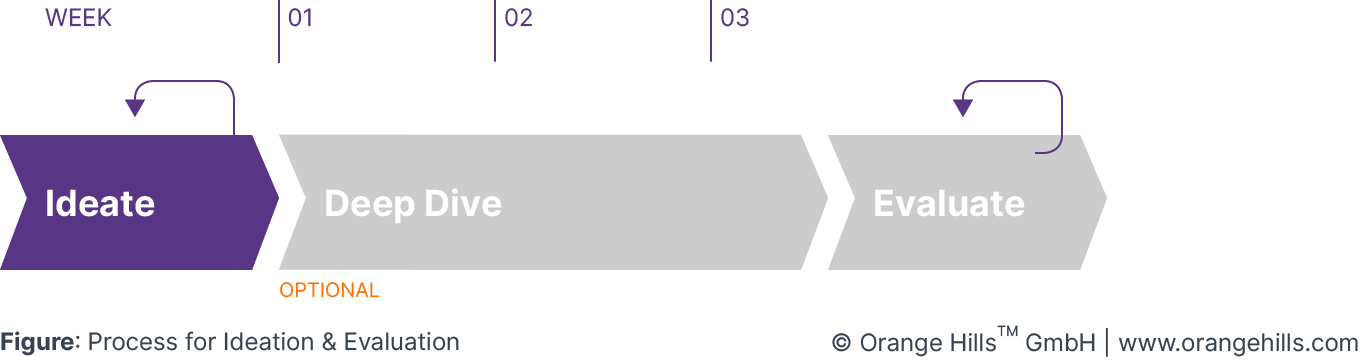
So make sure every ideation effort has a clear focus. Developing ideas can happen in Ideation Workshops, where a small group of selected experts works together for 6–8 hours. Ideally, these people were also directly involved in the preparation and have insight into the research results. At the end, we document every idea in a standardised “Idea Charter”. We apply the evaluation criteria to reflect once more on how well the ideas pay into the future vision, goals and KPIs. You may need to cluster and synthesise some of the ideas first. We also update the Portfolio with the new entries and try to evaluate the ideas (Step 3: Evaluate). If we can’t evaluate an idea, we often continue with short deep dives (Step 2: Deep Dive).
2. Duration
Ideation Workshop: 6-8 hours
3. Formats
4. Participants
Designer (optional)
5. Tools & Materials
Creativity Techniques (optional support for the ideation itself)
6. Instructions for Coaches
Don’t skip the preparation: An Ideation Workshop only works if the future vision, success definition and playground research are already in place — check this before you schedule the session.
Keep the group small: a handful of selected experts who already know the research, ideally the same people who helped shape it.
Push back on trigger questions that hide a solution or that are too broad to give the ideas real direction. A good trigger question names the problem and the benefit for a specific target group — nothing more, nothing less.
Bring in a designer if you can: Real-time sketches and storylines keep the energy up and make ideas tangible immediately.
Close every workshop with documentation: An idea that isn’t captured in the Idea Charter and the Portfolio doesn’t count as an outcome — and don’t force an evaluation you can’t make yet; schedule a deep dive instead (see Step 2: Deep Dive).