Demo or Die
Demos, visuals, alphas, betas, models, prototypes — all different words for the same thing: visual representations of a new idea. We learned over the years that they can make all the difference when you work on something new — for your idea and for your team. Here's why we build prototypes in Business Design, and what we build in each phase of the end-to-end innovation process.

1. Introduction
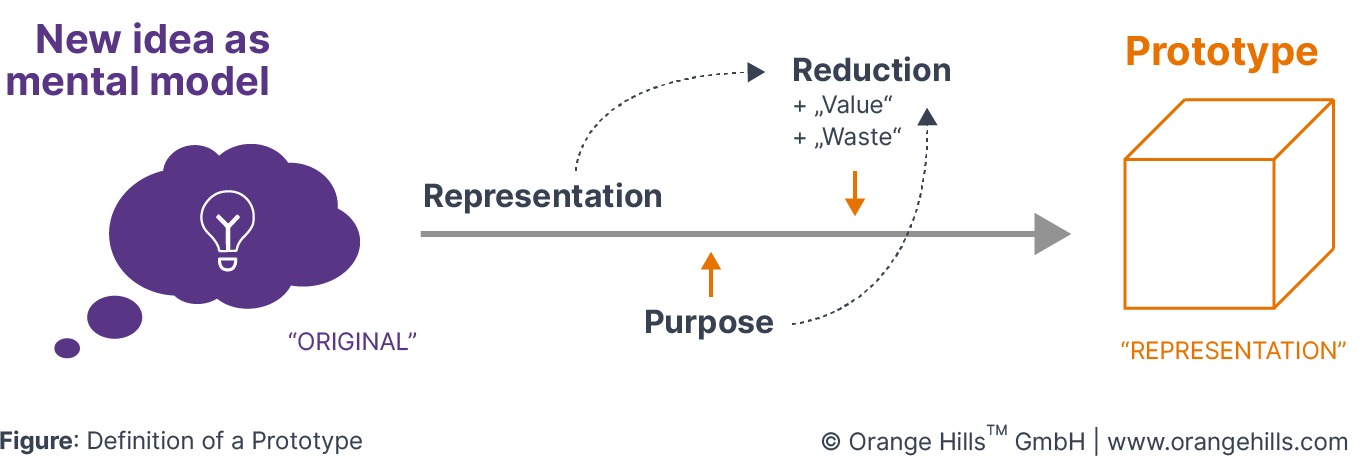
Visualising and demonstrating new ideas is one of the key activities of every innovation endeavour. Some people say: "If you can't visualise or demo your new idea, stop wasting other people's time — #nobullshit". In Business Design, we follow a very wide definition of what a "model", "demo" or "prototype" is — based on the ideas of Herbert Stachowiak ("General Model Theory"). For us, a model is a visual, reduced representation of an idea or concept built for a specific purpose. It can be a video, a presentation, a landing page or a functional prototype (see Prototyping).
The purpose can be manifold. In Business Design, it comes down to five main reasons why we build prototypes:
To make ideas tangible and understandable. Prototyping is thinking with your hands — for you and for your team.
To communicate and convince. Prototypes build a shared visual language inside the team and with everyone outside it.
To get concrete, honest feedback. Everyone responds to a prototype, and they respond precisely.
To explore and test uncertainties. Experiments with prototypes replace assumptions with data before you invest.
To form innovative teams. Building prototypes together changes how a team works.
2. The Five Main Reasons Why We Build Prototypes
Prototypes Make Our Idea Tangible and Understandable
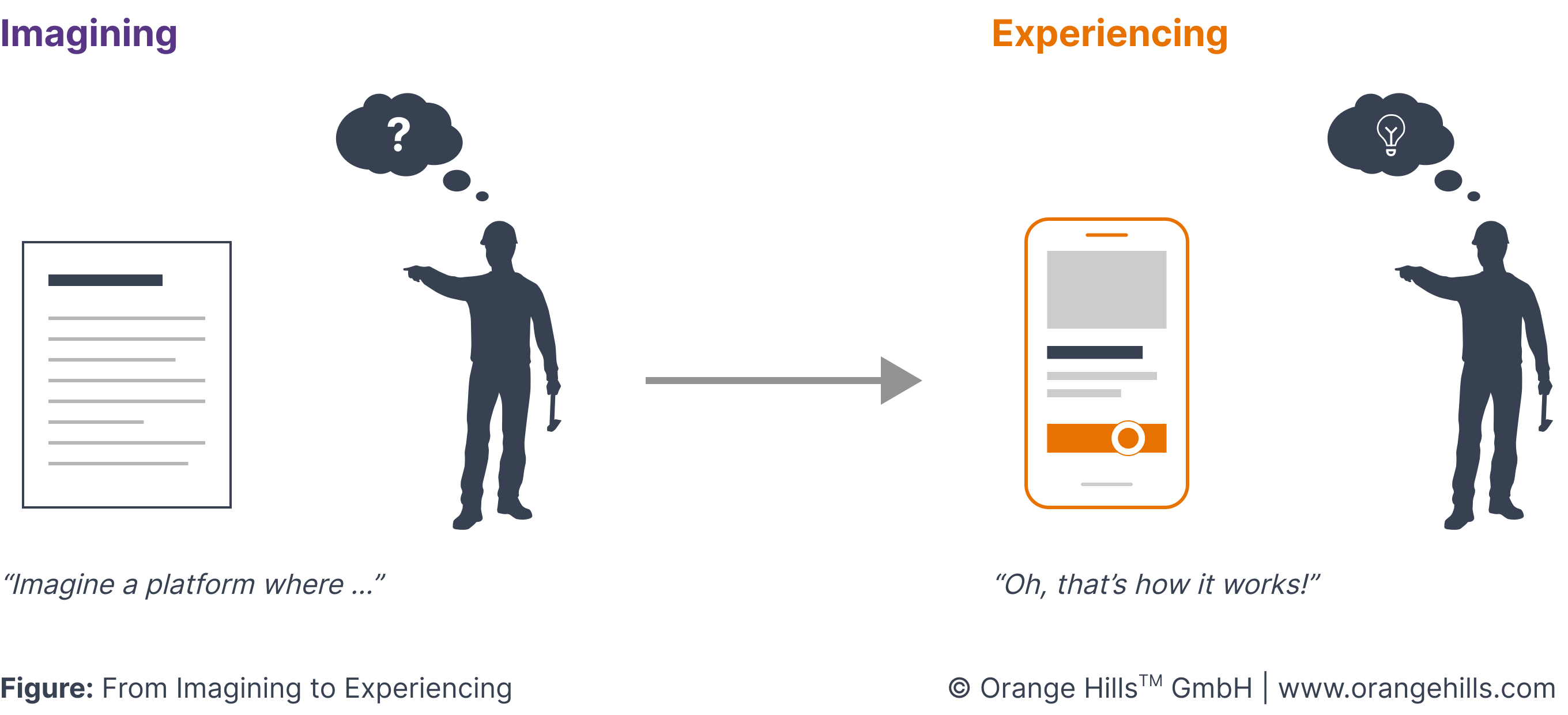
In innovation, we deal with ideas and concepts the world has never seen before — things that are fundamentally new. The problem: people are not good at imagining new things. That's why it is so important to make new ideas tangible. A prototype shifts the brain from imagining to experiencing, and that generates clearer insights, stronger emotions and more reliable feedback. It lets you feel an idea, not just think about it — and that's where you start to truly understand it.
Prototypes also support your own thinking. Building a model forces you to work through specific problems (e.g. technical feasibility) that are easy to skip as long as an idea only exists in your head.
Prototypes Help Us Communicate and Convince
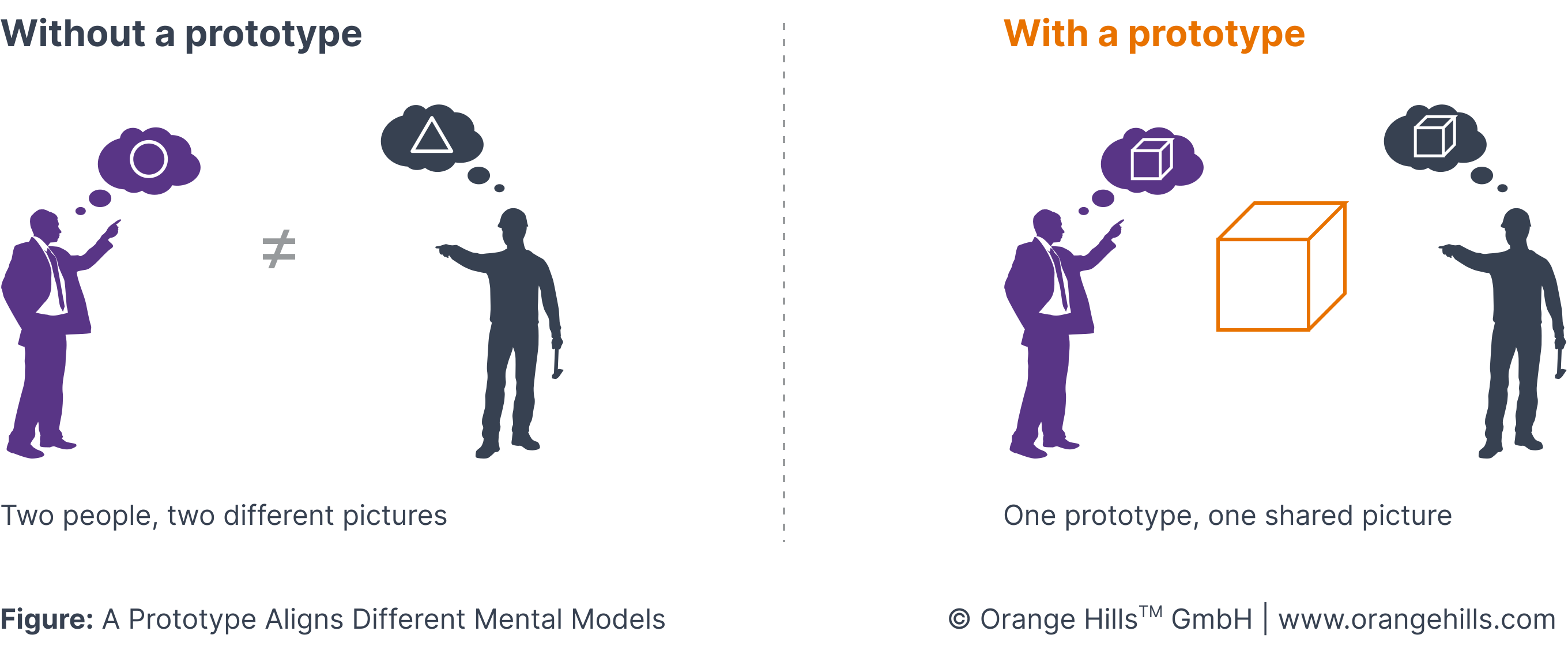
The most common use case for models and prototypes is to support interactions — within the project team and with other stakeholders such as customers, users, domain experts, investors or the Project Sponsor. All of them need to understand what you are doing and where you are heading. People take in images differently than words. Seven effects make this difference:
Order: People look at images before they read text. The first impression comes from the picture.
Speed: An image lands in a fraction of the time a sentence needs. Words get weighed and questioned along the way; an image is already in your head by then.
Attention: Images draw more attention than words. On a wall full of text, everyone looks at the one sketch first.
Activation: Images trigger emotions and associations, so people engage with the content instead of skimming it.
Comprehension: A picture shows relationships that take paragraphs to describe. A picture is worth a thousand words. Visual representations help align different mental models of abstract ideas and concepts.
Credibility: People trust what they see more than what they hear. Use this with care: it is exactly why a polished prototype can make an idea look more mature than it is (see below).
Memory: Images stick better than words. The brain stores them twice, as an image and as words, so there are two ways to recall them.
So, if you talk about "platforms", "blockchains" or "data-driven business models" without any visuals, the chance is high that different people instantly form different pictures in their heads — each shaped by their own past experience. Aligning these mental models at high speed is the foundation of any productive conversation. Prototypes get you there: they build a shared visual language, break down the barriers of technical jargon and make communication clearer, more vivid and more convincing.
Landing pages, visuals and click dummies are great tools for storytelling. In fact, a prototype cannot not tell a story. That's why you need to think carefully about how it looks, what goes into it, how you present it and how you handle the feedback it gets.
Prototypes Get Us Concrete, Honest Feedback
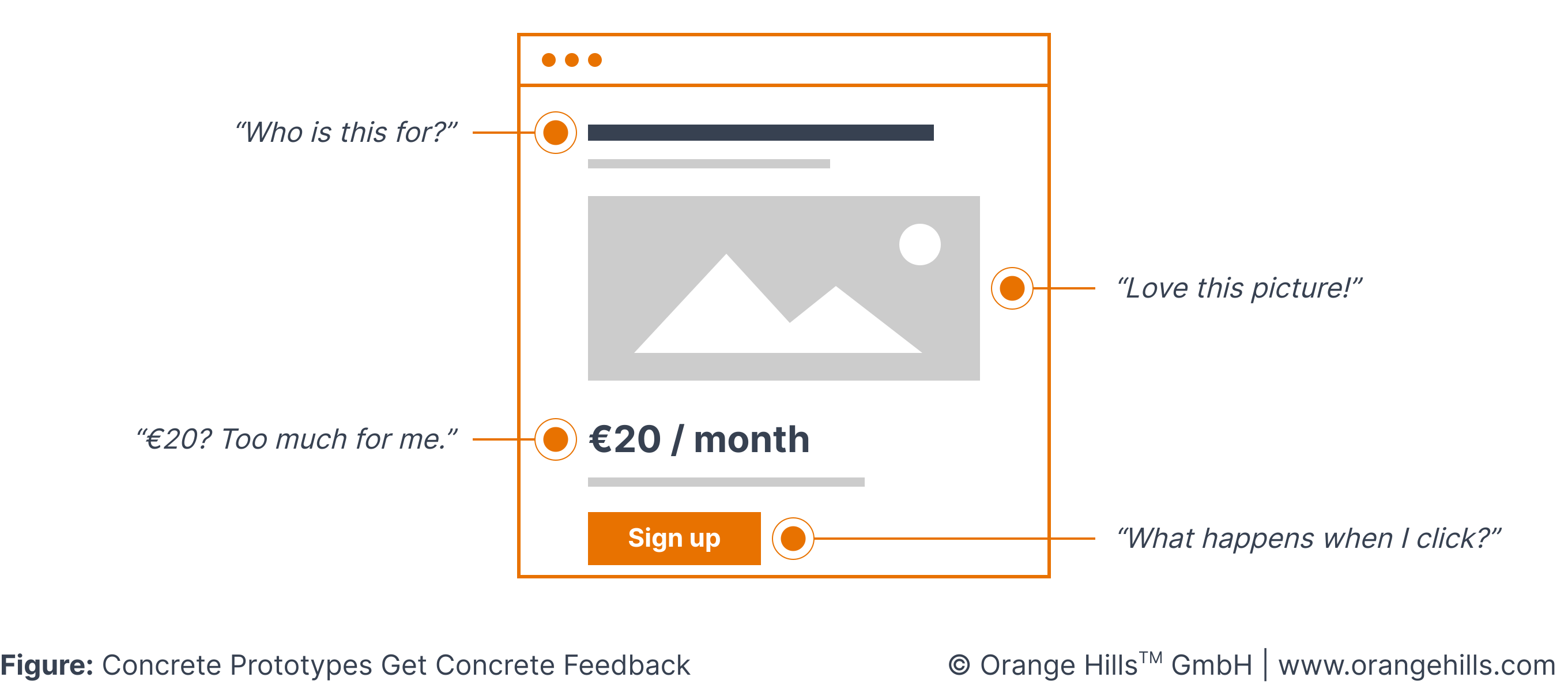
When you develop something new, you need a lot of feedback — and prototypes provoke it very efficiently. Everyone responds to a prototype, one way or another and often emotionally. That's a good thing: embrace it, because you can learn a lot from it. And since people respond precisely to something concrete, the feedback you get is more concrete, faster and more truthful.
Prototypes also let people give feedback through action, not only through words. Users often can't tell you what they want or need — but when they interact with a prototype, you see their frustrations and wishes. And prototypes encourage real critique and discussion, not just polite nods.
Be aware, though, that every prototype shapes the feedback it gets. A polished prototype with a great user interface can give the impression that an idea is mature and well thought out — even when it isn't. In Phase III, for example, flashy designs can sway the decision-makers who evaluate your portfolio (see Step 2: Deep Dive). You are framing your audience, which can be misleading when you're looking for honest feedback on open questions. You also anchor discussions with prototypes. That's not bad at all, as long as you do it intentionally and don't shift attention to less important aspects (see How Prototypes Shape Judgement).
Prototypes Explore and Test Uncertainties
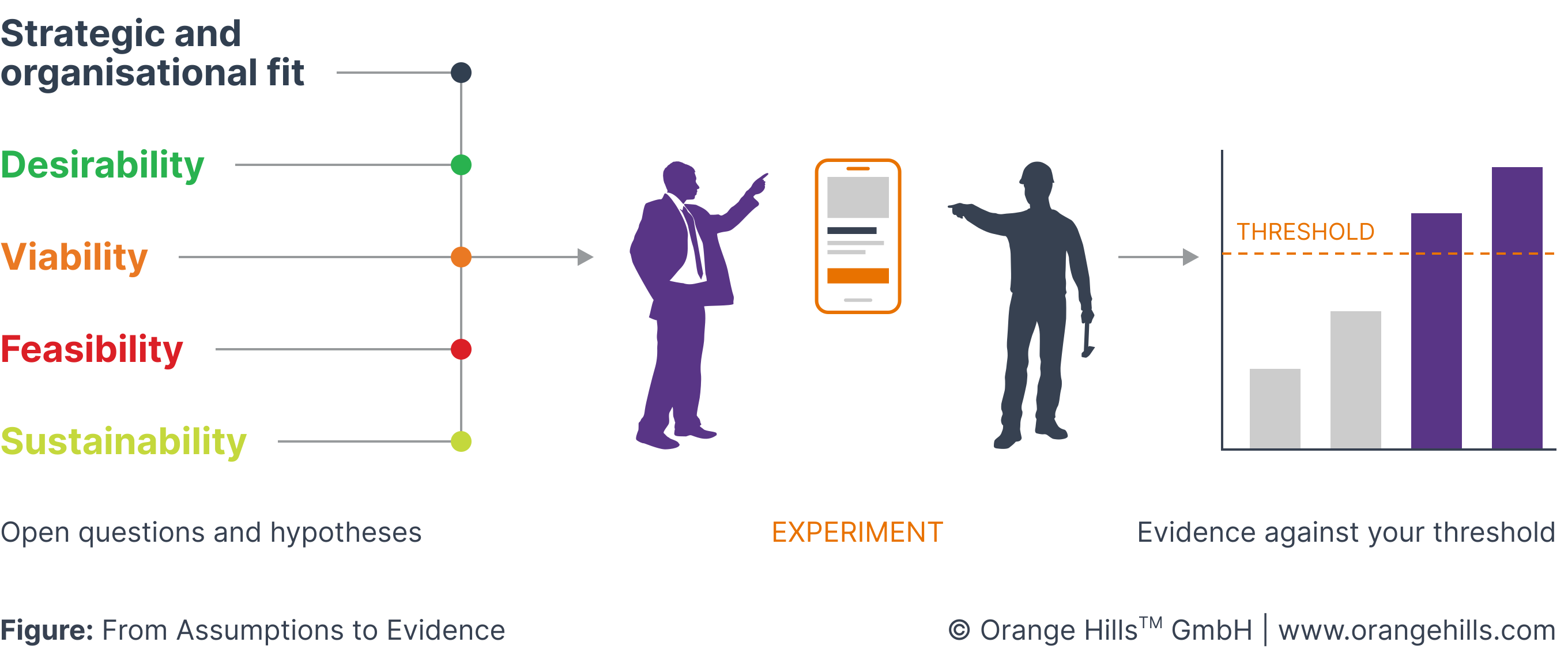
One of the most important reasons to build prototypes is to support experiments around open questions and hypotheses (see Hypotheses & Experiments). We translate parts of a business model into visual representations to simulate reality and gather data that proves or disproves uncertain assumptions. When you develop a new idea, you face unknowns in each of the five perspectives we look at from day one (see Introduction):
Strategic and organisational fit
Desirability
Viability
Feasibility
Sustainability
You can test them in a data-driven way with all kinds of experiments. Interview customers with your prototype to find out whether you are solving a real pain point for them (desirability). Turn your sales story into a landing page and run a smoke test with an ad campaign to learn about brand perception, market interest and conversion potential (desirability). Or run a fake door test or a sell-before-you-build experiment to test your customers' willingness to pay (viability). A Wizard of Oz experiment, in which your team does by hand what the technology will do later, shows you which technology you really need before you pay for it (feasibility).
Prototypes help you inside your own organisation, too. Walk your sponsor and the C-Level Managers through your prototype and ask them for budget and people: a commitment tells you more than any nod in a meeting (strategic and organisational fit). Experiments like these give you the data you need to answer the most important questions before you invest in building an idea.
Functional prototypes — or even first marketable versions of a product or service (Lean Offerings) — show you whether customers will actually use or pay for your offering. It is always a trade-off between level of reality and effort. The most convincing test would be to just build the product, ship it and see what happens — but that usually costs significant time and money. AI is increasingly helping to stretch those boundaries and speed up development.
Keep in mind
If you want to learn more about how to use experiments to test your hypotheses, we go into much more detail in Choosing Experiments.
Prototypes Form Innovative Teams
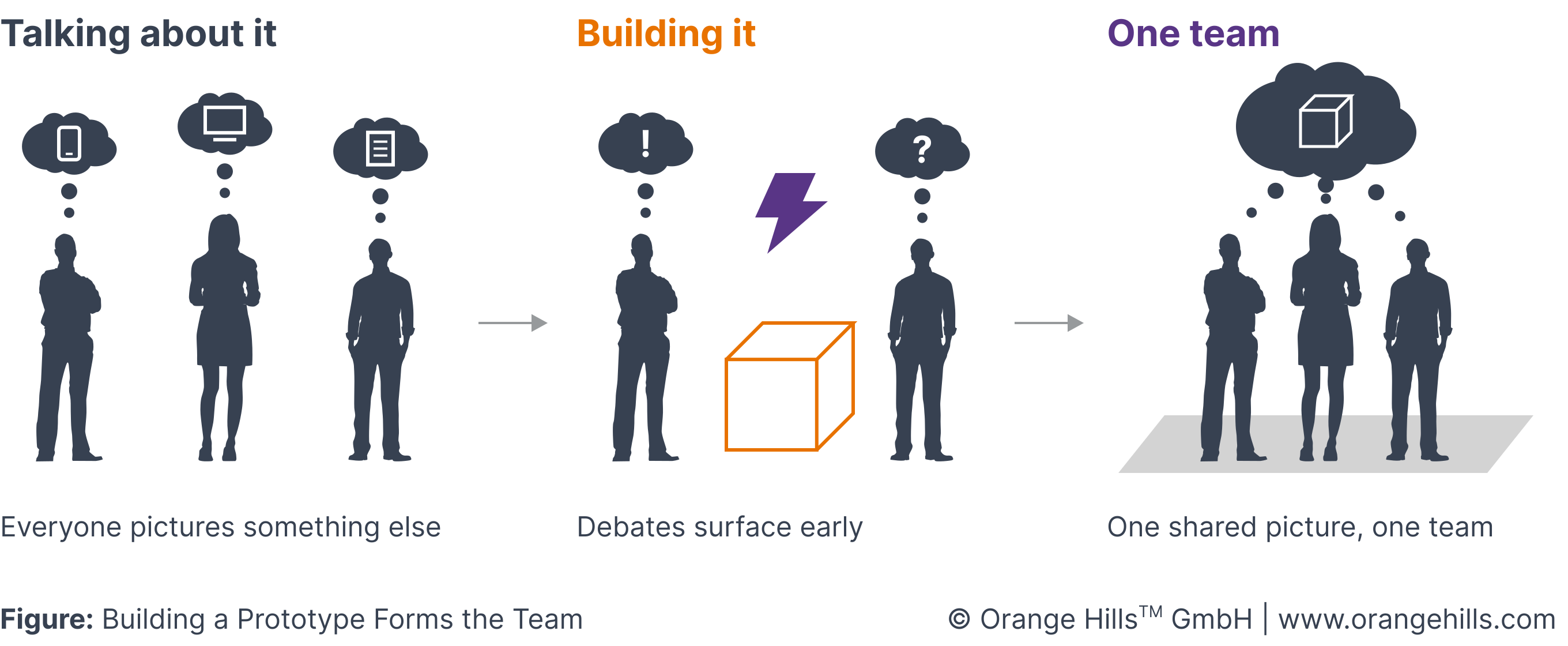
The most critical success factor in innovation is the team and how it operates — no doubt about it. A team that doesn't work well will not reach the market, even with the greatest idea you can imagine.
What we learned over the years is that prototypes, and the process of building them, have a great influence on social team dynamics: on motivation, identification, conflict resolution, teamwork, understanding of roles and hierarchical thinking. It turns out that a prototype is not a final product; it's a social artefact which influences how a team operates. And it mirrors the team's strengths and weaknesses: "Show me your prototypes and I know where you are."
The notion that innovative teams generate innovative prototypes is giving way to a recognition that innovative prototypes are the focus for generating innovative teams.
That's a quote from Michael Schrage from his book Serious Play. This impact on teams is probably the biggest asset of prototyping.
Keep in mind
If you want to learn more about how prototyping impacts teamwork, can make conflicts visible, breaks up organisational hierarchies and influences the motivation and identification of innovation teams, we have a dedicated page on that topic: How Prototypes Shape Teams. Check it out!
3. What We Build in Each Phase
Prototyping isn't a step of its own — it runs through the whole innovation process. Here's what we typically build in each phase, and for which of the five reasons:
Phase | What we build and why |
| |
| |
| |
| |
|
In Phase IV, prototyping runs through the steps of the sprint, and what you build changes with every step. Some examples:
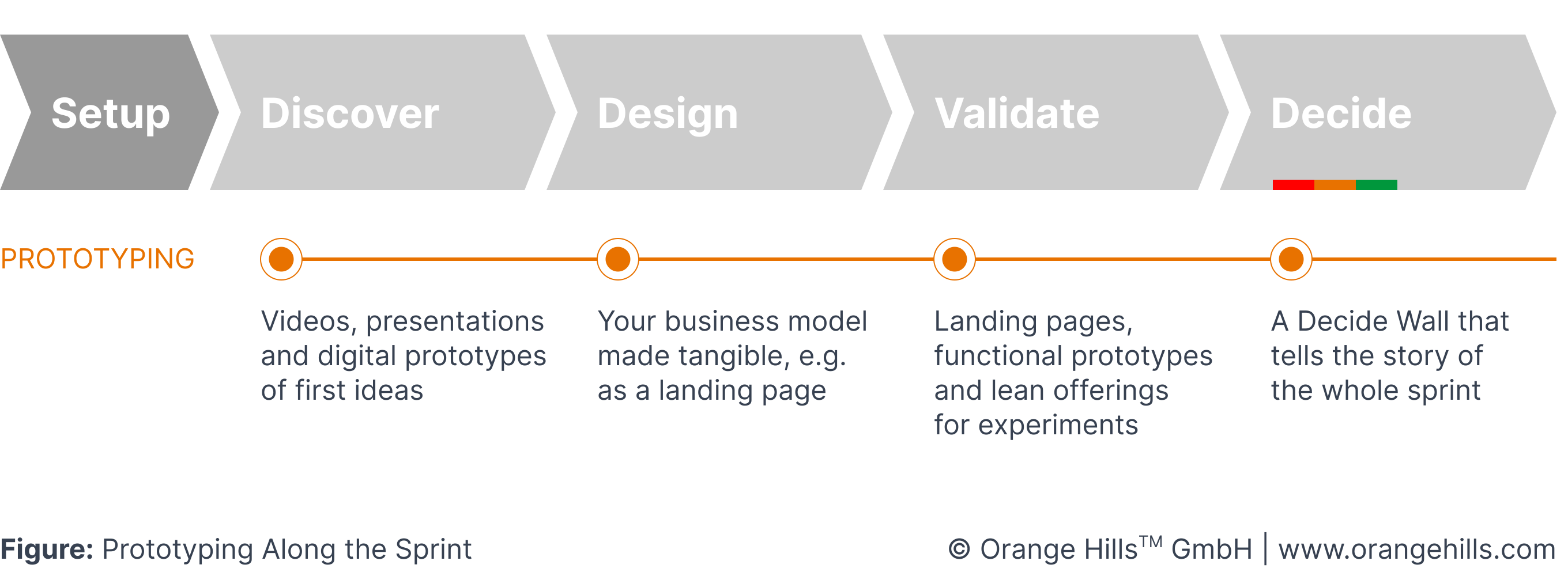
Dive deeper into each phase of our End-to-End Innovation Process to explore visualisation and prototyping in more detail.
4. Conclusion
Prototyping is a cornerstone of Business Design. In innovation, you work with the maximum level of uncertainty: everything is new. Prototypes, and the process of building them, help you find your way. Whatever phase or step you are in, ask yourself which of the five reasons you need right now — and build the prototype for exactly that. Demo or die.
Want to go deeper? Each of these pages answers one question:
Prototyping – what exactly counts as a prototype and how to build the right one
Choosing Experiments – which experiment/prototype gets you which facts
How Prototypes Shape Teams – what building prototypes does to your team
How Prototypes Shape Judgement – which effects and biases kick in when people look at a prototype or build one
Readings
Schrage, M.: Serious Play, Harvard (Amazon)