
Exploring Markets
After exploring customers, estimating market sizes and analysing market conditions is the next important task when you explore a market-driven playground. This article introduces the concepts and shows how they connect to the other research areas.

Gabriele Bacher
Team Coach

Sabine Schoen
Team Coach
Content
1. Purpose
A market is the physical or virtual place where companies and customers meet and exchange their offerings, and it sets the conditions our innovation work has to live with. Exploring Markets is closely linked to Exploring Customers: you need to know who your prospective customers and users are before you can analyse their markets. Four things a project team should understand early on:
Number of prospective customers: Once you know who your customers are, work out how many of them exist in the regions that matter to you. Add this to your Target Groups template for a visual overview.
Spending power: The total amount of money customers spend on offerings related to your playground. These numbers are hard to come by in B2B niche markets in particular — market reports from research institutes are your friends here.
Bargaining power: Every market distributes bargaining power differently between buyers and sellers. In some, buyers can put pressure on sellers and negotiate prices and conditions. In others it's the other way round.
Growth dynamics: How the attributes above have changed over recent years, and how they may change in future.
Keep in mind
In the first weeks of an exploration, a proper market analysis is often both difficult and premature. If you don't know yet who your preferred customers are, you don't know where to look. Understand your customers first, before you invest too much time in a high-level market study. We usually invest more time in a proper market analysis later on, once the Business Model takes shape.
Framing the market is the second useful concept. The total size of a market is often irrelevant, because you can't reach every customer anyway. That's why we distinguish two perspectives:
Total addressable market (TAM): The spending power of all potential customers with a possible demand for products and services like the ones you are about to launch. This is the top-down perspective. It often helps to break the TAM down to the regions and customer segments relevant to you — the serviceable addressable market (SAM).
Serviceable obtainable market (SOM): The share of the SAM you can actually reach and serve with the resources you have at hand. This is the bottom-up perspective.
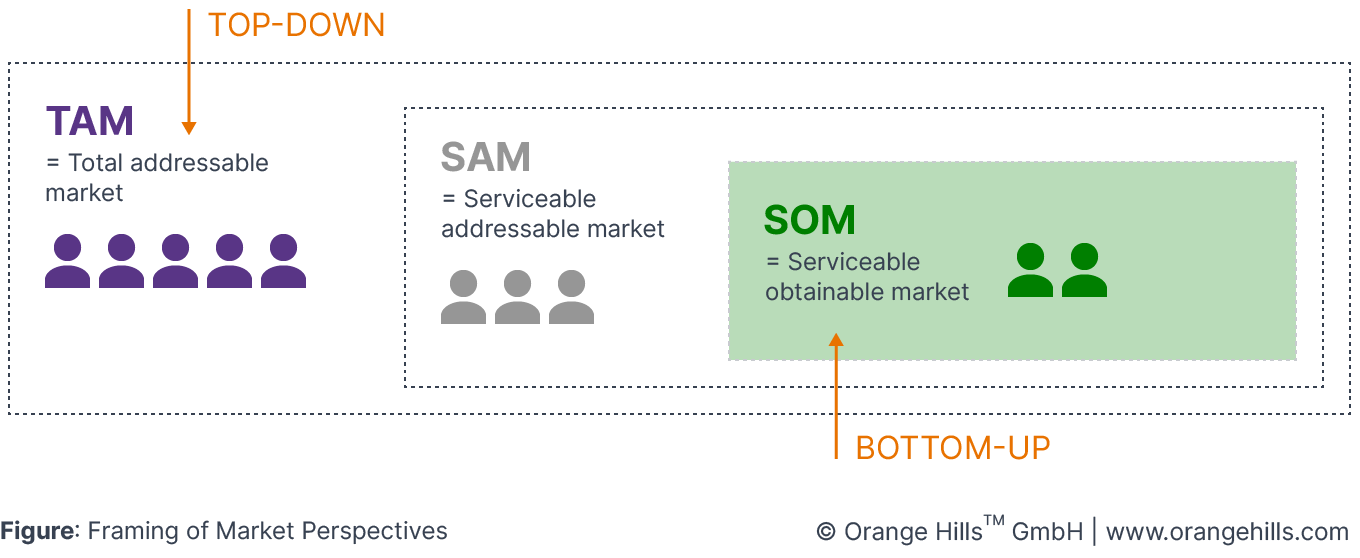
Consider both perspectives. The SOM is the more relevant one for short-term targets.
Working out TAM, SAM and SOM properly — top-down and bottom-up, and the two cross-checked against each other — is deep-dive work. It means chasing figures across several sources, each with its own reference year and definition of the market. With a scanning or T-shaped scope (see Exploring Playgrounds), go for one order of magnitude with its source and reference year, and label it as the estimate it is.
Keep in mind
Keep in mind that innovators regularly change market sizes and conditions, and sometimes create entirely new markets through disruptive offerings and technology. Don't box yourself in with detailed market calculations — your numbers won't match reality anyway. This isn't about precision, it's about getting a professional gut feeling.
A simple example: imagine you are building a new kitchen appliance that peels carrots, apples and pears. Your TAM is the total amount customers spend on similar appliances to get that job done. Your SAM is the share of the TAM covering only the regions and segments you care about — professional chefs in the European key markets, say. And your SOM is the share of the SAM you can reach with your marketing, sales and delivery power.
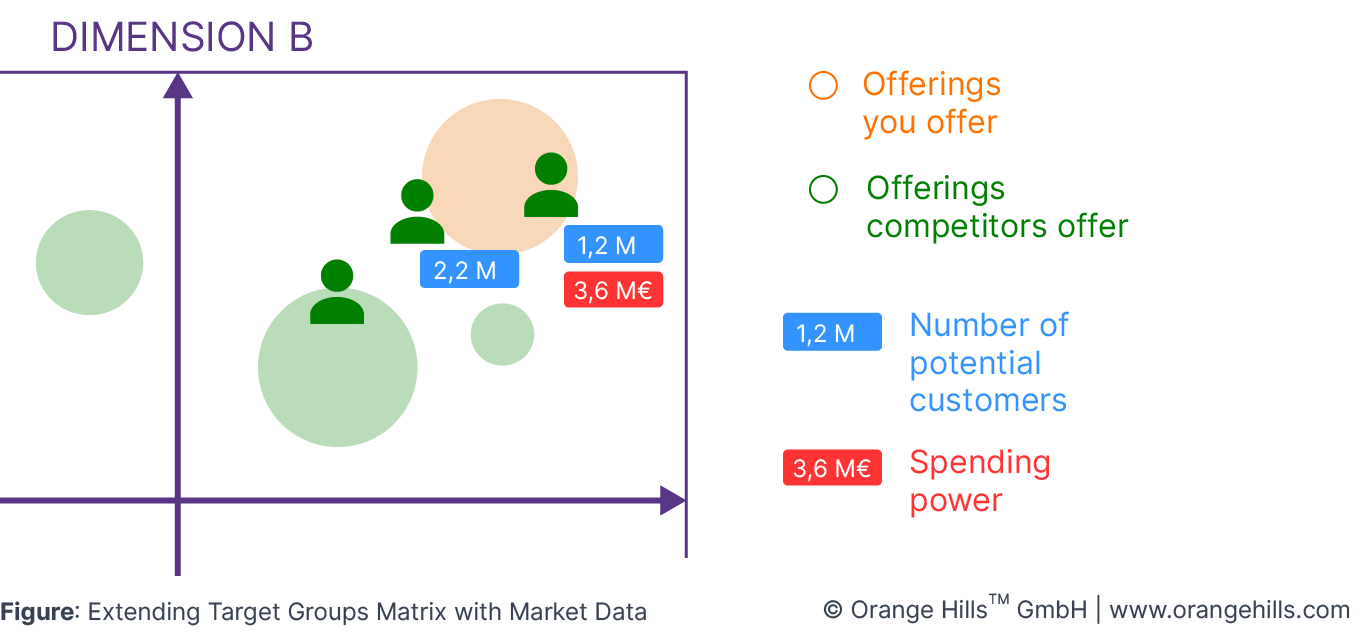
The results feed back into the Target Groups template, and into the segment discussion you start in the Review Workshop. Where competitors sit in those segments is covered in Exploring Competitors.