
Step 2: Research
Content
1. Purpose
After the Kick-off Workshop, the team has a clear picture of its research focus, the questions it wants to answer and how to answer them. Every Team Member has their tasks and starts researching to gather fresh and surprising insights. Depending on the focus of the playground and the scope of the exploration project, the research concentrates on certain key areas: a scanning exploration touches several of them with a few questions each, a deep-dive works through a single one. The following table gives you a first impression of what research in these areas may look like.
Research Area | Methods (Examples) | Result format (Examples) |
Customers & users |
|
|
Market structure & dynamics |
|
|
Technology |
| Short technology reports with implications for future business ideas |
Competitive landscape |
|
|
Rules & regulations |
| Short reports with implications for future business ideas |
Data & resources |
| List of available data pools including quality criteria, plus other resources with a unique character |
Today's business model |
| SWOT analysis |
Practices & processes |
|
|
Keep in mind
Research is close to worthless if the team doesn't bring back anything fresh or surprising. A list of competitors with name, website, headcount and last year's revenue is a start, but the project learns little from it. Find out why your strongest competitor's "direct-to-consumer" campaign failed, and inspiration arrives on its own.
2. Duration
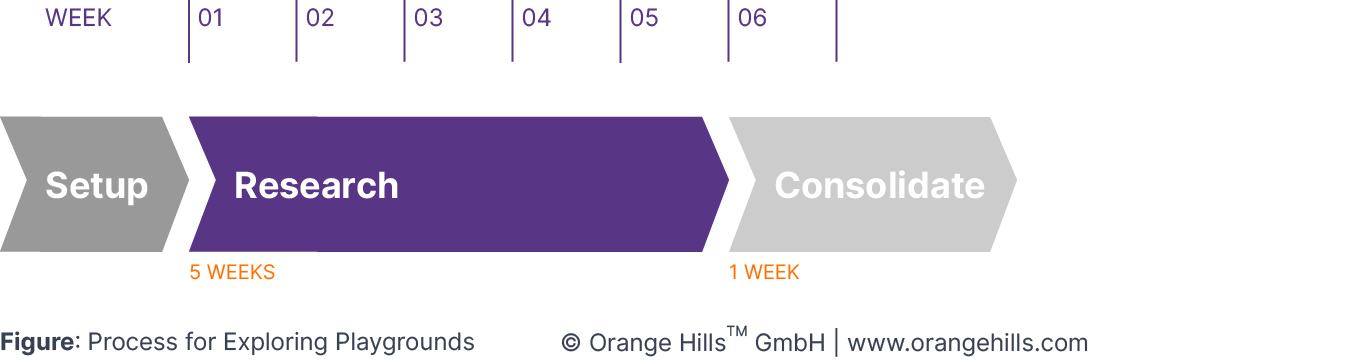
5 weeks
3. Key Activities
Set up the research: The research starts with the Kick-off Workshop. The team comes together to get familiar with the Project Charter "Exploration", collects open questions and defines the research agenda for the coming weeks: research questions, methods, output formats — all of it within the focus and scope the charter sets. The team plans the first research activities and often starts preparing them together — drafting guidelines, templates or a list of interviewees. Where needed, the Team Coach or a Research Expert introduces the methods and how to apply them, interviewing technique for instance.
Conduct research: The team conducts the research according to their agenda and captures the results — sound, pictures, videos, reports. Depending on focus and scope, they interview customers along their interview guideline, run DIY activities, hold expert talks and do desk research. You'll find further examples on our subpages Exploring Customers, Exploring Markets and Exploring Competitors. Halfway through, the team shares intermediary findings in the Review Workshop, then reflects and adapts the research agenda with the Team Coach for the second iteration.
4. Formats
Individual research work: interviews, observations, DIY activities, expert talks, desk research
Review Workshop after the first iteration
5. Tools & Materials
Customer & User Interview — interview guideline and documentation template
Action Plan for the Weekly Status Calls
For the physical material of the two workshops, see Kick-off Workshop and Review Workshop; for everything else, see Tools & Methods for Phase II
6. Participants
7. Q & A
Can we hand the research over to a market research institute or other agencies? We advise against it. The point is that Team Members get first-hand impressions instead of reading tables and pie charts with insights someone else has already pre-digested. You want them to look their customers and colleagues in the eye and feel what those people deal with today. On top of that, many institutes have little experience with qualitative research in an innovation context.
What if a team member makes hardly any progress? The reasons are usually lack of time, lack of motivation, or trouble with the method — and the Weekly Status Calls are there to surface this in week one rather than week four. Talk to the person directly and find out which of the three it is. Where availability is the problem, involve the Team Manager: a research task nobody has time for gets reassigned or dropped, not carried along for another three weeks.
What if the team wants to add a research area halfway through? Check it against the scope you agreed on. A new question inside the scope is a normal adjustment for the second iteration. A new area is not: with five weeks of research, adding one means taking time away from everything else. Note it as a candidate for a follow-up exploration and decide with your Project Sponsor if it really cannot wait.
What if the team only brings back findings that confirm what everyone already believed? Then treat it as a warning sign, not as a result. Teams tend to gather what fits their beliefs. Combine different sources on the same question, involve the whole team in collecting and analysing the data, and keep asking for the surprising detail behind the tidy answer. If nothing surprises you after five weeks, you have scratched the surface.