
Customers First
Customer centricity is one of those buzzwords that is omnipresent in many companies. That's great. The challenge we see every day is what it actually means in practice. This article explains how customer centricity can be applied in organisations and what to watch out for to succeed.

Sabine Schoen
Business Design Field Researcher
Putting customers and users at the centre of your innovation projects is a great way to create innovation that really matters. Most innovation practitioners and leaders would agree. The challenge starts when you think about how to integrate customers into your projects at various stages – and how to make sense of the results.
Business Design integrates customers and users in almost all phases of the End-to-End Innovation Process:
Phase I: We imagine the future life of our customers by exploring trends and interacting with so-called "lead users" – people who are usually ahead of their time and show behaviour that is not yet common. We call this kind of research "inspirational research".
Phase II: We explore the current world of customers within a defined scope (playground) to get a deep understanding of pain points, needs, thoughts, emotions, behaviour, and preferences – usually with smaller research samples. We search for surprising insights that ultimately spark great ideas.
Phase IV: When it comes to validating and refining business ideas, customers are the key source of insights in the "Discover Phase" and "Validate Phase" – to explore open questions and prove hypotheses with larger research samples and produce reliable results.
All these research types require slightly different setups and methods to deliver reliable, usable insights for the next step in the innovation process. Always know what kind of research you are doing. Don't mix up these approaches or ask the wrong questions to the wrong people.
Inspirational research | Exploratory research | Validation research | |
Key attitude | be curious and get inspired | understand and deep-dive into the status quo | determine probability of success for an idea |
Type | qualitative | qualitative | quantitative |
Sample size | small (< 25) | small (< 25) | large (> 200) |
Results | "Sparks" & stories from people and organisations who are ahead of their time | "Surprising insights" categorised by relevance | Tested assumptions with a robust and repeatable experimental setup |
Phase | I | II and IV | IV |
Check out the corresponding pages in the End-to-End Innovation Process section for more details.
It's not easy to have useful conversations with customers. Make sure your interviewers are trained in advance and ask the right questions to collect data as neutrally as possible. Mitigate Confirmation Bias and Response Bias by applying the right interviewing techniques. Learn more on our page about Customer Interviews.
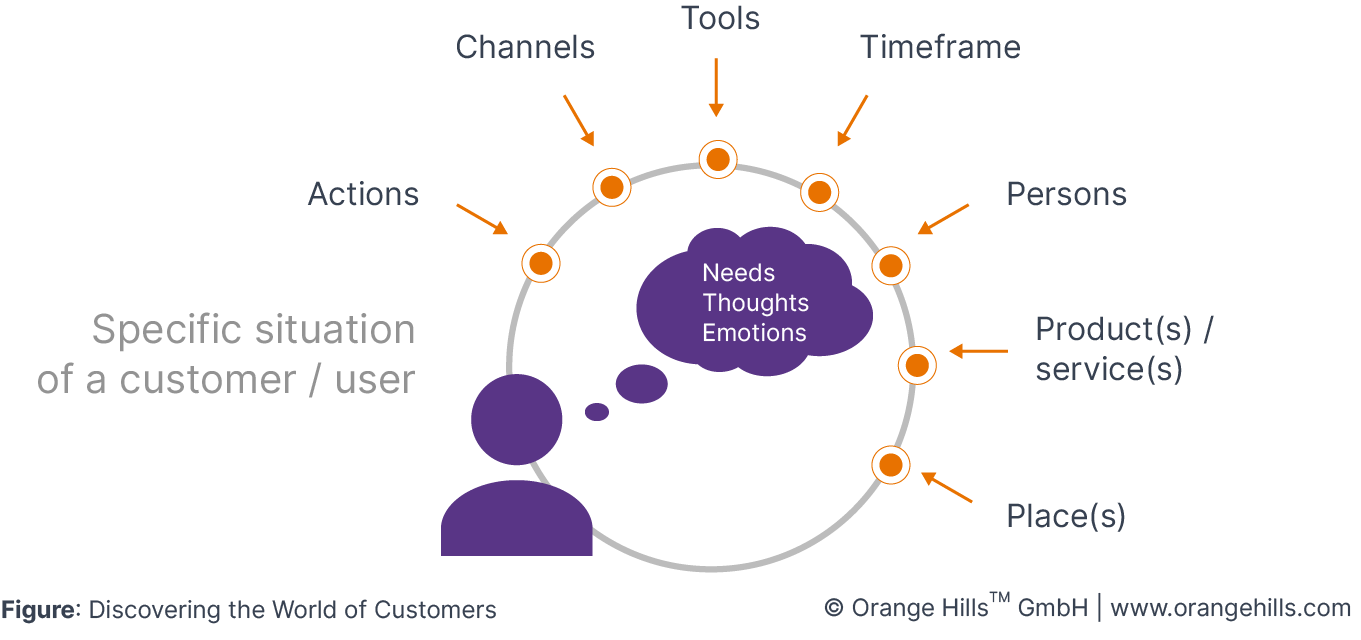
Beyond methodology, it is equally important to be aware of how organisations deal with the results of customer research. Customers don't care about how companies are organised when they give answers. And very often their answers don't fit neatly into the existing world of companies – which creates confusion and sometimes strange behaviour from decision-makers:
Results are partly ignored: Only results that fit the current thinking and structure of the company are welcome. Others get ignored. This is fine to some extent – when that 'ignorance' is deliberate. It becomes a problem when results that overshadow pretty much everything in a given context are suppressed simply because people don't want to hear them.
Methodology is challenged: A common way to distract from research results is to doubt the methods applied. This is fair if a project team has mixed up research types or applied them unprofessionally. Very often, however, you hear people say that the sample size for an explorative study (Phase II) was not big enough – which is usually an unhelpful comment that reveals the need for more training in innovation methods.
Fear of presenting results: Sometimes, project team members are afraid to present customer research results to their supervisors because they don't want to create confusion or disappoint leaders who believed a certain idea was stronger than it turned out to be. The naked truth sometimes hurts.
Besides customer and user research, we usually also conduct research on market dynamics, competitive landscapes, and new technologies.
Good customer research takes time, courage, and effort. We are always looking for tools to help. As part of that mission, we recently tested the Synthetic Users tool. At first, we were impressed by how it presented interviews with synthetic (AI) users. The more we looked, the more weaknesses we found. If you are working with synthetic user interview results, be aware that:
We may lose sight of important details – situational context, cognitive dissonance
We miss the chance to build genuine empathy with customers
There is no emotional connection between researcher and researched – which is so valuable for the rest of the innovation project
The team may be less willing to accept uncomfortable answers, because the results don't feel 'real'
Synthetic interviews can be misused to justify projects
Check out Phases I, II, and IV of our End-to-End Innovation Process for more details on how we plan and conduct professional customer research.