
Picture of the Future
The Picture of the Future template shall help you structure your strategic discourse in your company. The template is not meant to replace a strategic project, but to organize your thoughts on how to design your future company. It is your vision of what a desired future could look like, and the starting point to decide what innovation activities are required to get there.

Bernhard Doll
Business Design Maverick
1. Overview
The Picture of the Future template consists of a series of questions that help you describe the future world of your customers, users, and your own organisation. The point is not to predict the future, but to create a vision that serves as a 'North Star' — giving executives and employees orientation for all strategic decisions. A "Picture of the Future" shows which customers and users will be relevant in the future, how they will change over the coming years, and how their business model (B2B) or behaviour (B2C) will shift. It also shows what value creation will look like and what might change. If fundamental things change along the way (e.g., new legislation), we adapt the picture to the new framework conditions.
The left side of the template covers questions about customers, users, interfaces, and a company's future offerings. The right side addresses your own organisation and its future value creation. Guiding principles and performance measurement complete the picture.
2. Layout & Download
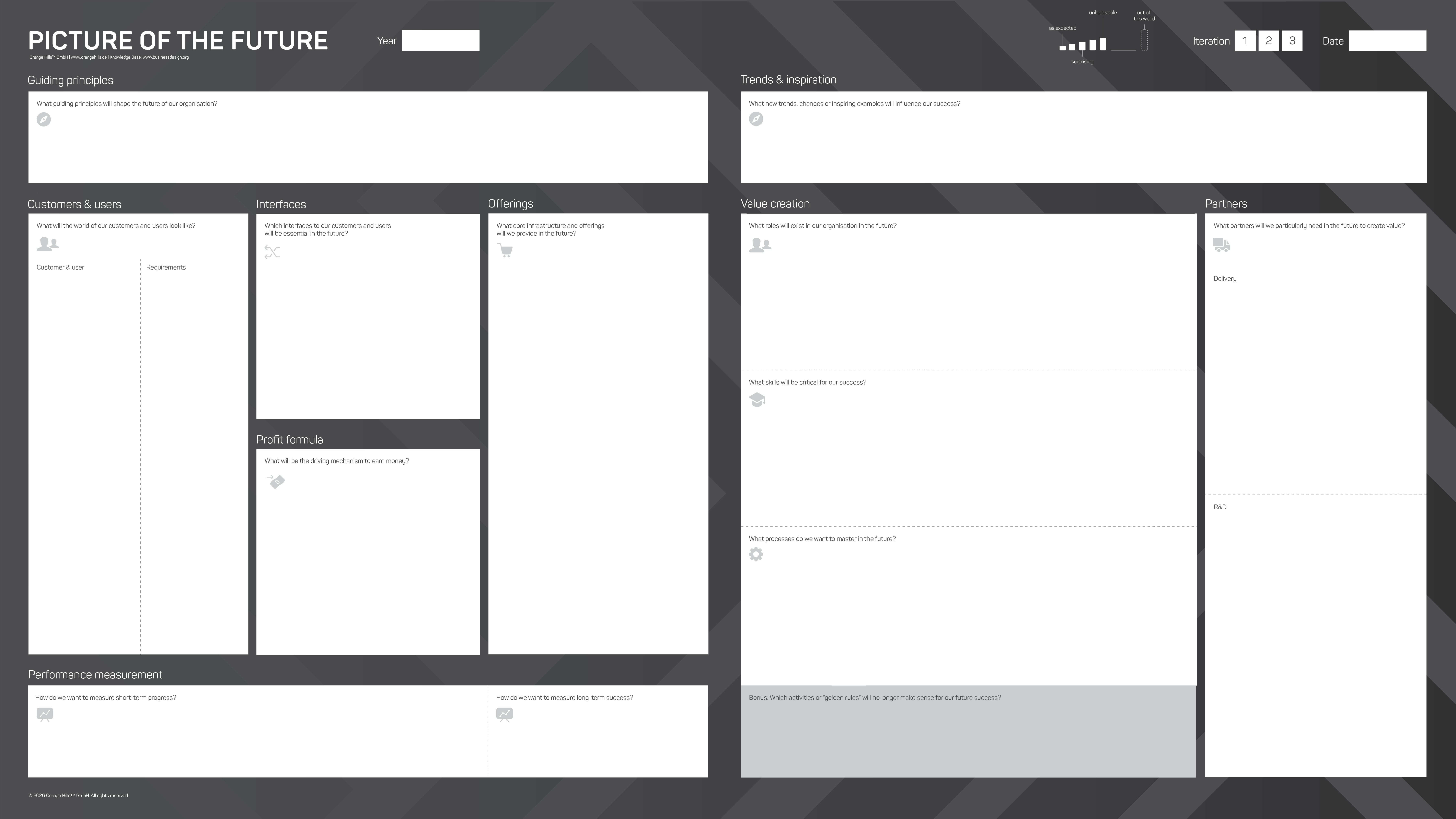
3. Key Elements
Element | Question | Comments |
Guiding principles | What guiding principles will shape the future of our organisation? | These principles are the stable foundation of the Picture of the Future. Everybody in your organisation should know them by heart. Link them to your organisation's purpose. |
Trends & inspiration | What new trends, changes or inspiring examples will influence our success? | If you've already carried out some inspirational research, use this box to capture the best examples and key insights. |
Customers & users | What will the world of our customers and users look like? | Focus on the future differences in business models (B2B) or behaviour changes (B2C) among your customers and users. |
Interfaces | Which interfaces to our customers and users will be essential in the future? | Future marketing, sales and delivery channels. |
Profit formula | What will be the driving mechanism to earn money? | We don't need numbers here — just core ideas about how you'll make money in the future. Think revenue streams, charging mechanisms, etc. |
Offerings | What core infrastructure and offerings will we provide in the future? | Products, services, software — whatever your company will sell in the future. |
Value creation |
| The idea here is to visualise, as concretely as possible, how the company will create and capture value in the future. It's not about departments or specific people in specific roles — it's about the overall mechanism for creating and capturing value. |
Partners | What partners will we particularly need in the future to create value? | All the partners you need to cover processes and skills that don't make sense to keep in-house. |
Performance measurement |
| Check out our page on Measuring success and progress for more details. |
4. Usage Scenarios
Structuring a strategic discourse
Compiling answers to strategic questions about your organisation's future
Briefing a designer to visualise your picture of the future
5. Q & A
What if the answers to the questions of the template are not future-oriented at all? Chances are the people involved would benefit from an Inspirational Research. That said, a 'leap of faith' isn't always necessary — it depends on the industry and the pressure for change.
What if the participants can't reach a consensus on some questions? Same as always: it's absolutely OK to build a picture of the future in several iterations. The first version can be rough, even uninspired in places. Looking at that first visualisation often sparks new ideas to refine the picture.
What if some stakeholders don't want to visualise a "Picture of the Future"? No problem. Visualisation is still an important step in Business Design, but most of the value comes from the answers to the questions, not from the visualisation itself. Create a text document or something else instead.