
Project Charter "Sprint"
Content
1. Overview
The Project Charter "Sprint" is the specific variant of the Project Charter tailored for a "Validation & Refinement" project in Phase IV: Validation & Refinement of the End-to-End Innovation Process — the core 10-week innovation cycle. While the general Project Charter concept applies to any project setup, the Sprint version is designed for the fast-paced, iterative nature of Business Design work.
The charter is jointly developed and signed by the Project Sponsor and the Team Manager. It represents a commitment: the sponsor provides the entrepreneurial challenge, resources, and political cover; the team commits to delivering fact-based insights and validated concepts within the agreed timeframe.
A good charter goes through several iterations before the sprint starts. Don't rush this. The Team Coach is involved in shaping the charter to ensure the scope is manageable within a single sprint.
2. Layout & Download
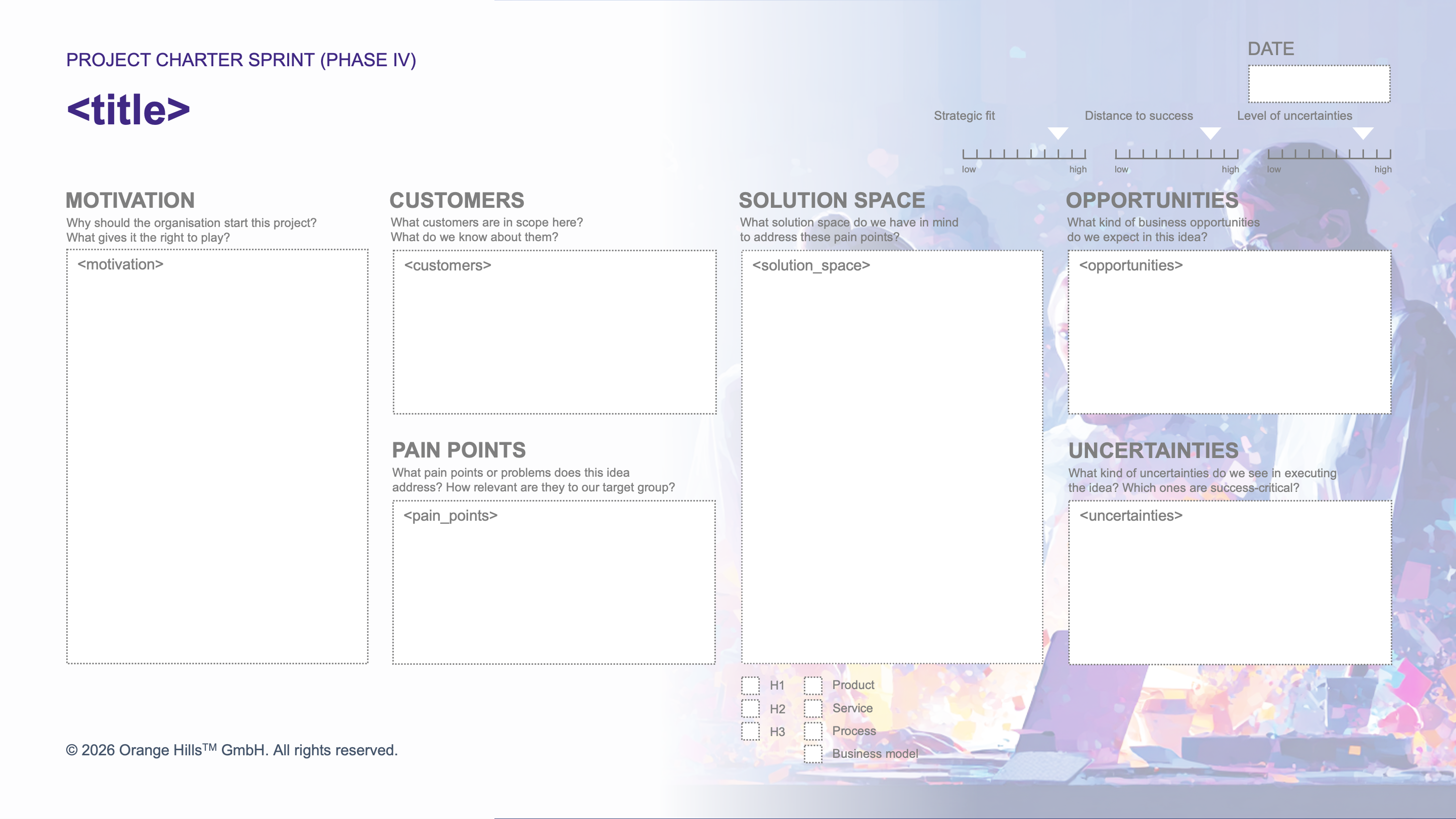
3. Key Elements
The Project Charter "Sprint" addresses seven core questions. Each element serves a specific purpose — skip one, and your sprint will have a blind spot:
Motivation: Why are we doing this now? Be specific: market pressure, competitive threat, new technology, a concrete business challenge. "Because innovation is important" is not a motivation.
Problem Statement: What customer or internal pain points or problem are we solving? One problem per sprint. If you have three, pick the most critical one and address the others in subsequent iterations.
Draft Solution (optional): What potential solution does the sponsor have in mind? Keep it as a hypothesis, not a commitment. The sprint will challenge this — and that's the point.
Opportunities & Uncertainties: What business opportunity do we see in this project? Wjhat kind of uncertainties do we see in executing the idea? Which ones are success-critical?
Assumptions (optional): What could derail us? List the scariest ones first. These often become your first Hypotheses & Experiments once the sprint begins.
Objectives: What measurable outcomes do we target? Include numbers: "€X new revenue", "Y new customers in segment Z", "X% cost reduction". If the objective has no number, it is not yet an objective.
Resources & Stakeholders: Who is on the team and how much time do they get? Minimum 1.5 days per week per Team Member over 10 weeks. No exceptions. Make sure every Team Member has confirmed their availability before the charter is signed.
Schedule: When does the sprint start and what are the milestones? Fix the workshop dates first (Kick-off Workshop (Phase IV), Decide Workshop (Phase IV)), then work backwards. A 10-week sprint needs all dates locked before it starts.
4. How to Write a Strong Charter
Start with the sponsor's motivation or pain. The best charters emerge from conversations, not templates. Sit down with the sponsor, ask probing questions, and translate their answers into the charter format.
Be aware that sponsors often start too broad. "We need to innovate our product portfolio" is not a charter-ready statement. Push for specifics: Which product? Which market segment? What is happening right now that triggered this urgency?
The objectives should be measurable from day one. "Increase customer satisfaction" tells you nothing. "Achieve an NPS of 40+ among SME customers in the DACH region" gives the team a target to work towards. The same principle applies to every element: if you can't put a number on it, sharpen it until you can.
Don't forget to discuss the Step 1: Setup (Phase IV) with the sponsor early on. Are you aiming to create project results, enable people, or stress-test the system? This decision shapes the entire charter. You can't optimise for all three at the same time.
5. Usage Scenarios
Setting up a new "Validation & Refinement" project with the sponsor during the Step 1: Setup (Phase IV)
Aligning expectations between sponsor, Team Manager, and Team Coach before the Kick-off Workshop (Phase IV)
Presenting the entrepreneurial challenge and project setup at the Kick-off Workshop (Phase IV)
Benchmarking sprint outcomes against the sponsor's original objectives at the Decide Workshop (Phase IV)
Re-chartering for subsequent sprint iterations based on learnings from the previous cycle
6. Instructions for Coaches
Don't accept a charter at face value. Your job is to challenge and sharpen it. Schedule at least two rounds of revision with the sponsor and Team Manager before the sprint starts.
Watch out for charters that try to cover too much ground. A single sprint can address one clearly defined problem for one target group. If the charter lists multiple disconnected problems, work with the sponsor to prioritise. You can always address the remaining topics in subsequent sprints.
Check the stakeholder section carefully. Every Team Member listed should have confirmed availability of at least 1.5 days per week. If someone says they are "very busy but will try to make it work" — that's a red flag. Discuss this openly with the sponsor and, if needed, replace the Team Member before the sprint starts.
Make sure the sponsor understands what signing the charter means: full commitment to attending the Kick-off Workshop (Phase IV) and the Decide Workshop (Phase IV), making quick decisions when the team needs them, and protecting the team from organisational interference during the sprint.
7. Q & A
What if the sponsor wants to start immediately without a proper charter?
We don't start. A sprint without a clear charter is a sprint without direction. Take the time to get it right — even if it means delaying the start by one or two weeks.
How many iterations does a good charter need?
Typically two to three. The first draft captures the sponsor's initial thinking, the second sharpens the scope and objectives, and the third confirms feasibility with the Business Design Coach's input.
What happens if the project focus changes during the sprint?
Minor adjustments are normal — discoveries during the Step 2: Discover often refine the original focus. Major pivots should trigger a re-chartering conversation with the sponsor. Don't silently drift away from the original agreement.
What if the charter scope is too large for a single sprint?
Break it down. Identify the most critical problem or assumption and charter the first sprint around that. Document the remaining topics as candidates for follow-up sprints. A focused sprint with clear results beats a sprawling one that delivers nothing concrete.