
Dream Big, Act Small
This article is for advanced Business Designers who want to bring their Business Design projects to a more ambitious level. We consider a tangible and aligned dream - a so called "Picture of the Future" - one of the most important prerequisites for successful Business Design projects. We want to explain what a "Picture of the Future" looks like and why it matters so much for innovation projects.

Bernhard Doll
Business Design Maverick
Every innovation activity, every innovation project needs guidance and orientation. And this guidance can't come from goals alone, such as:
"We want to become the Nr. 1 in our industry XYZ and increase our gross margin by 3%."
A goal defines success. But it gives you very little guidance here and now: Which ideas are relevant? Which projects should be kicked off, which should stay in the backlog? Goals don't answer questions like how AI might help your organisation improve. The real question is always: What kind of organisation do you want to build?
What innovators need is an idea – call it a dream – of what a desired future looks like. Not in every detail, but as an entrepreneurial narrative that makes today's decisions easier, even small ones. Business Design can't work if management has no clear picture of what customers and the organisation should look like in the future.
Why does that matter? If your idea of the future is vague – more a goal or a buzzword ("digitalisation", "sustainability", "AI-driven") than a concrete vision – pretty much everything you do in managing innovation will be difficult. You'll get vague decisions and never 100% commitment to new ideas. You won't attract the best people for your project team. Managers will always fall back on numbers and business cases. It will be hard to kill a bad project, because nobody knows what "bad" actually means. Nothing is clearly good, nothing is clearly bad.
And here's the tricky part: You need sharp instincts to recognise that the missing "dream" is the root cause of all this. Because everyone will tell you the opposite: "Sure, we have a strategy! We know what we are doing!"
We call such a dream a "Picture of the Future".
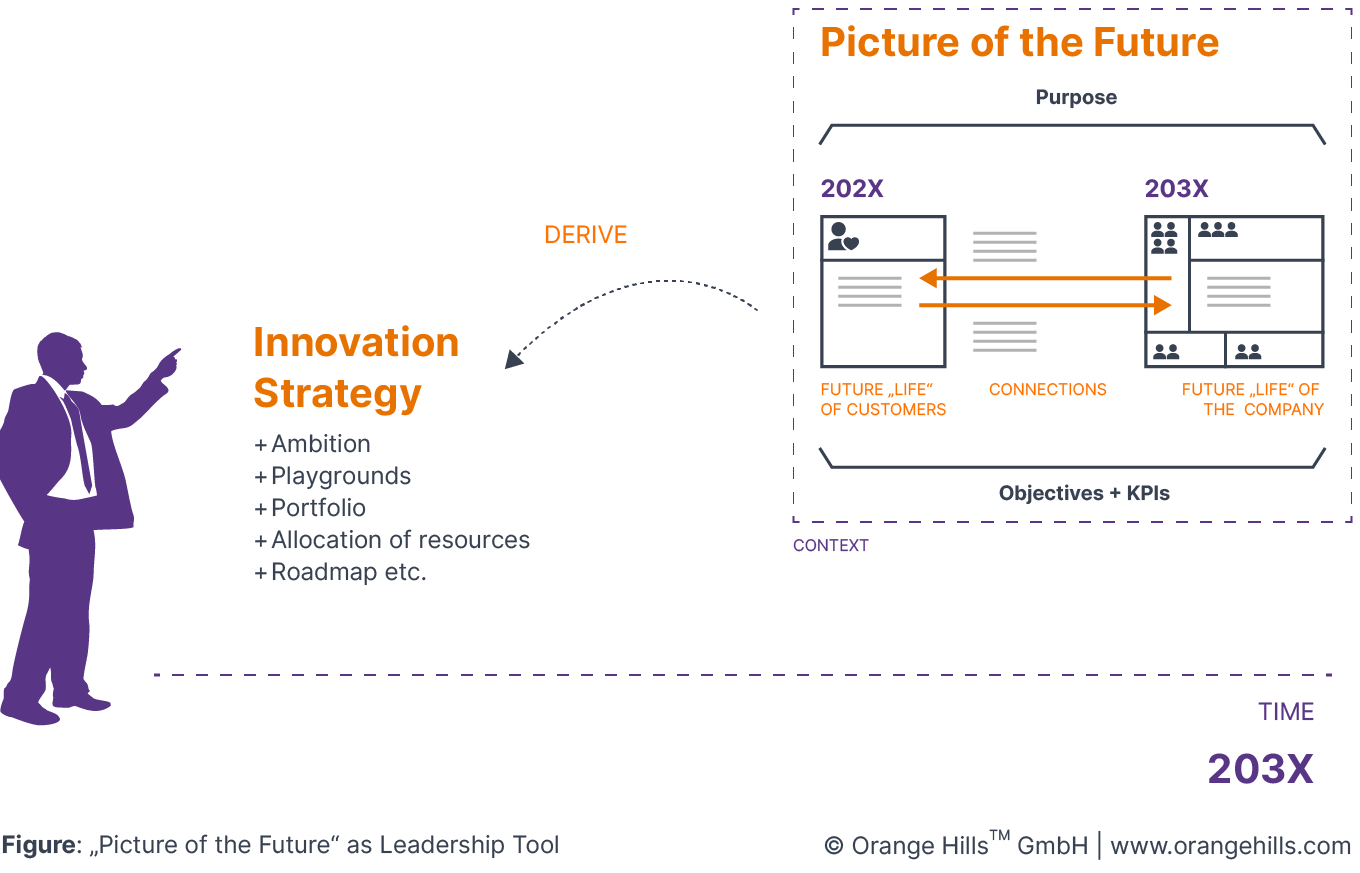
Smart people might say: "How can we predict the future?" That's not the point. It might happen that we end up with a different reality than we had imagined. We don't need a perfect map of the future. The point is that every endeavour around new products, services, or business models needs one clear direction for everyone in an organisation to follow – to reduce chaos, ambiguity, and friction. If we learn along the way that some aspects of our dream are not achievable, we adapt. The goal is not to predict the future precisely, but to help everyone in an organisation make big and small decisions in an aligned way. This impacts your hiring process. It impacts which ideas get prioritised. It impacts how sponsors of Business Design projects guide new innovation projects.
A "Picture of the Future" is not primarily driven by the pains and challenges your customers experience today. Your vision should be driven by an entrepreneurial idea of what kind of future YOU want to build with your company. Sounds scary? It shouldn't be. And by the way – your picture of the future can be revisited and revised over the years. Be brave!
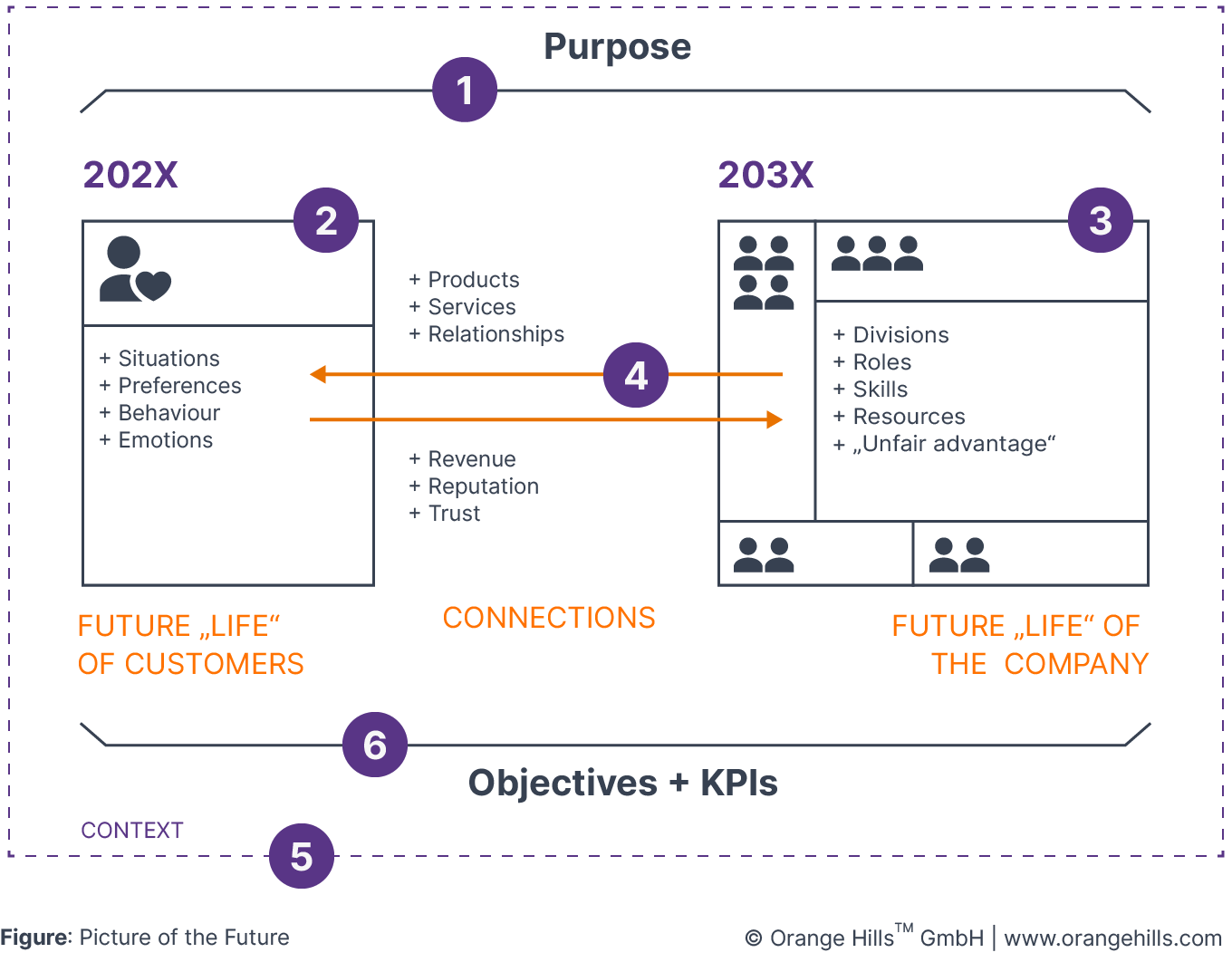
So let's build your dream. A good "Picture of the Future" that truly enables innovation consists of six aspects:
The purpose of your organisation: Why will your company still be relevant in the future – to customers, society, employees, and partners?
The future life of your customers: What will the lives of your customers look like? Be specific enough to identify implications.
The future life of your organisation: How will your company create value for customers in the future? This is not just a reaction to point 2 – you are designing the future.
The connections between 2 and 3: Future products and services, customer relationships, sales and marketing approaches.
The future context of your organisation: Every company is embedded in a social, technological, economic, environmental, and political context. Highlight the aspects most likely to shape your customers and your organisation.
Ways to measure success and progress: Define and measure success (long-term > objectives) and progress (short-term > KPIs).
Here are the questions we love to use as a starting point to build a "Picture of the Future":
Purpose of your organisation:
Why will your organisation still exist in the future?
What are the most relevant playgrounds in the future?
What do you want to be famous for?
Future life of your customers:
"Who do you want your customers to become?" (see book from Michael Schrage)
How will customers live and work in the future?
How many customers are potentially available in key markets?
Future life of your organisation:
Who will be in your organisation and what will they be doing every day?
What will be your core assets and unfair advantage in the future?
What do you need to unlearn to build a sustainable future?
Finding answers to these questions is hard, and the answers will change over time. That's the nature of strategy. But as a leader, you must have answers to steer the organisation, decide, and prioritise. Capturing your answers in a visual format (mind map, video, LEGO Serious Play, illustration, Innovation Monitor) can help – but it's not always necessary. Running a few Business Design projects is one of the best ways to find brutally honest answers about where you stand today and where you need to go.
Consider this quote from sociologist Karl E. Weick in the context of your strategy process: "An organisation can never know what it thinks or wants until it sees what it does."
We think this is true – but a bit too extreme. You can imagine the future (top-down) and always need to consider what your organisation is actually capable of doing (bottom-up).
Check out the Phase I of our End-to-End Innovation process for more details on how we build a "Picture of the Future" with the right participants.