
LEGO Serious Play
Building models with LEGO bricks is one of the most powerful ways to align a diverse group of people on tough, abstract questions. Words alone often fall short when you need to answer things like...
"What value do we create for customers and how?"
"What should a 10-star customer experience look like?"
"What is good leadership for our company?"
"What kind of innovation culture do we want to establish here?"
"What should our company look like in 5 years from now?"
Raise one of these questions in a regular meeting and you will likely end up in pointless discussions with no clear outcome. Words are limited when it comes to conveying abstract ideas. LEGO bricks change that. Why?
LEGO is easy to use, cheap, clean, and works perfectly in any office environment.
The huge range of bricks – windows, mini figures, accessories, trees, flowers, animals – allows you to build highly specific models.
LEGO bricks let you think in metaphors. A tree can stand for life-long learning. A wall can represent a barrier. You re-interpret bricks to communicate abstract concepts.
A LEGO model can be modified on the spot. It literally follows a team discussion in real time. Not many tools can do that.
Building LEGO models is fun. People get into a flow experience, they feel ownership over what grows under their hands, and the energy in the room goes up. It is a powerful team development exercise.
How Does It Work?
You can use LEGO bricks in many ways depending on your purpose. If your goal is to align different perspectives in a team, follow this procedure:
Start with a warm-up exercise. Let participants understand why and how you build models with LEGO bricks. Think of it as learning a new language – the language of 3D modeling.
Raise your question (see examples above) and ask everybody to answer it by building an individual model.
Let every participant explain their model by telling a story to the whole team. Allow questions to support understanding. Reject critique at this stage.
Ask participants to mark the most important features of their individual models with a red, blue, or green flag.
Invite the group to create a shared model that integrates ALL flagged features from the individual models. Let the team present the full story together.
Derive guiding principles from the shared model that answer the original question. Boil them down to concrete actions, tasks, or initiatives.
Repeat steps 1–6 for additional questions if necessary.
You can also build a service encounter without merging perspectives – just use the bricks as you see fit. It's fun and serious at the same time!
LEGO models are usually NOT the right artifacts to show customers for feedback. Use them internally within Business Design project teams. If you need a customer-facing version, transfer your LEGO model into a 3D rendering with tools such as Cinema 4D or freeware alternatives.
Usage Scenarios
Envisioning a service encounter, process, or experience
Building a company vision
Visualizing a corporate culture or leadership style
Developing great teams
In short: aligning different perspectives on abstract topics
Warm-Up Exercises
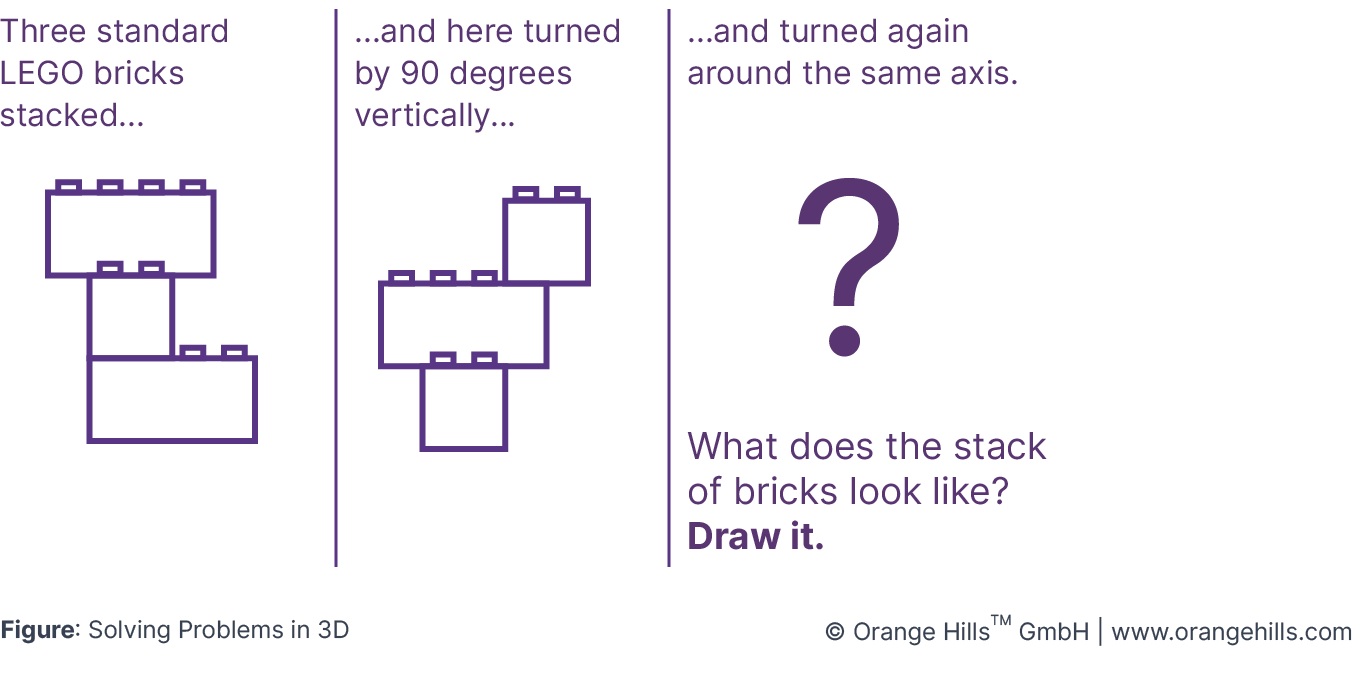
Solving Problems in 3D
Show the picture below and ask participants to draw the third perspective.
Give them 2–3 minutes. Then hand out three standard LEGO bricks with 8 dots on top to each participant (preferably in different colors).
Ask them to solve the same problem with bricks instead of drawing. Watch carefully what happens.
After 1–2 minutes, discuss the difference between solving 3D problems in 2D (pen & paper) and 3D (LEGO). The insight is immediate.
Metaphorical Building
Ask participants to pick 10 random bricks and put them together – no rules, no guidance.
Form pairs. Each person presents their model by answering the question: Why does this model represent a perfect boss / best friend / colleague / entrepreneur (pick one)?
Reflect on how our brain instantly creates meaning for anything we see, touch, or hear. Use this power in 3D modeling: start building even if you don't know what to build. Your brain will do the rest.
Building a Tower
Ask participants to pick 10 bricks and build a tower as tall as possible. A mini figure must be placed on top.
Watch carefully how they react to the challenge, embrace competition, and develop an emotional bond with what they build.
Discuss your observations. Focus on the key insight: modeling creates passion and emotional ownership – exactly the kind of energy you need in Business Design projects where uncertainty is high.
Example
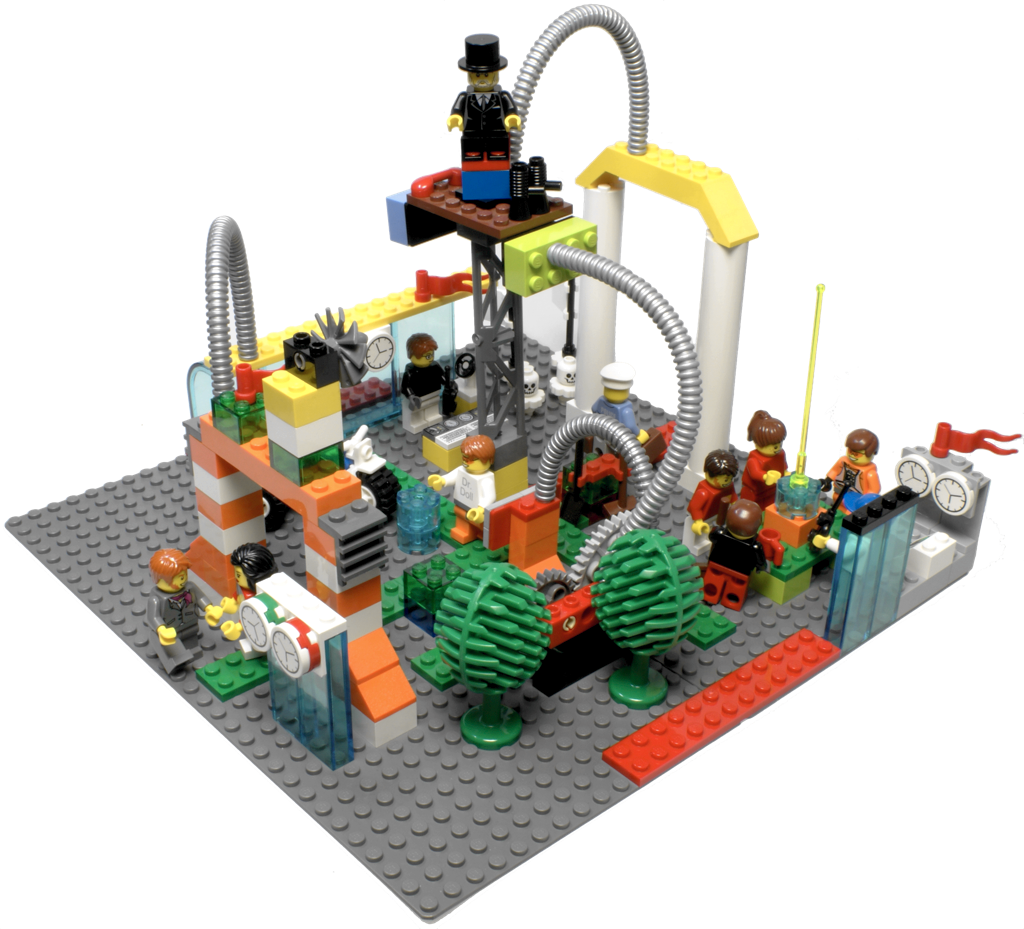
The model below shows how a multimedia agency creates value for its clients. Notice how metaphorical expressions help communicate aspects that are nearly impossible to convey with words alone.
Tools & Materials
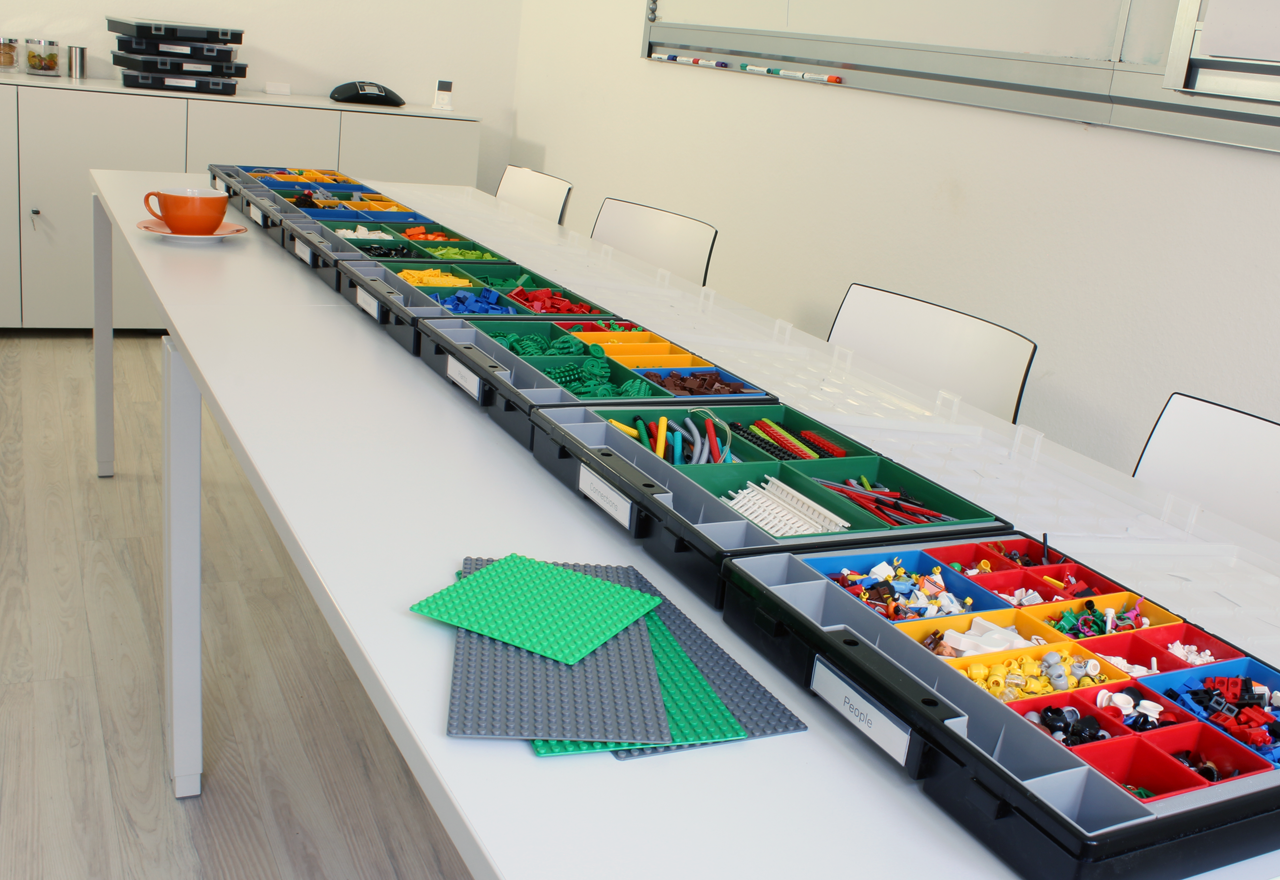
In Business Design projects, we use a specially assembled LEGO kit designed for building "social systems". The kit covers these categories:
Actors / people
Connections / relationships
Metaphorical expressions (motion, growth, boundaries, etc.)
Standard bricks
Here is how you present the bricks in a workshop:
You can order a good selection of bricks at the LEGO store:
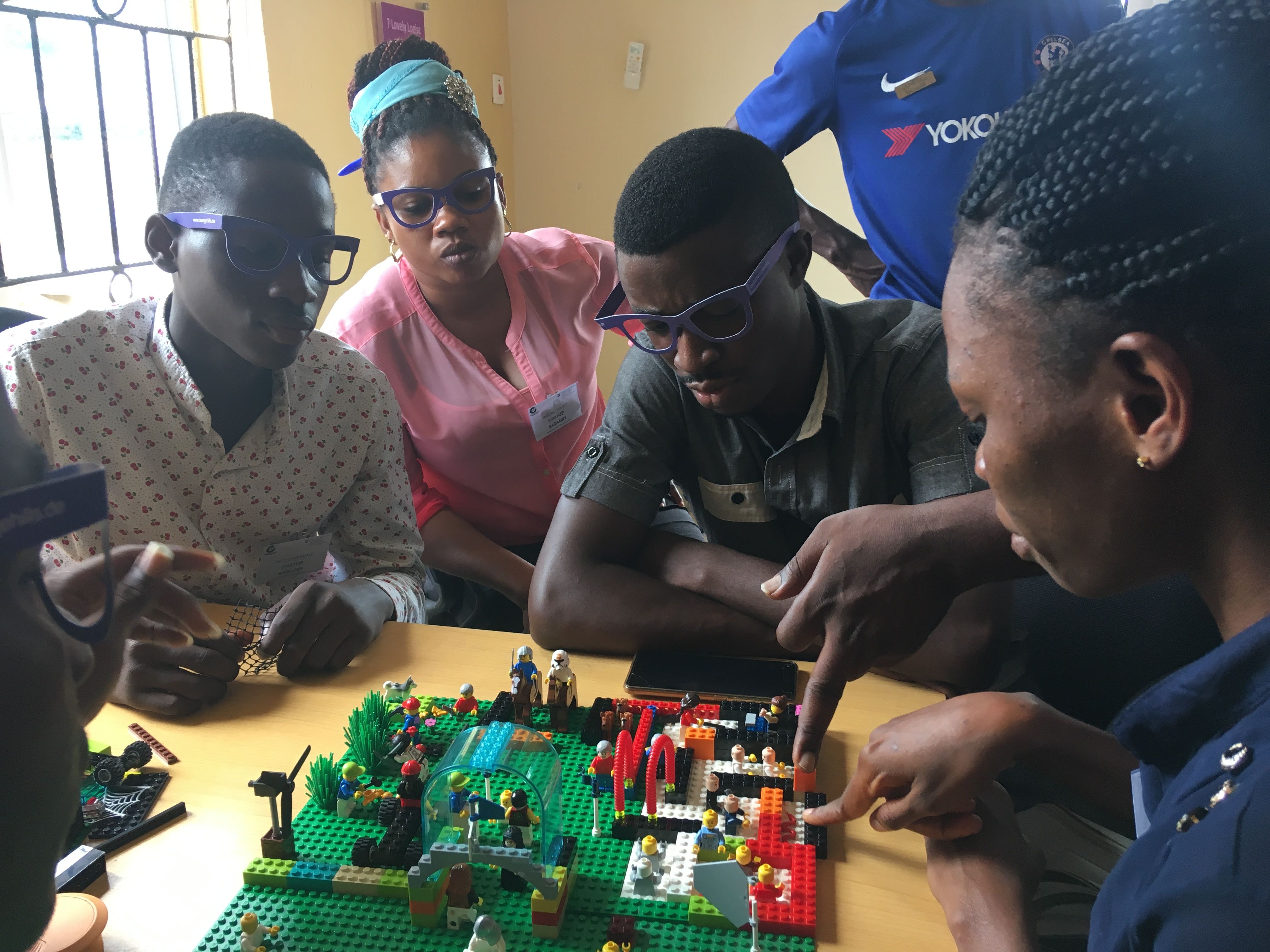
The picture below shows students at a Nigerian entrepreneurship centre (CYID) discussing a new concept to help farmers sell directly to end-consumers. This is the kind of engaged discussion LEGO triggers. Every time.
Instructions for Coaches
Encourage participants to start building even if they don't know what. Don't wait for the "perfect idea". Our brain is powerful enough to create meaning from any model – and that becomes the starting point.
Always build on large base plates. Without them, it is nearly impossible to carry models around or connect them with others.
Let participants tell different stories around their models. Vary the perspective:
Inside out: "Hey, this is me, employee of this department. In the future, I will play this role and do this and that..."
Outside in: "This is our future customer! They will go through this gate, which already shows the key ingredients of our work culture..."
From past to future: "In the past we did this... From tomorrow, we will be doing that..."
Take pictures of every model after the workshop. Document each element and the story behind it. PowerPoint works well for this. Even better: record a short video of someone explaining the model while pointing at each element.
Good Readings
Kristiansen, P. & Rasmussen R.: Building a better business using LEGO Serious Play method (Amazon)
Roos, J., Victor B. & Statler, M.: Playing seriously with strategy (Science Direct)