
Step 3: Design
Content
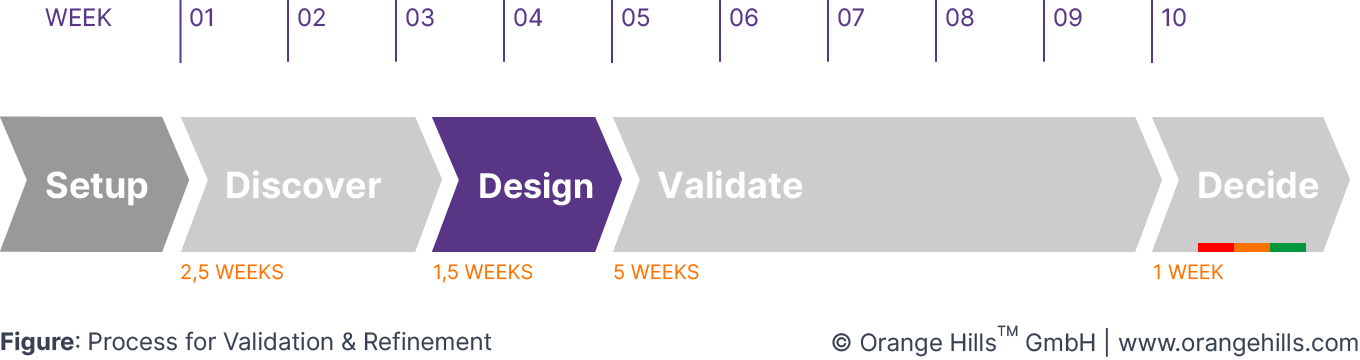
1. Purpose
Now it is time to create ideas! The Business Design approach directly translates insights from the Discover Phase into new or improved business models, products, services or software applications as a future scenario. You also focus on defining how this future scenario can be challenged systematically under real conditions. This allows you to plan how to get feedback quickly to improve the future scenario in an iterative approach. The Design Phase usually consists of a Design Workshop followed by a virtual teamwork phase. After the Design phase, you will have created an entire business model, product, service or software concept around your favourite business idea and defined which experiments you will undertake to challenge and further improve your future scenario in the following Validate Phase. In the teamwork phase, project teams usually spend time to visualise the output of the Design Workshop properly and schedule a short "Sneak Preview" with the sponsor of the project.
Keep in mind: A business model is NOT a business case. Forecasting future revenues, expenses, earnings etc. is important but only half of the story. You first need to understand what your business may look like before you start crunching numbers. A business case is "just" the financial projection of a business model.
2. Duration
1.5 weeks
3. Key Activities
The following activities represent the core of the Design phase and will be started in the Design Workshop and continued in virtual teamwork:
Synthesise learnings: In order to make the insights gained available to your whole team, all team members need to share their insights and key learnings from the Discover Phase with the project team and derive "Golden Nuggets" (surprising and highly relevant, see Insights Matrix) for the upcoming ideation exercises.
Develop future scenarios: Jointly brainstorm a range of rough business ideas and select the most promising ones. Business ideas alone cannot create any value without being translated into coherent business models, products, services or software applications as future scenarios. Use the Business Model template to develop your preferred business ideas into business models. Choose one business model you want to further pursue.
Plan validation of business model: A business model needs to be continuously challenged and improved before it can successfully hit the market. Therefore, use the Hypotheses & Experiments template to define how you will test your assumptions and get customer feedback by running experiments. You also think about your initial ("lean") market offerings with the Lean Offerings template.
Now it's all about validating your business model under real market conditions. Be aware that teams tend to be overconfident in the accuracy of their judgements, specifically in their interpretations and predictions regarding given data sets (Illusion of Validity / Overconfidence Bias). We can mitigate this bias by challenging each entry of the business model and requesting team members to be frank in their judgement towards the validity of each aspect of their business model.
4. Formats
Virtual teamwork to visualise ideas (see Visualising Ideas)
Virtual teamwork to further develop the business model (see Business Modelling)
5. Participants
Optional: Customers and (team) external experts like Prototyping Expert
6. Tools & Materials
See Design Workshop
7. Q & A
See Design Workshop
Do we need software / hardware / service designers in that phase? We highly recommend including real design professionals in that phase who know how to bring your ideas to another visual level through prototyping. It will be so much easier to discuss your ideas with externals and your sponsor. Does it cost a fortune? Usually not. You can make a huge difference with less than €3,000.