
Decide Workshop
Now it's your time to shine! In this article we describe what happens throughout the Decide Workshop and what you can do for a long-lasting impact.

Bernhard Doll
Business Design Maverick
Content
1. Purpose
The purpose of the Decide Workshop is to present results and insights from all phases of the Business Design Process to the Sponsor. Walk the Sponsor through the full "story" – all phases of the process. Without this context, the final results won't land. We present the results on a large, highly visual "Decide Wall". A typical presentation structure is outlined in the Review Workshop. After the presentation, we take plenty of time for sponsor feedback and discussion. The sponsor reviews the results and makes clear, transparent decisions on how to proceed. Three decisions are possible:
STOP | The facts show our ideas won't work. Time to stop. |
ITERATE | We learned how to improve our ideas and how we work together as a team. |
GO | Wow. The results from the previous iteration indicate that our ideas are ready to be launched on the market. Go! |
After the presentation, discussion and decision-making, the project team meets for a short debriefing to reflect on the results and define next steps.
2. Duration
6 hours + preparation and documentation
3. Participants
4. Preparation
As a Project Team Member
Now is your time to shine! Communicate your preparation status regularly with the team before D-Day. What isn't prepared upfront won't happen on the day itself. Plan enough time for multiple rehearsal sessions. The more you rehearse, the more confident you and the team will feel on stage.
Finalise your part of the presentation or Decide Wall
Rehearse, rehearse, rehearse!
Prepare answers for potential sponsor questions
Free up your calendar and attend the workshop with 100% attention
Arrange travel and accommodation if needed
As a Business Design Coach
Keep an eye on the details and apply the "best man" principle. You support the team in delivering the best possible presentation – but you stay in the background. D-Day is the team's time to shine. Your job is to take care of all the nitty-gritty details that make the presentation a success (room setup, stage, audio/video, tech, air quality, light, etc.) while the team focuses on content and results.
Sometimes you'll have more than one manager in the room. This has pros and cons: more stakeholders can mean stronger backing for next steps. But a group of managers instantly creates political noise, status fights and groupthink. If the social mix looks tricky, "pre-frame" every participant in short individual sessions before the workshop. Tell them what will happen and give them a brief content preview. Listen carefully to their questions and prepare the project team to answer them. Encourage the sponsor to make clear, quick decisions right after the presentation.
Make sure all workshop outcomes are carefully documented. The workshop doesn't end after this day. Schedule enough time afterwards for your team and the sponsor to turn decisions into actionable tasks.
Check that the presentation / "Decide Wall" is prepared and practiced to convey the full "story" of the project (see Review Workshop)
Brief the sponsor on their role and the nature of the decisions to be made on D-Day
Coordinate with the Team Manager that all team members are invited and travel and accommodation are arranged
Define and align the agenda with the Team Manager
Check the sponsor's availability and send the invitation
Book and organize room and catering
Prepare and print all tools & materials
5. Signs of Success
We consider the Decide Workshop as a success...
...if the project team is motivated and engaged in delivering a great presentation
...if the sponsor is surprised by the presentation and results
...if the sponsor sees the results as a solid basis for clear decisions on how to proceed
...if the sponsor makes decisions right in the workshop
...if the project team knows exactly what to do next
6. Tools & Materials
1x "Moderation Wall" with purpose and agenda
1x Visualisation of Process in Business Design and/or carpet
1x Project Charter in the Project Workspace
Structured and prepared "Decide Wall" (preferred) OR 8x Filled flip chart papers on the wall
1x Time Timer
Optional: 1x Anti-Bullshit Spray
Optional: Customer's Glasses
Optional: Tools for virtual collaboration
7. Q & A
What can I do to ensure a smooth workshop? Check the preparation status closely with the team before D-Day. What isn't prepared upfront won't happen on the day itself. You and the team need that time for the final presentation setup.
My team is quite nervous. How can I help? Plan enough time for several rehearsal sessions. Consider including a final rehearsal in the D-Day schedule (e.g. start early) using the actual room and presentation materials. The more your team rehearses, the more confident they'll feel on stage.
Does "best man" principle mean I should not talk at all? Of course! Prepare a short intro that you deliver as a coach before the team starts presenting. Use it to make sure everyone knows the structure, duration and when to ask questions.
Should I allow other stakeholders, like colleagues or supervisors, to participate? Avoid larger audiences at all costs – additional people introduce political conflicts and hinder decisions. The D-Day workshop is for the team and the sponsor only. The intimate setting creates a safe space for the questions and discussions needed to reach the sponsor's decision.
How can I make sure that the project doesn't end abruptly after the D-Day? Make sure next steps are clearly defined and documented at the end of the workshop. Plan and agree on a date for a follow-up workshop with the team and the sponsor. This is essential to turn decisions into action.
8. Documentation
Workshop results are documented in the Project Workspace (in particular the decisions made in the workshop) and photos are uploaded
Next steps planned (briefly) incl. next meeting or conference call
9. Room & Infrastructure
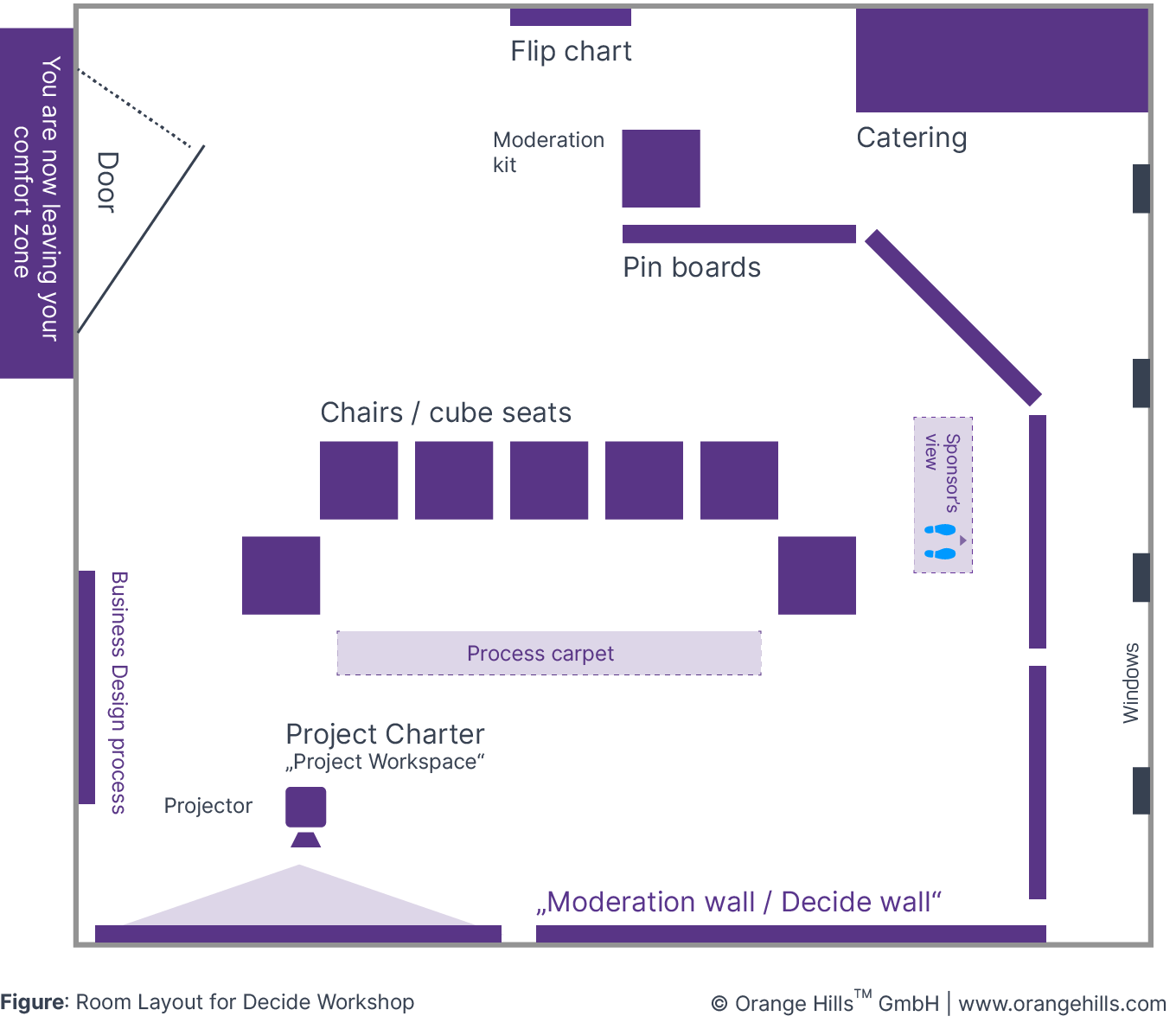
1x Empty wall: > 420 x 200cm
1x Empty wall: > 220 x 90 cm
Chairs or cube seats
1x Low-distance projector for Project Workspace
1x Table for catering
Hot & cold drinks, snacks or finger food
Example Layout
10. Example Agenda
In some cases the Decide Workshop has to take place in a virtual work environment, which influences the agenda. Check out our Miro Board to facilitate the Decide Workshop online.
Time | Activities | Format* | Stakeholders |
08:30 - 09:00 | Arrival and "Good Morning Coffee" | B | All |
09:00 - 09:15 | Welcome and introduction | P | Project manager & Coach |
09:15 - 10:00 | Presentation to sponsor (see structure as outlined in the Review Workshop) | D | Project team Sponsor |
10:00 - 11:00 | Feedback of sponsor and discussions | D | Project team Sponsor |
11:00 - 12:30 | Decision-making with sponsor | D | Project team Sponsor |
12:30 - 13:30 | Lunch break | B | All |
13:30 - 14:30 | Debriefing and planning of next steps | D | Coach |
14:30 - 15:00 | Wrap-up and farewell
| D | Coach |
* P = Presentation | D = Discussion | B = Break | T = Teamwork