
Demo or Die
Demos, visuals, alphas, betas, models, prototypes – all different words for the same thing: visual representations of a new idea. We love visualising ideas to align different perspectives in interdisciplinary teamwork at different phases of the End-to-End Innovation Process. Here's what that means in practice.

Markus Sorg
Business Design Prototyper
Visualising and demonstrating new ideas is one of the key activities of every innovation endeavour. Some people say: "If you can't visualise or demo your new idea, stop wasting other people's time - #nobullshit". In Business Design, we follow a very wide definition of what a "model", "demo" or "prototype" is – based on the ideas of Herbert Stachowiak ("General Model Theory"). For us, a model is a visual, reduced representation of an idea or concept built for a specific purpose. That purpose can be manifold:
Supporting our thinking on specific problems (e.g. technical feasibility)
Answering specific questions
Facilitating communication within diverse project teams
Enhancing communication between a project team and other stakeholders
Reflecting the strengths and weaknesses of a project team ("Show me your prototypes and I know where you are.")
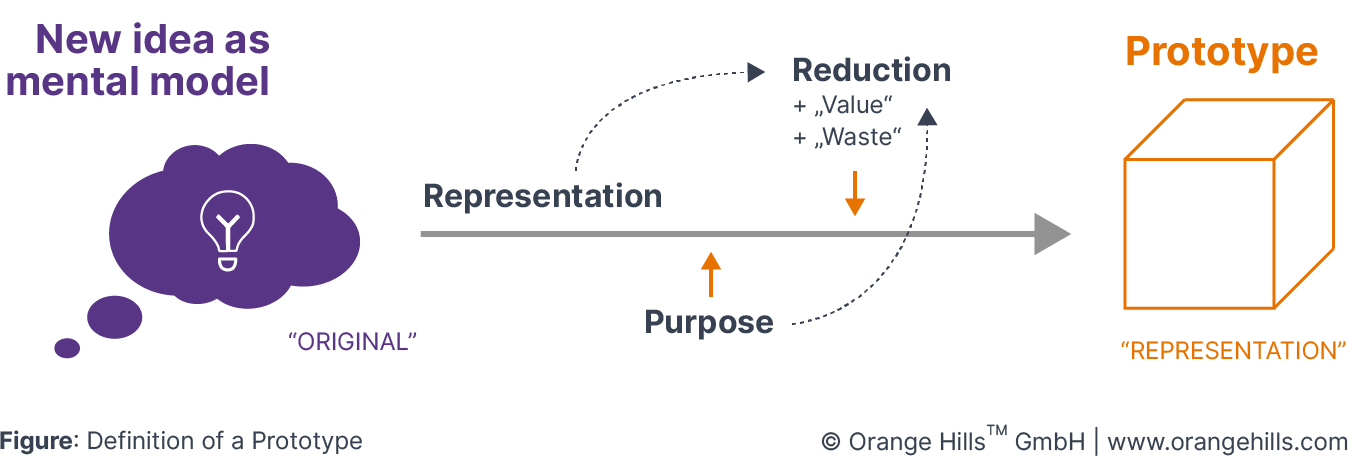
The most common use case for models and prototypes at early stages of the innovation process is to support interactions between project team members and other stakeholders – customers, users, domain experts, or the sponsor. Visual representations help align different mental models of abstract ideas and concepts. If you talk about "platforms", "blockchains" or "data-driven business models", the chance is high that different people instantly form different pictures in their heads – each shaped by their own past experience. Aligning these mental models is the foundation of any productive conversation, and visualisations help get you there.
Another important use case for these kinds of artefacts is to support experiments around open questions and hypotheses. We translate parts of a business model into visual representations to simulate reality and gather data that proves or disproves uncertain assumptions. For instance, turning your sales story into a landing page and letting potential customers interact with it under real conditions is a great way to test brand perception and value proposition. Functional prototypes – or even first marketable versions of a product or service (lean offerings) – help you test customers' willingness to use or pay for your offering. It is always a trade-off between level of reality and effort when building prototypes to reduce uncertainty. The most convincing test would be to just build the product, ship it and see what happens – but that usually costs significant time and money. AI is increasingly helping to stretch those boundaries and speed up development.
No matter what purpose your models and prototypes serve, be aware of the psychological effects of introducing visuals and demos of different kinds into a project team's work environment. Visual representations influence how people think about the underlying idea. A polished prototype with a great user interface can give the impression that an idea is mature and well thought out – even when it isn't. You are framing your audience, which can be misleading when you're looking for honest feedback on open questions. You also anchor discussions with prototypes. That's not bad at all, as long as you do it intentionally and don't shift attention to less important aspects. What we also learned over the years is that the process of building models and prototypes itself has a great influence on social team dynamics. On motivation, team commitment, conflict resolution, teamwork, understanding of roles and hierarchical thinking. It turns out that a prototype is not a final product, it's a social artefact which influences how a team operates.
The notion that innovative teams generate innovative prototypes is giving way to a recognition that innovative prototypes are the focus for generating innovative teams.
That's a quote from Michael Schrage from his book Serious Play. This impact on teams is probably the biggest asset of prototyping.
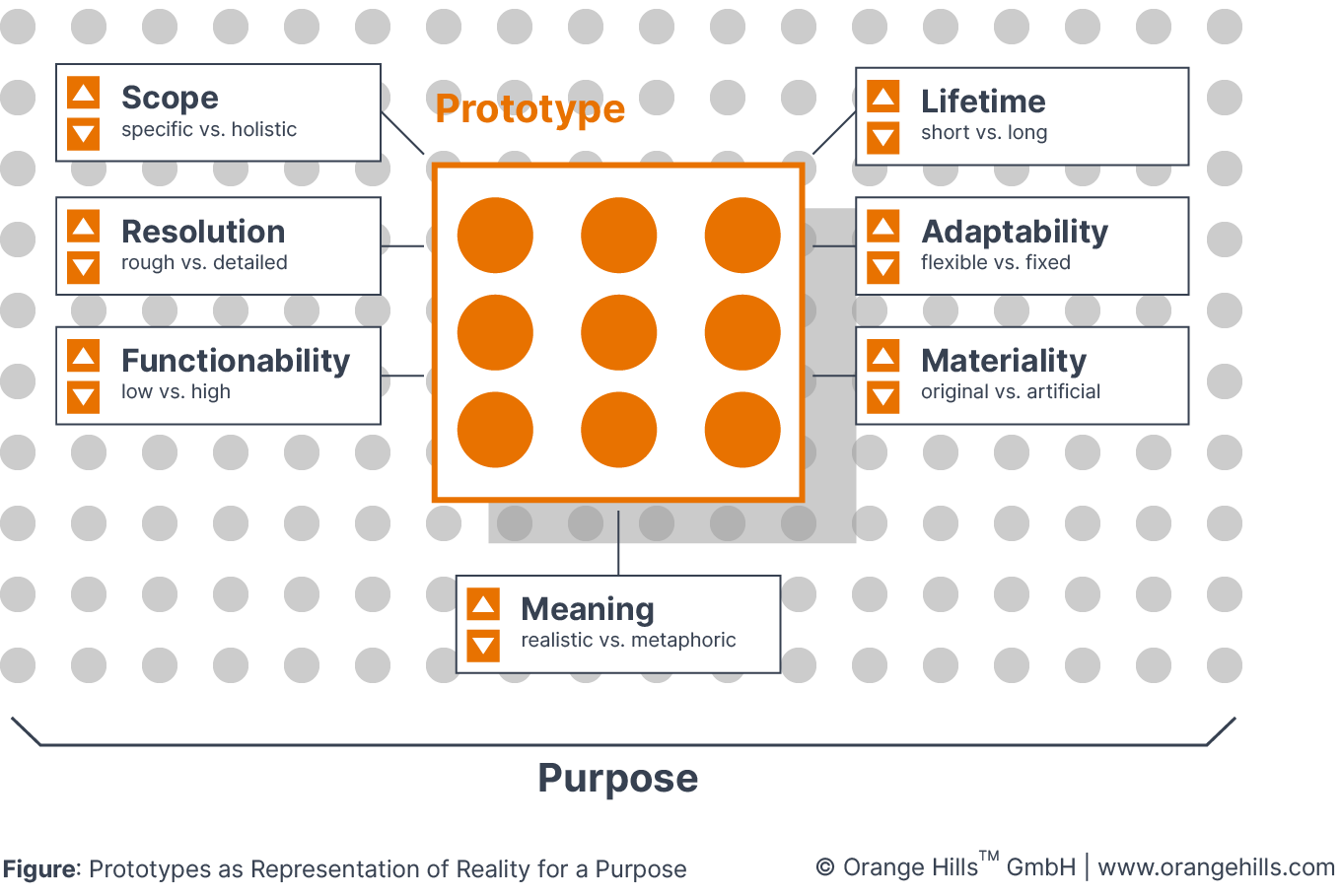
Building the right model or prototype for a defined purpose is key in Business Design. Few frameworks exist that help you precisely define and describe prototypes. That's why we developed our own – a set of attributes that describe any prototype as a visual representation of an idea in the context of Business Design:
Parameter | Description |
Scope | ...defines how many functions or components of an idea or concept are mapped into the prototype. We often describe the scope with "user stories". |
Resolution | ...defines how detailed the functions or components are mapped into the prototype. |
Functionability | ...defines whether the prototype will "work" the way it is intended. |
Adaptability | ...defines how quickly and easily a prototype can be adapted to new insights and requirements. |
Materiality | ...defines whether we use the original material to build the prototype – or not. |
Lifetime | ...defines how long the prototype should be usable for the given purpose. |
In our End-to-End Innovation Process, we typically build the following visuals in each phase:
Phase | Models |
Phase I |
|
Phase II |
|
Phase III |
|
Phase IV |
|
Dive deeper into each phase of our End-to-End Innovation Process to explore visualisation and prototyping in more detail.