
Introduction to Business Design
Welcome to Business Design! This article is a great starting point for everyone who is interested in Business Design as an agile innovation management approach. Whether you are a prospective team coach, a project sponsor or team member or any other kind of innovation practitioner, you will learn what Business Design is and when it helps you reach your innovation ambitions.

Bernhard Doll
Business Design Maverick
Content
1. What is Business Design?
Business Design is an agile end-to-end innovation management approach that works best when you are confronted with many uncertainties while building something new. Irrespective of whether you are about to develop a new business model, product, service or software application, the Business Design approach guides you through a structured but flexible innovation journey and helps you find your next big opportunity beyond the resources you currently control. "End-to-end" means that Business Design covers the entire journey from your vision of your company all the way to the first revenue you generate from innovation. We consider Business Design as a comprehensive and modern innovation management system.
The Business Design approach consists of five key elements, which support you to become a successful innovator. All elements will be described in this knowledge base:
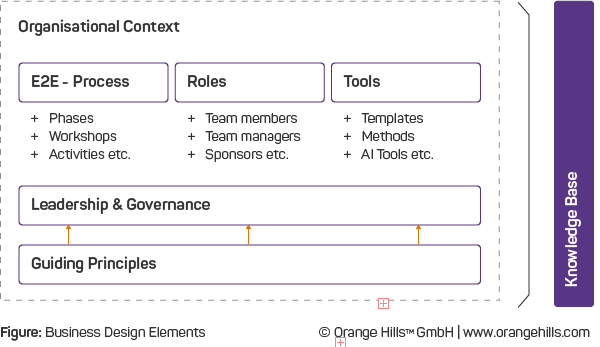
If you are interested in becoming a successful innovator, you might be also interested in our Certificate Program (DE). Join us in our Business Design Academy.
2. From Strategy to Practice
Business Design is a holistic innovation management approach that strives to include a variety of perspectives right from the start. Innovation can thrive if a company has a "system" in place that defines and supports the entire journey from vision to revenue. Very often we see highly fragmented innovation processes with different sometimes inconsistent approaches not linked together in a smooth and integrative way. Business Design is different. We have built this system from scratch based on 20 years of experience in innovation management. Business Design is the result from this experience and is now publicly available to everybody who aims to run successful innovation projects and wants to implement a modern innovation management system that works and delivers.
Business Design works alongside an end-to-end innovation process consisting of the following phases:
Phase I: Picture of the Future & Strategy
Phase II: Playgrounds & Exploration
Phase III: Portfolio & Evaluation
Phase IV: Validation & Refinement
Phase V: Execution & Go-to-Market
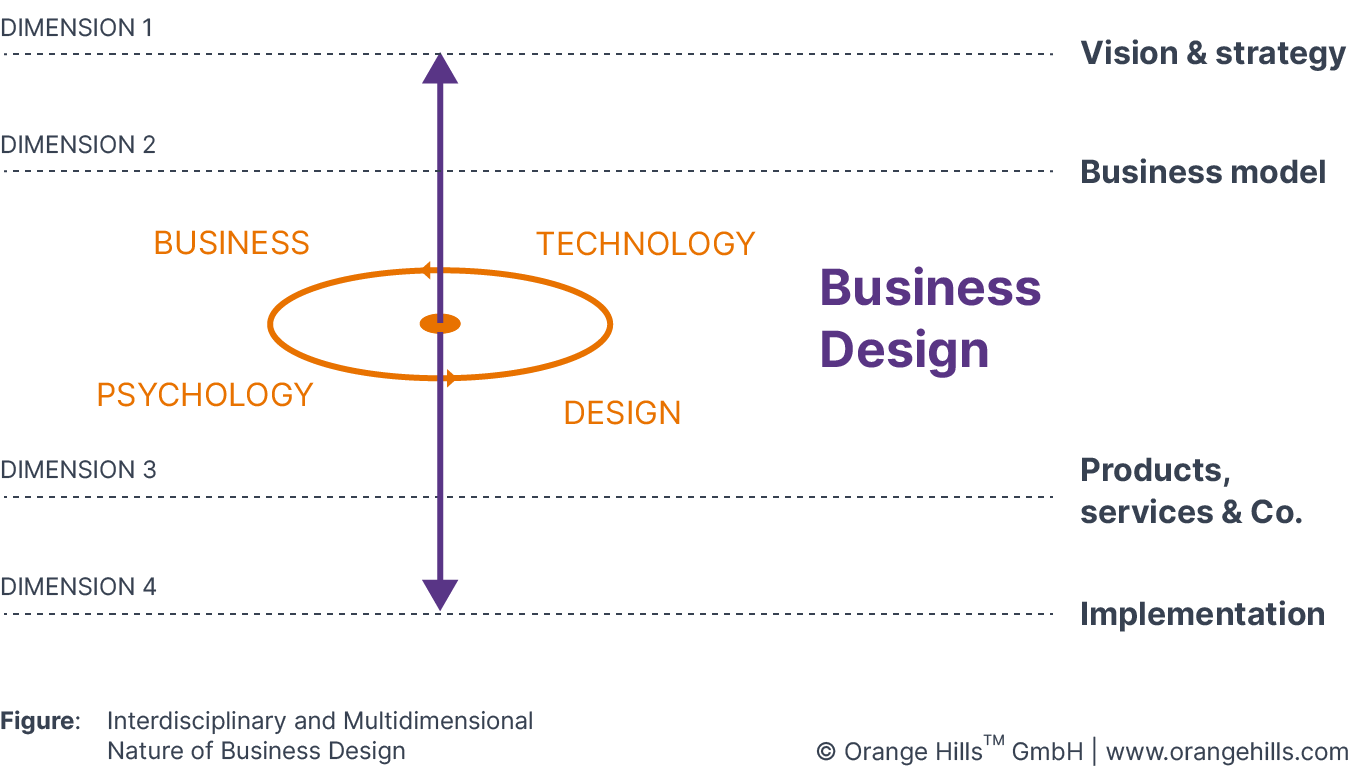
Yes, Business Design starts with visionary work and strategy. Without a vision – we call it a "Picture of the Future" – and a clear strategy, innovation projects can't work. Without a sound business model, generating value with new products and services for both customers and the company is, let's say, a challenge. With a desired picture of the future for both customers and the organisation, innovation work and leadership are so much easier! Moreover, we believe in business model thinking, which gives us a holistic perspective of what we are going to change, improve or disrupt. Even if we are "just" about to develop a new product or service, the business model as context is key to understand and adjust if necessary. And finally, if there is no close link between concept and implementation, we get stuck in theory without tangible results. Thus, the nature of Business Design is highly multidimensional and interdisciplinary. Business Design can only produce results and fulfil its promises if we include various dimensions as mentioned before:
Dimension 1: Vision and strategy
Dimension 2: Business model
Dimension 3: Products, services (= offerings)
Dimension 4: Implementation
3. Exploration rather than Exploitation
Business Design is the right choice if you are searching for new business opportunities or visionary game changers rather than finding incremental improvements ("extensions to the core") of today's business.
We define the three horizons as follows:
Extension to the core: Revision or extension of an existing product, service, software or business model for the same target group. Can be new features of products or services (for current customers) or process improvements ranging from strengthening the brand perception, sales support or even efficiency gains.
New business opportunity: New product, service, software or business model with no logic predecessor within an organisation, serving today's and/or new customers from the same position in the value chain. Here, we usually deal with significant uncertainties at the edge of the comfort zone, which is why the end-to-end innovation process can play to its strengths.
Visionary game changer: New product, service, software or business model with no logic predecessor within the organisation, serving new customers from a different position in the value chain. Ideas here have the potential to disrupt today's businesses or create totally new markets. Complexity, ambiguity and uncertainties are our key enemies but the upside potential is just huge.
Considering these horizons, it becomes obvious that successful innovation is not bound to the domain of inventing new products, services with many new features. If innovation is about finding new ways to grow a business, this growth can happen in various areas of a business model. Be open and don't let your engineers rule the innovation game (alone).
4. Reducing Uncertainties
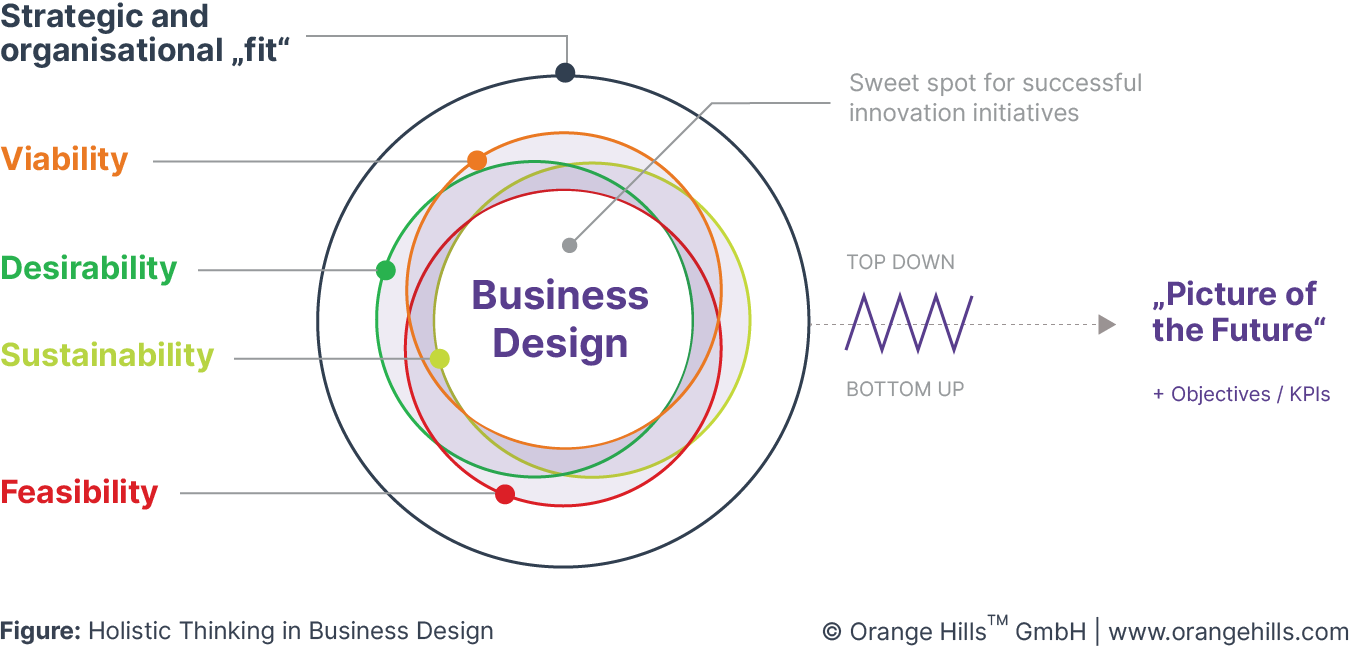
In Business Design, we love to explore new space and unveil surprising insights that will ultimately lead to new ideas and innovation. Innovation is not so much about creativity as it is about building ideas based on facts that are not broadly known or widely considered in product and service design. Knowing what others don't and turning this advantage into promising innovation at high speed is what counts. "The future is already here – it's just not very evenly distributed." is what William Gibson wrote a long time ago. And if the "future" is our future, a future we desire, then this statement makes a lot of sense. To fulfil that promise, from day 1 in Business Design, we look at five dimensions to build new business that works:
Strategic and organisational fit: Business Design aims to create innovation that fits well with the strategic vision and envisioned capabilities of a company
Desirability: Business Design aims to create innovation that fits well with today's or future world of customers and users
Viability: Business Design aims to create innovation that helps achieve economic targets
Feasibility: Business Design aims to create innovation that can be engineered and produced under certain economic conditions
Sustainability: Business Design aims to create innovation that doesn't harm the society or life of future generations (by the way, this is not just "blah blah" but an aspect we take very seriously)
5. Systematic Learning
Business Design is based on the idea of an agile learning process to create innovation. What does that mean? We don't believe that successful innovation (which is defined as something "new" determined to generate "growth", see three horizons) can be built in a traditional business development approach in which project teams go through a linear process of learning (= market research through customer surveys), planning (= business case modelling), decision-making (= management decision to allocate budget), building (e.g. burning the budget until it is gone) and finally launch the innovation on the market.
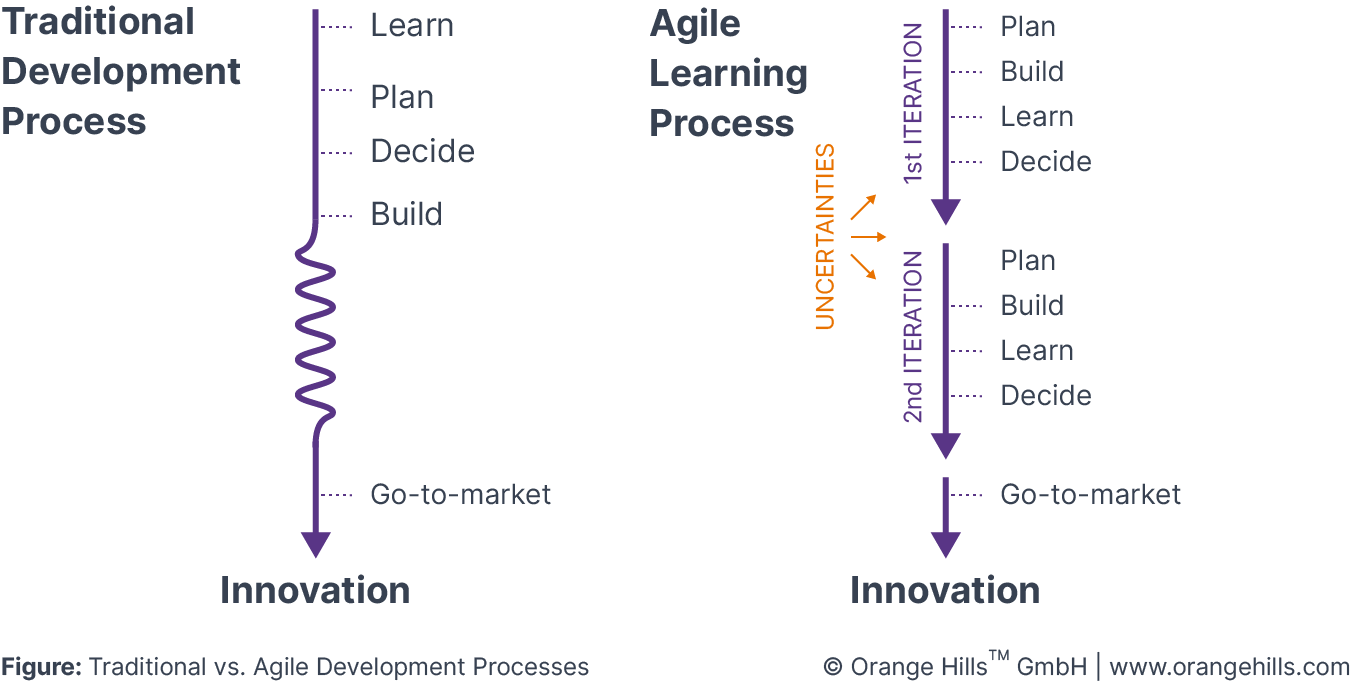
The likelihood is very low, however, that both the project team and the management were able to anticipate the future and hit the bull's eye with their decisions. The world is fast, customers' behaviour diverse and uncertainties high (by the way, "uncertainties" are not "risks", since risks are controllable and somewhat predictable). This is why Business Design puts the traditional development process upside down and turns it into an agile development and learning process. Through short iterations, a project team enabled and facilitated by an experienced coach quickly makes progress with tangible results and reduces uncertainties through systematic learning. The management (= project sponsor) is invited to make decisions not only once but many times throughout the journey to literally steer an innovation project to the market - step by step.
Ries, E.: Lean Startup, Currency (Amazon)
Schrage, M.: Serious Play, Harvard (Amazon)
Schrage, M.: The Innovator's Hypothesis, MIT (Amazon)
Newport, C.: Deep work (Amazon)
Osterwalder, A. & Pigneur, Y.: Business Model Generation (Amazon)
Humble, J., Molesky, J. & O'Reilly, B.: Lean Enterprises: How High Performance Organizations Innovate at Scale, O'Reilly (Amazon)
Maurya, A.: Running Lean, O'Reilly (Amazon)
Roam, D.: Blah, Blah, Blah: What do we do when words don't work, Marshall Cavendish (Amazon)
Kawasaki, G.: The Art of the Start 2.0 (Amazon)